Synopsis:
Regional drought summaries tell procurement teams that dry conditions exist somewhere in their grower network, but not which specific contracted fields are actually at risk, or how much time is left to act. This blog makes the case for field-level drought visibility across grower contracts in the Netherlands, Belgium, Germany, and France, framed explicitly around supply assurance rather than risk transfer. It covers why regional drought data obscures field-level reality, the lead time early detection actually buys procurement teams. Finally, it shows how Cropin delivers this visibility in practice, so teams can start planning conversations with data.
By the time a delivery shortfall shows up in your Q4 numbers, the field that caused it has been under stress for weeks. That’s the part of drought exposure that doesn’t make it into most supply conversations. It is not the drought itself or, for that matter, excess rainfall, but the lag between when it starts and when procurement finds out.
For Food & Beverages (F&B) companies sourcing from contracted growers across Europe, like the Netherlands, Belgium, UK, Germany, Italy, and France, that lag is the real variable in Q4 2026. Not whether drought conditions exist somewhere in the portfolio; they usually do, in some form, every season. What matters is which fields, how much, and how much runway you have to do something about it before it becomes a delivery problem.
The Q4 Question Procurement Teams Are Already Asking
Every procurement lead we talk to this time of year is asking some version of the same thing: are we going to get the volume we contracted for, and if not, when will we know?
Usually, the honest answer is “closer to harvest than anyone would like.” Regional weather summaries and grower check-ins are useful, but they tend to confirm a problem after it’s already shaped the outcome – not early enough to change it. And by September or October, the options left on the table are limited:
- Spot-market buying under pressure
- Delivery renegotiations with growers who are just as caught off guard
- Simply absorbing the gap
None of that is a supply strategy. It’s damage control. The difference between the two is lead time! And lead time only exists if you can see exposure before it becomes shortfall.
Drought Doesn't Hit a Region; It Hits a Field
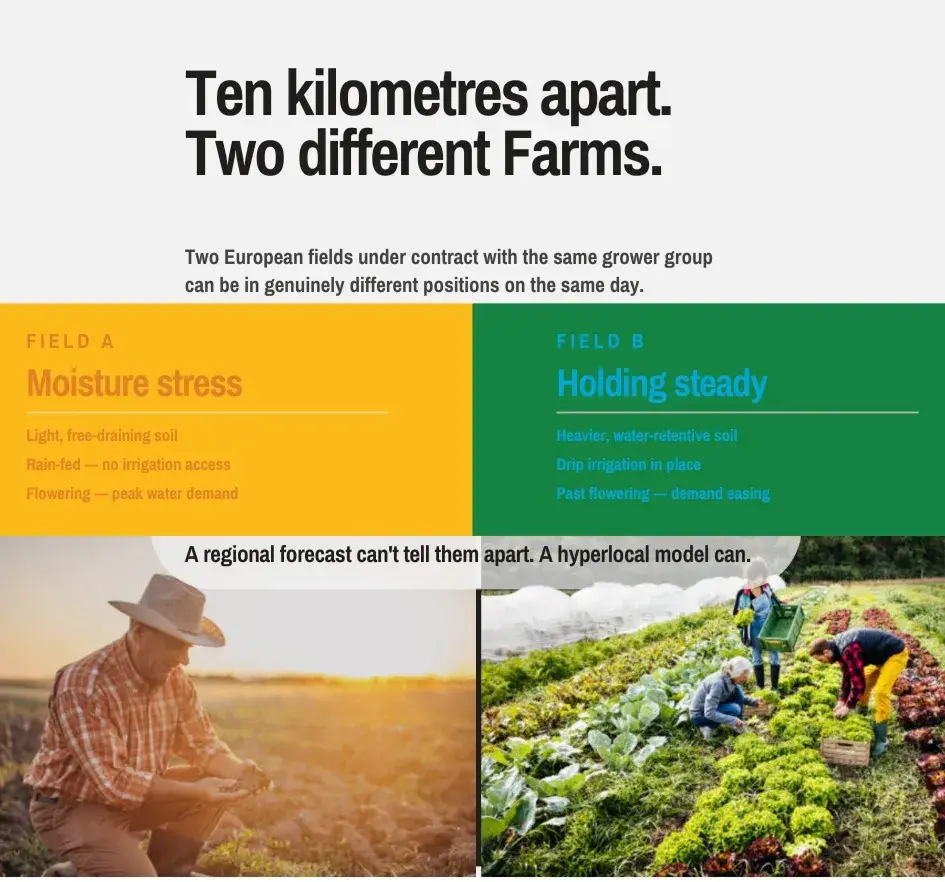
This is the part worth sitting with. “Drought in northern France” or “dry conditions across Flanders” isn’t wrong, but it’s not actionable either. Two fields ten kilometers apart, under contract with the same grower group, can be in genuinely different positions. One under real moisture stress, the other holding steady, because of soil type, irrigation access, or where each crop is in its growth cycle.
Why Field-Level Visibility Changes the Picture
A regional view averages that difference away. A field-level view doesn’t. When you can see moisture stress, crop stage, and stress trajectory plot by plot, you’re no longer reacting to a regional headline; you’re looking at your actual contracted supply, field by field, and making decisions based on what’s really happening on the ground.
What This Looks Like Across some EU Contracts
In practice, this means your Dutch potato contracts, your Belgian vegetable growers, your German and French grain and root crop suppliers can each be assessed on their own terms, not lumped into a single “European drought” narrative that tells you very little about which specific commitments are actually at risk. Some of your portfolio may be entirely fine. Knowing which part, specifically, is what turns a vague concern into a workable plan.
The Lead Time That Actually Matters
Field-level visibility is only useful if it arrives early enough to act on. Satellite-based monitoring can flag moisture and crop stress signals weeks before they show up in yield estimates or grower reports, often the difference between a proactive conversation in July and a reactive one in October.
From Signal to Decision: What Early Detection Buys You
That window matters because of what you can actually do with it. Weeks of lead time means you can talk to affected growers about irrigation support or harvest timing while there’s still time for it to matter. It means you can start adjusting sourcing mix or delivery scheduling across your existing grower network, rather than scrambling for alternative volume after the fact. It means any conversation about Q4 delivery happens on your terms, early, rather than being forced on you by a shortfall you saw coming too late.
This isn’t about transferring the risk somewhere else. It’s about keeping your existing grower relationships and delivery commitments intact, by acting while there’s still a real choice to make.
From Reactive Escalation to Proactive Supply Planning
Most procurement teams we work with didn’t design their current process to be reactive; it became that way because the information simply wasn’t available earlier. The grower call in September isn’t a failure of planning. It’s a failure of visibility.
Shifting that starts well before harvest. It means having a live view of field conditions across your contracted supply base in June and July, not just anecdotal grower updates in September. It means Q4 planning conversations that start with data, not with a phone call after a problem has already surfaced.
How Cropin Makes This Visibility Possible
This is where field-level intelligence stops being a concept and becomes something your team can actually act on.
Cropin monitors contracted acreage continuously, using satellite imagery and AI models that track soil moisture, crop stress, and growth stage at the individual plot level, across your entire grower network in the Netherlands, Belgium, Germany, France, or anywhere else in the EU. Neither sampled sites nor regional estimates. Every contracted field gets its own read on drought exposure, updated through the season, so you’re working from what’s actually happening on the ground rather than a grower’s best guess or a regional bulletin. You get advanced yield estimates 45 days before harvest, enabling you to identify alternate procurement regions well ahead. Weather alerts across the horizon – historical (for decades), nowcast, and up to a 6-month forecast power you for data-driven decision-making.
Weather data, historical records, geospatial data, and a time series of field observations are consumed by Cropin’s conceptualized AI models to provide a more detailed assessment of developing scenarios on the farm in near real-time. That intelligence is built to sit inside how your team already works. Alerts flag which specific fields are moving into stress before it shows up in yield data, giving your procurement and grower-relations teams the same weeks of lead time we’ve been talking about throughout this piece. The advantage is that it is early enough to have a real conversation with a grower, not just record what already happened. And because it’s plot-specific, you’re not managing a vague regional risk. You’re managing a short, prioritized list of fields that actually need attention, while the rest of your contracted supply carries on as planned.
The goal isn’t to hand you another dashboard to check. It’s to make sure the first time you hear about a supply issue is weeks before Q4, from your own data not in October, from a shortfall.
What This Means for Your Q4 Planning - Starting Now
If you’re sourcing under grower contracts across EU this season, the practical next step is straightforward: get a field-level view of drought exposure across your current contracted acreage now, while there’s still time to act on what it shows you.
That doesn’t require ripping up how you work with growers today. It means adding the visibility that lets you have the right conversations with growers, with your own leadership weeks before Q4 delivery data would have told you the same thing, too late to change it.
Conclusion : A Conversation Worth Having Now
Drought exposure isn’t going away as a seasonal reality. What can change is how early you see it coming, and how much room you have to respond. That’s the difference between managing Q4 and being managed by it.
If you’d like to see what field-level drought exposure looks like across your own contracted grower base, we’re glad to walk through it – no commitments, just a clearer picture of where things actually stand.
Frequently asked questions (FAQs)
How early can drought stress be detected in contracted fields across the EU?
Satellite-based monitoring can flag moisture and crop stress signals several weeks before they show up in yield estimates or grower-reported updates. For contracts across the Netherlands, Belgium, Germany, and France, this typically means visibility in June or July, well ahead of the September–October window when Q4 delivery risk usually becomes apparent through traditional reporting.
Does field-level drought monitoring account for regional differences between NL, BE, DE, and FR growing conditions?
Yes. Soil type, irrigation access, and crop calendars vary significantly even within a single country, let alone across four. Field-level monitoring assesses each contracted plot on its own conditions, rather than applying a single regional drought classification across an entire grower network.
What data sources are typically used for drought monitoring in European agriculture?
Satellite-based moisture and vegetation indices, combined with weather station and forecast data, are the standard basis for field-level drought assessment across the EU. This is distinct from broader public tools like the European Drought Observatory, which report at a regional or national scale rather than at the level of an individual contracted field.
Is field-level drought monitoring compliant with EU data regulations?
Field-level monitoring based on satellite imagery and geospatial data doesn’t process personal data in the way GDPR governs, since it’s assessing land and crop conditions rather than individual identities. Any integration with grower or contract-specific records should still follow standard data handling agreements between the F&B company and its monitoring provider.
How does field-level supply visibility support EU sustainability and ESG reporting requirements?
Verified, plot-level data on climate exposure and crop conditions can support the kind of evidence-based disclosure increasingly expected under frameworks like the Corporate Sustainability Reporting Directive (CSRD), since it documents actual field conditions rather than self-reported or estimated figures.
Author Bio

Haripriya Muralidharan
Haripriya Muralidharan leads content marketing at Cropin Technology Solutions, bringing a unique scientific rigor to brand storytelling. With a Master's in Chemistry from Pune University and research experience in cancer immunology, she discovered her passion in storytelling. For two decades, she has operated at the intersection of content, communication, and brand strategy, specializing in turning complex ideas into impactful narratives. Prior to Cropin, Haripriya leveraged her creative skills at Elsevier’s Chemical Business News Base and shaped multi-format content strategies for B2B marketing at Scatter.