Synopsis:
UK food manufacturers have invested heavily in downstream visibility, but their supply chains go dark at the farm gate. Without real-time, independent farm-level data, procurement planning, sustainability reporting, and sourcing reliability all rest on shaky foundations. This blog unpacks why the gap exists, what is driving companies to close it now, and how digital agriculture platforms like Cropin are providing food companies with the field-level intelligence that is increasingly demanded by their operations and regulators.
What large food manufacturers still can’t see about the crops and regions they source from
Ask the procurement director of a major UK food manufacturer what they know about this season’s wheat harvest in East Anglia, or the tomato crop they’re sourcing from Spain, and you’ll likely get an honest answer: not enough. They know purchase volumes, agreed prices, and supplier names. What they rarely know is what’s actually happening in the fields, which plots are under stress, how yields are trending, whether a pest outbreak is spreading three counties away from their primary supplier.
This is agriculture’s biggest reporting gap. And for the import-dependent UK food sector, navigating a tightening web of sustainability regulations, retailer mandates, and climate volatility, it is becoming impossible to ignore.
Why the gap sits upstream at the farm and field, not in the factory
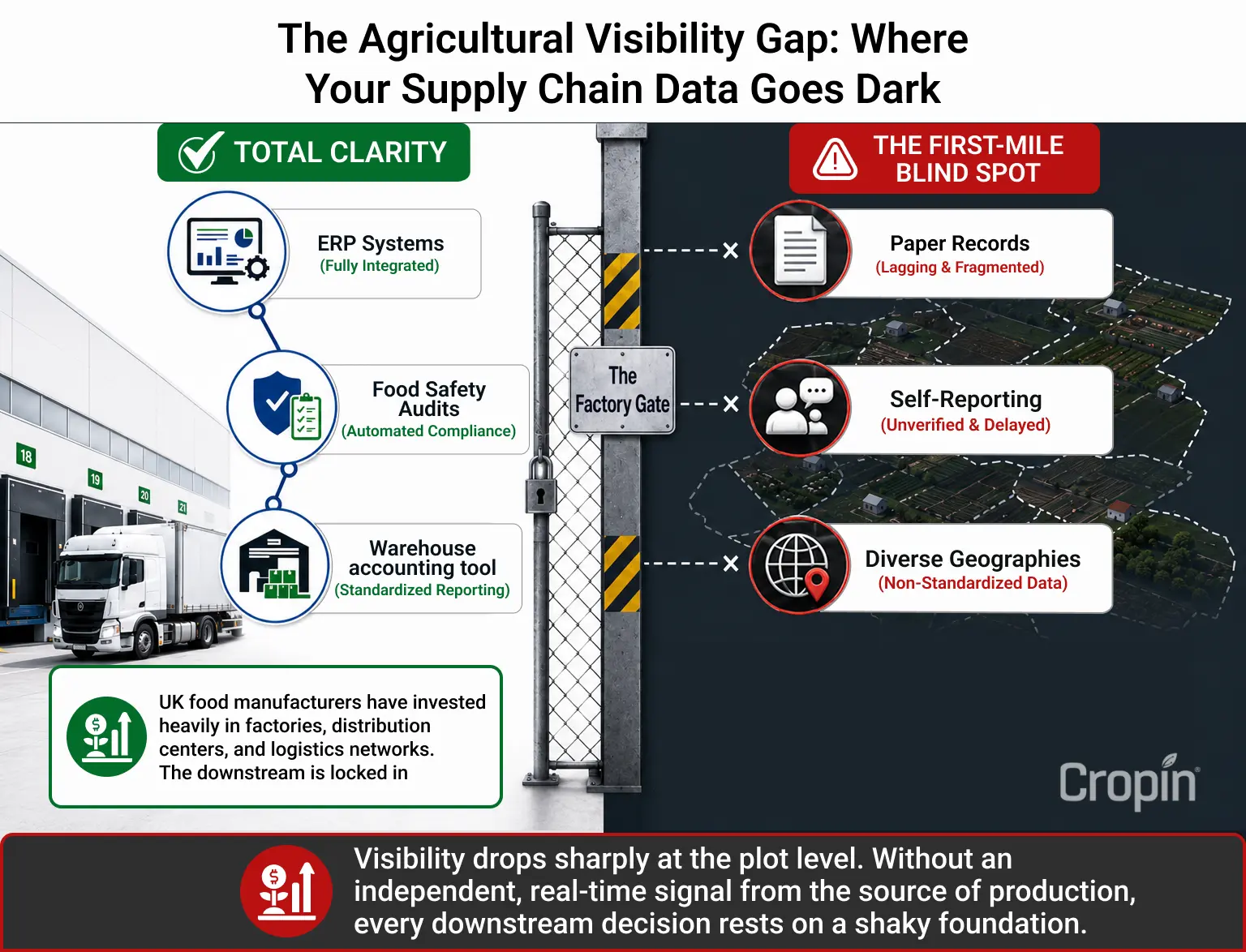
UK food manufacturers have invested heavily in traceability and reporting across the downstream, in factories, distribution centres, and logistics networks. ERP systems, food safety audits, and warehouse accounting tools are well established in this part of the chain. Now let’s move upstream. As we reach the farm, the field, the plot visibility drops sharply.
The fundamental problem is structural. Farm-level data has historically been fragmented, paper-based, and difficult to standardize across diverse geographies and crop types. Suppliers self-report what they choose to report, when they choose to report it. There is no independent, consistent, real-time signal coming from the source of production. And that means every downstream decision, from procurement planning to sustainability reporting, rests on foundations that are shakier than they appear.
What’s Forcing UK Food Companies to Close the Gap Now
UK sustainability and sourcing-transparency reporting tightening (UK SRS S1/S2, FDTP harmonization)
The regulatory environment for UK food companies has shifted decisively. The UK Sustainability Reporting Standards (SRS), aligned with IFRS S1 and S2, now require companies to disclose material climate-related risks across their value chains. This includes Scope 3 emissions from purchased goods, which for food manufacturers means agriculture. At the same time, the UK’s Food Data Transparency Partnership (FDTP) is advancing harmonized standards for supply chain reporting. Self-declared figures from suppliers are no longer sufficient; companies need verified, auditable, field-level evidence.
Retailer and buyer mandates for verified, farm-level proof
Major UK retailers, like Tesco, Sainsbury’s, and Marks & Spencer, have embedded farm-level sustainability criteria directly into their supplier codes of practice. These are no longer aspirational commitments; they are commercial conditions. Food manufacturers that cannot provide verified data on regenerative practices, soil health, or water use across their supply base risk losing shelf space. The ask has moved from “do you have a sustainability policy” to “can you prove it, field by field?”
Climate and supply-chain volatility threatening sourcing reliability
The UK experienced its wettest 18-month period on record between 2023 and 2024. Elsewhere, heat stress across European cereal-growing regions disrupted harvests on which UK manufacturers depend. These are not isolated events; they are the new operating environment. Sourcing teams that lack early-warning visibility into yield risk, regional crop stress, and weather-driven supply disruption are managing reliability retrospectively rather than proactively.
Consumer and regulator pressure for credible provenance and “low-carbon” claims
Consumer trust in food provenance claims is under scrutiny. The Competition and Markets Authority’s Green Claims Code has set a clear standard: sustainability claims must be accurate, substantiated, and verifiable. For UK food companies making “sustainably sourced,” “regeneratively farmed,” or “low-carbon” product claims, the ability to trace those claims back to field-level evidence is no longer a nice-to-have; it is a legal and commercial necessity.
The Farm-Level Reports That Actually Help Farmers Grow Better Crops
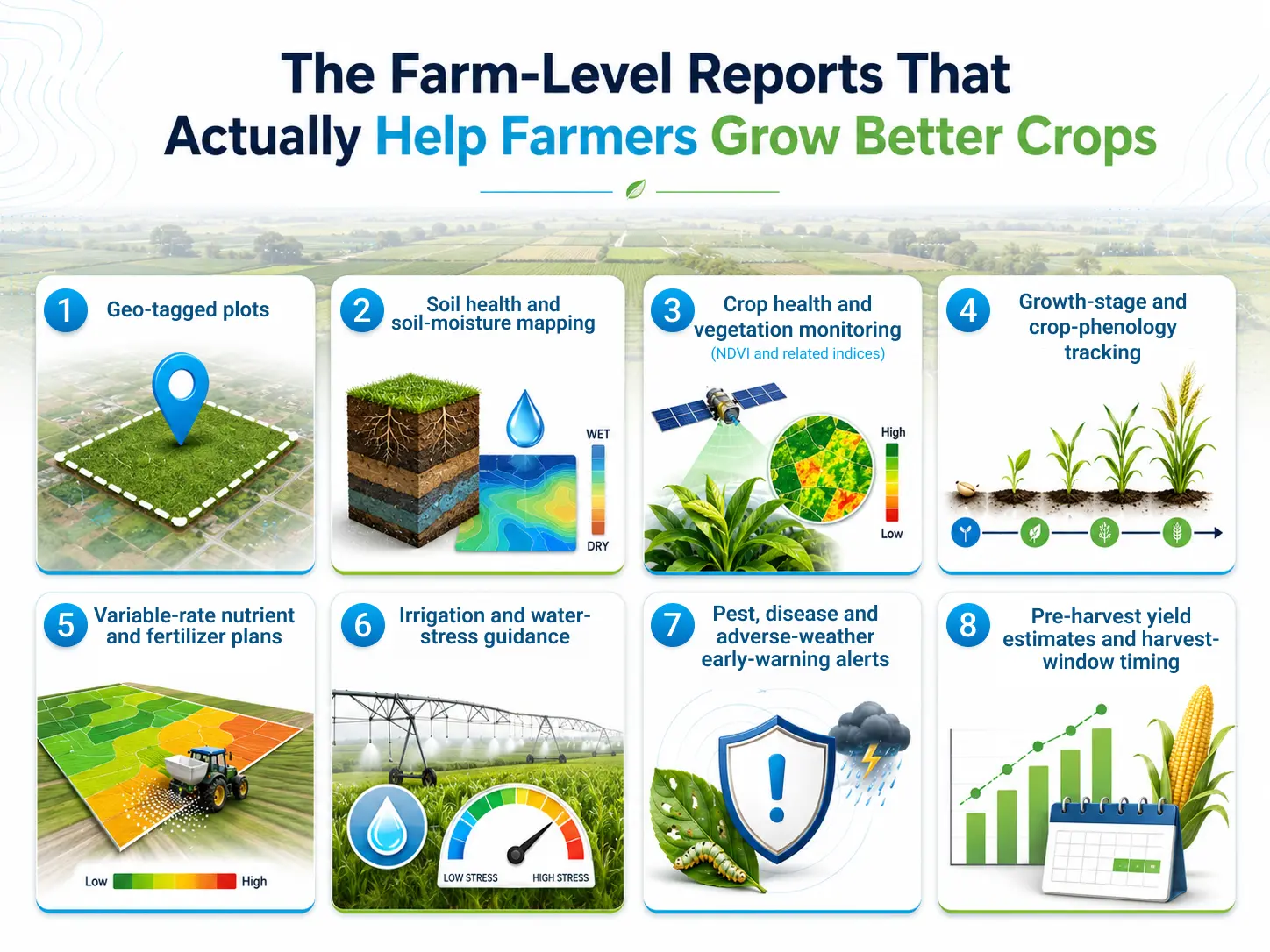
Understanding what farm-level data looks like in practice is essential context before examining what food companies need from it. The best digital agriculture platforms generate a rich set of field-level intelligence that serves farmers first. By doing so, it creates the data backbone that the whole supply chain can draw on.
Geo-tagged plots
A geotagged plot is a piece of agricultural farmland whose precise physical boundaries have been digitally mapped and tied to exact geographic coordinates (latitude and longitude) using GPS. The farmer or field agent walks or drives the perimeter of the field using a mobile device to draw a digital boundary line. This process creates a virtual polygon that represents the true footprint of that specific piece of land. It connects the plot to satellite data, helps identify the exact origin of production, overcomes smallholder fragmentation, and directs data-driven decision making.
Soil health and soil-moisture mapping
Digital soil maps combine satellite data, sensor readings, and agronomic models to give farmers a plot-by-plot picture of soil organic matter, compaction risk, and moisture levels. This drives smarter input decisions and supports regenerative practice adoption.
Crop health and vegetation monitoring (NDVI and related indices)
Normalized Difference Vegetation Index (NDVI) imagery, derived from satellite and drone data, reveals where crops are thriving and where they are struggling. And most importantly, this insight is often offered weeks before the stress becomes visible on the ground. Early detection means early intervention.
Growth-stage and crop-phenology tracking
Knowing precisely which growth stage a crop is at across a sourcing region allows farmers to time inputs accurately and gives supply chain teams a reliable forward view of harvest timing.
Variable-rate nutrient and fertilizer plans
Rather than applying uniform inputs across a field, variable-rate plans use plot-level data to prescribe exactly the right amount of fertilizer or nutrients in the exact right places within the plot, reducing waste, cutting costs, and lowering the carbon intensity of production.
Irrigation and water-stress guidance
Water-stress indices combined with weather forecasts allow farmers to irrigate precisely when and where crops need it, reducing water use and improving yield consistency in moisture-sensitive crops.
Pest, disease and adverse-weather early-warning alerts
Predictive models that combine weather patterns, crop growth stages, and historical outbreak data can issue early warnings on the probability of disease pressure 10–15 days in advance.Similarly, weather alerts are also offered. These give farmers a genuine window to act before damage occurs.
Pre-harvest yield estimates and harvest-window timing
AI-driven yield models provide pre-harvest estimates at plot level, helping farmers plan logistics and giving supply chain teams the production visibility they need to plan procurement and processing capacity.
What Big Food Manufacturers Need From That Same Farm-Level Data
The data generated to help farmers grow better crops is exactly the data food manufacturers need to plan, report, and manage risk across their supply chains. The two sets of needs are not in conflict; they are complementary. The challenge is connecting them through a shared, trusted data infrastructure.
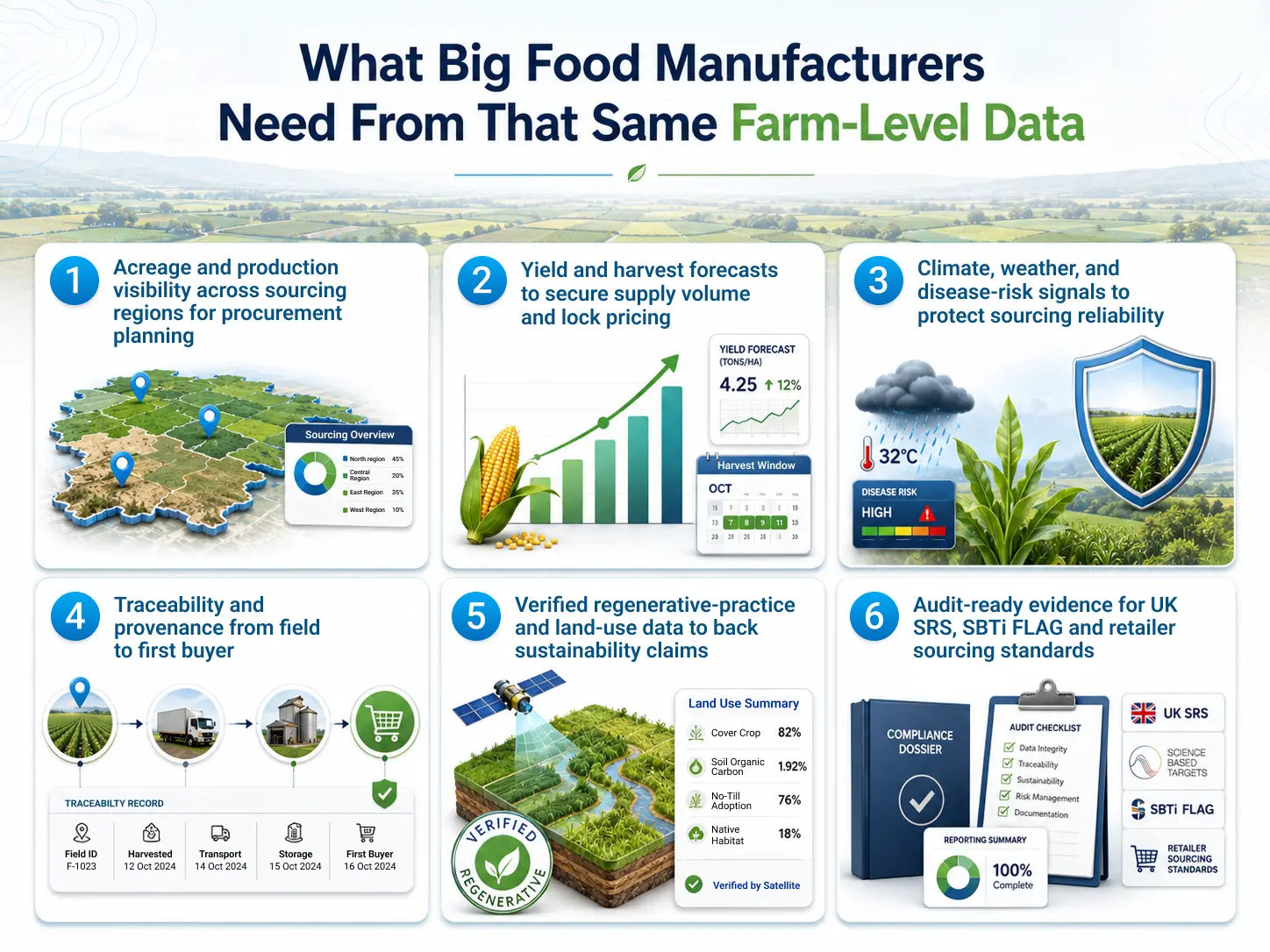
Acreage and production visibility across sourcing regions for procurement planning
Knowing how many hectares of a specific crop are planted and in which regions gives procurement teams a real foundation for supply planning rather than relying on supplier estimates and historical averages.
Yield and harvest forecasts to secure supply volume and lock pricing
Pre-harvest yield intelligence allows manufacturers to make better-informed forward-purchasing decisions, reduce exposure to spot-market volatility, and negotiate supply agreements from a position of knowledge rather than uncertainty.
Climate, weather, and disease-risk signals to protect sourcing reliability
Early-warning signals for weather events or disease outbreaks allow sourcing teams to identify potential supply gaps weeks before they materialize. This helps them activate contingency sourcing plans while options are still available.
Traceability and provenance from field to first buyer
Digital field records create an unbroken, verifiable data trail from the specific plot where a crop was grown, through harvest and first point of sale. This is the foundation of credible provenance claims and rapid response to food safety events. A crucial piece of information, as well as a gap in adherence to regulations such as the EUDR.
Verified regenerative-practice and land-use data to back sustainability claims
Rather than relying on supplier self-declarations, food manufacturers can access independently generated, satellite-verified data on regenerative practices, cover-crop adoption, land-use change, and soil carbon trajectories. Cropin Cloud platform provides customized dashboards to manage the above.
Audit-ready evidence for UK SRS, SBTi FLAG and retailer sourcing standards
Field-level data, captured consistently and independently, produces the audit-ready evidence pack that UK SRS reporting, Science Based Targets initiative FLAG guidance, and retailer sourcing standards increasingly require. This replaces manual, survey-based processes with structured, verifiable digital records.
How UK Food Companies Are Closing the Farm-Level Data Gap
Moving from supplier self-reporting to independent, verifiable data
The most significant shift is cultural as much as technical: moving from trusting what suppliers tell you to independently verifying what is happening in the field. Digital agriculture platforms achieve this by capturing data through satellite, sensor, and mobile channels that operate independently of the supplier’s reporting process.
Combining satellite, weather, and field data into one source of truth
Satellite imagery, weather station data, agronomic models, and farmer-captured field observations are most powerful when combined into a single, integrated data layer rather than held in separate systems. Integration eliminates the need to reconcile conflicting data sources and provides procurement teams with a single, actionable picture.
Plot-level intelligence to monitor every field, not regional averages
Regional averages conceal the variation that matters most. A sourcing region may report average yields that look stable while specific clusters of fields are underperforming significantly. Plot-level intelligence reveals this variation and allows sourcing teams to understand their real supply position, not a smoothed estimate.
Predictive analytics to flag risk before it reaches supply
Leading food companies are shifting from reactive monitoring to predictive risk management. Platforms that combine historical patterns, live weather data, and crop models can flag supply risk weeks before it becomes a shortfall. This gives procurement teams the time to respond rather than react.
Interoperable platforms that feed procurement, ERP and reporting systems
Farm-level data only creates value when it flows into the systems where sourcing decisions are made. Modern digital agriculture platforms are designed to integrate with ERP, procurement, and sustainability reporting systems. It converts field signals into operational intelligence without manual data transfer.
How Cropin Closes the Farm-Level Data Gap for Food Companies
Cropin’s agri-intelligence platform is purpose-built to connect farm-level data with enterprise supply chain decisions. Working across more than 100 countries with global food manufacturers, development agencies, and governments, Cropin brings together five integrated capabilities that address the full spectrum of the farm-level reporting gap.
Plot Level Intelligence: Field-by-field visibility across sourcing regions
Cropin’s Plot Level Intelligence combines satellite imagery, agronomic models, and ground-truth data to deliver crop health, growth-stage, and stress signals at individual field level across any sourcing geography. For UK food companies, this means moving from regional estimates to a precise, continuously updated picture of every field in their supply base.
Cropin Data-hub: ML-Ready Data Pipelines for Analytics
Cropin Data Hub acts as an interface to unify data from all agri-data sources. It enables easy access, management and processing of incoming data moats from structured and unstructured data sources through an agri-object model. It brings together agri-data from vivid sources such as in-field farm management apps, IoT devices and drones, mechanization data from farming equipment, remote sensing satellite information, open sources, weather advisory sources, legacy systems like ERP, etc. This layer helps combining agronomy, enterprise, & remote field data for Cropin’s Crop Intelligence models to deliver insights.
Crop Knowledge Grid: Crop, acreage and growth-stage intelligence at scale
The Crop Knowledge Grid is Cropin’s proprietary dataset of crop-type mapping, planted acreage, and phenological stage data built from over a decade of agronomic data. It forms the basis for all models built by Cropin and for their training. It has the biggest advantage: specific, granular, deep agronomic insight that is largely absent from any other model. It gives procurement teams the production visibility they need to plan supply volumes, anticipate harvest timing, and identify sourcing risk across regions and seasons.
Risk Mitigation: Early warning on climate, weather, disease, and yield risk
Cropin delivers automated, predictive alerts on weather events, pest and disease pressure, and yield deviations, typically 10–15 days ahead of impact. For sourcing teams, this transforms supply risk management from a reactive process into a proactive one, with enough lead time to act on contingency plans before options close.
Cropin Sage: AI-driven insight from farm signal to procurement decision
Cropin Sage is the GenAI intelligence layer that transforms raw farm signals into procurement-ready insights. It synthesizes data across crops, regions, and risk dimensions to answer the questions supply chain teams actually ask: Which sourcing regions face the greatest yield risk this season? Where should we prioritize forward contracts? What does our Scope 3 emissions exposure look like across this crop portfolio?
Digitising farm-level data capture at the source
Cropin’s farmer-facing app Cropin Grow, is used by agronomists and field agents to capture plot-level data includin crop observations, input records, scouting reports, and harvest data, directly at the source. This creates the foundational digital farm record that supports both farmer advisory services and supply chain traceability.
A Practical Roadmap to Closing the Gap
Step 1: Map where your farm-level visibility actually ends today
Before investing in new technology, conduct an honest audit of where your supply chain visibility currently stops. For most UK food manufacturers, it ends at the first point of purchase, the supplier or aggregator. Mapping this boundary precisely is the starting point for prioritizing where data investment will have the most impact.
Step 2: Prioritize your highest-risk crops and sourcing regions
Not all crops or sourcing regions carry equal risk. Identify which commodities represent the greatest volume, margin sensitivity, or sustainability reporting exposure, and which sourcing geographies face the most acute climate or compliance risk. Start with these.
Step 3: Pilot digital, field-level data capture with key suppliers
Run a structured pilot with two or three key suppliers, deploying digital data capture across a defined crop and geography. Set clear success metrics, like data completeness, yield forecast accuracy, and the ability to generate audit-ready sustainability reports. Use pilot results to build the internal business case for broader rollout.
Step 4: Connect farm data into procurement and reporting workflows
Data that lives in an agronomy platform but never reaches the procurement or sustainability team creates no enterprise value. In the design phase, map the integration points between farm-level data and your ERP, sourcing, and reporting systems. The goal is farm-to-decision data flow, not a separate agricultural dashboard.
Step 5: Scale toward full supply-chain visibility
Use pilot learnings to refine the data model, supplier engagement approach, and integration architecture, then scale systematically across your broader supply base. Full farm-level visibility is a multi-year program, but the commercial and compliance pressure to start is immediate.
Conclusion
The farm-level data gap is the most consequential blind spot in UK food supply chains today. It sits at the intersection of three forces that are only intensifying: regulatory pressure from the UK SRS and FDTP, commercial pressure from retailers demanding verified sustainability proof, and operational pressure from climate volatility that threatens sourcing reliability.
The good news is that the technology to close this gap is mature, deployable, and already proven at scale across global food supply chains. The data that helps farmers grow better crops is the same data that helps food manufacturers plan better, report more credibly, and source more reliably.
For UK food companies, the question is no longer whether to invest in farm-level intelligence. It is how quickly you can build the visibility that regulators, retailers, and supply chain resilience already demand.
Cropin is ready to help you close the gap. Explore how at
Frequently asked questions (FAQs)
What is agriculture's biggest reporting gap?
It is the sharp drop in data visibility that occurs upstream at the farm, field, and plot level. While downstream factories and logistics are highly digitized, manufacturers lack real-time, independent visibility into true crop health, field-level climate stress, and harvest trends at the source of production.
Why can't large UK food manufacturers get reliable farm-level data today?
The barrier is structural: farm-level data has historically been fragmented, paper-based, and non-standardized across different crop types and geographies. Manufacturers currently rely on reactive supplier self-reporting, which means data is unverified, delayed, and delivered only when the supplier chooses to share it.
What farm-level data do food companies need most?
Food companies primarily need acreage and production visibility for procurement planning; early-stage yield and harvest forecasts to secure volume and lock pricing; real-time climate, weather, and disease risk signals to protect supply reliability; and verifiable field-to-buyer provenance data to satisfy tightening regulatory frameworks like UK SRS, SBTi FLAG, and EUDR.
What reports help farmers grow better crops and why do buyers want the same data?
Farmers use digital tools for geotagged plot mapping, soil moisture monitoring, NDVI crop health tracking, variable-rate fertilizer planning, and pest early warnings to optimize inputs and boost yields. Sourcing teams want this exact same data because verified, field-level agronomic reality allows them to accurately forecast supply risks and fulfill strict commercial sustainability mandates.
How do satellite and AI technologies close the data gap?
They bypass manual self-reporting by generating an independent, real-time signal directly from the field. Satellites monitor localized crop health and water stress remotely, while predictive AI models cross-reference historical datasets and live weather grids to flag regional disease risks and yield deviations 10–15 days before they impact the supply chain.
How can a UK food manufacturer start improving farm-level visibility?
Manufacturers can follow a practical 5-step roadmap:
- Audit and map where current farm-level visibility ends.
- Prioritize high-risk, high-volume crops and sourcing regions.
- Pilot independent digital data capture with a few key suppliers.
- Integrate field data flows directly into existing enterprise ERP and procurement systems.
- Systematically scale the digital framework across the wider supply base.
How does Cropin help food companies close the data gap?
Cropin connects field realities to corporate decisions through its core capabilities like:
- Plot Level Intelligence : for field-by-field satellite visibility with Cropin App; Crop Knowledge Grid for granular agronomic insight and growth-stage tracking at scale;
- Risk Mitigation: models for 10–15 day advanced alerts on weather and disease;
- Cropin Sage (a GenAI layer) to translate raw farm signals into procurement-ready insights;
- Cropin Grow : to digitize data capture directly at the source via field agents.
- Cropin Data Hub acts as an interface to unify all data from field to legacy platforms. This ML ready pipeline is crucial for models in big data analytics.
Author Bio

Shashikant
Shashi Kant leads customer experience for the EMEA region at CropIn Technology Solutions, bringing a rare blend of technical depth and client-first thinking to the agri-tech world. With extensive expertise in implementation, pre-sales, and client onboarding, Shashi specializes in turning complex AI-driven data into smooth, successful adoption journeys. He works at the intersection of technology, agriculture, and human experience, ensuring that innovations such as satellite analytics, IoT-driven insights, and machine learning models deliver clear, measurable value. By bridging the gap between corporate sustainability goals and on-ground farming realities, Shashi helps our partners navigate the digital transformation of their food systems. He is dedicated to driving regenerative agriculture practices that benefit both the enterprise and the grower. His areas of interest include deforestation monitoring, soil and crop intelligence, and precision agriculture. Passionate about leveraging technology for sustainable agriculture, Deepak believes that the future of farming will be shaped by the convergence of geospatial intelligence, AI, and actionable field insights to create more resilient and efficient food systems worldwide.