Synopsis:
Wheat and grain procurement requires early visibility into crop conditions, expected yields, weather risks and supply availability. This article explores how AI, satellite intelligence and predictive analytics help procurement teams evaluate suppliers, plan inventories and make timely sourcing decisions.
Wheat is one of the world’s most important staple crops, contributing an average of 18% of global energy intake and 19% of global protein intake, according to the Food and Agriculture Organization (FAO). Its role in diets and food systems makes reliable wheat supply important for food manufacturers, processors, retailers, and other businesses across the value chain.
However, sourcing wheat and other grains is becoming more complex as climate change, weather variability, market volatility, and global trade disruptions affect production and availability. Traditional procurement methods often provide limited visibility into changing crop conditions and regional supply. AI-powered intelligence helps businesses anticipate risks, evaluate sourcing opportunities, and make more informed procurement decisions.
This blog explores how AI is transforming wheat and grain procurement and how Cropin supports smarter, data-driven sourcing.
What Is Wheat and Grain Procurement Intelligence?
Understanding Procurement Intelligence in Agriculture
Wheat and Grain Procurement Intelligence combines agricultural data, predictive analytics, satellite observations, and market insights to help businesses make informed sourcing decisions. For staple crops such as wheat, reliable sourcing also plays an important role in maintaining food security by supporting a stable supply of essential grains. It enables procurement teams to understand crop conditions, estimate regional production, evaluate supply risks, and identify sourcing opportunities before procurement activities begin. Instead of reacting to supply shortages, organizations can plan with greater confidence, support supply continuity, and improve procurement outcomes.
Why Traditional Procurement Is No Longer Enough
Traditional wheat procurement methods depend heavily on historical production records, supplier updates, and manual field reports. While these approaches provide useful information, they often fail to capture rapidly changing crop conditions caused by weather events, disease outbreaks, or climate variability. Modern procurement requires continuous visibility and predictive insights to support faster, more informed decision-making.
Why AI Is Transforming Wheat and Grain Procurement
AI for Smarter Procurement Planning
AI procurement intelligence helps procurement teams evaluate multiple data sources simultaneously to identify sourcing opportunities, estimate production trends, and prioritize procurement regions. This enables businesses to make proactive decisions instead of responding to disruptions after they occur.
Satellite Intelligence for Crop Monitoring
Satellite imagery provides continuous visibility into crop development across large agricultural regions. Procurement teams can monitor crop growth, identify stress conditions, and assess regional production potential without relying solely on field inspections.
Weather Intelligence
Weather conditions have a direct impact on crop health and harvest outcomes. By analyzing rainfall, temperature, soil moisture, and seasonal forecasts, procurement teams can better understand production risks and adjust sourcing strategies accordingly. They can assess the impact of frost, frost-free days, humidity, evapotranspiration, and more on production and gain realistic yield estimations.
Predictive Yield Forecasting
AI models analyze historical trends, current field conditions, and weather forecasts to estimate crop yields before harvest. These forecasts help organizations prepare procurement plans, manage inventory expectations, and reduce uncertainty across the supply chain.
AI-Based Procurement Risk Detection
AI identifies potential procurement risks by analyzing multiple factors such as weather anomalies, crop health, regional production changes, disease risks, and environmental conditions. Early risk detection allows businesses to take mitigative efforts to minimize yield loss and respond before disruptions affect procurement operations.
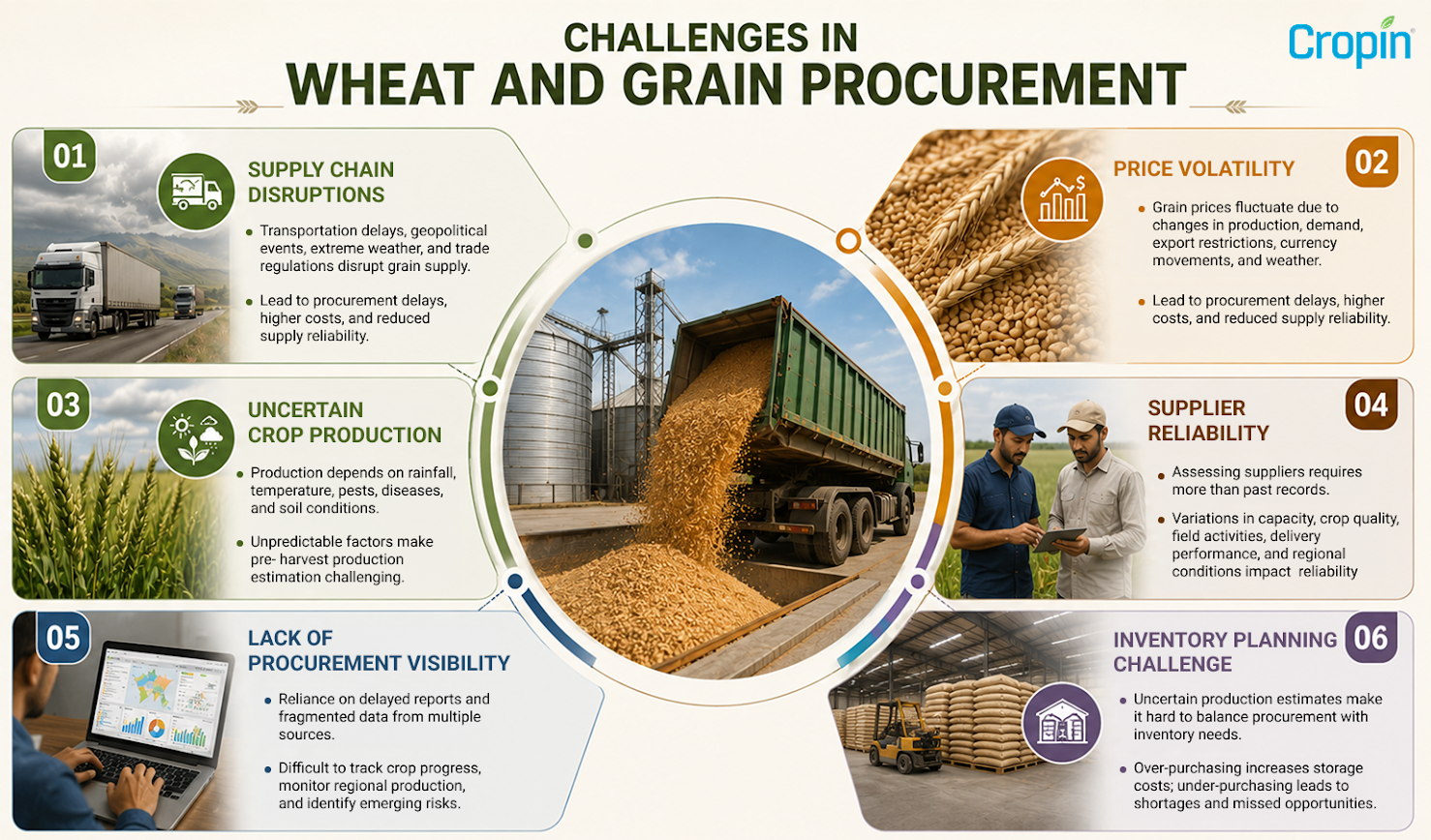
Challenges in Wheat and Grain Procurement
Supply Chain Disruptions
Grain supply chains are increasingly affected by transportation delays, geopolitical developments, extreme weather events, and changing trade regulations. These disruptions can delay procurement activities, increase sourcing costs, and reduce supply reliability. According to the Food and Agriculture Organization (FAO), nearly 14% of food produced globally is lost between harvest and retail, highlighting the need for better visibility and planning across agricultural supply chains. AI-powered procurement intelligence helps organizations identify potential disruptions early and respond with greater confidence.
Price Volatility
Grain prices can change rapidly due to fluctuations in production, changing demand, export restrictions, currency movements, and adverse weather conditions. These market shifts make it difficult for procurement teams to secure grain at the right price while maintaining profitability. Without timely market and production insights, organizations may face higher procurement costs and increased uncertainty during sourcing.
Uncertain Crop Production
Crop production is influenced by several factors, including rainfall, temperature variations, pest infestations, disease outbreaks, and soil conditions. Since these factors can change throughout the growing season, estimating production before harvest becomes increasingly challenging. Without continuous, real-time visibility into regional crop performance, procurement planning can be inaccurate, and unexpected supply shortages can occur.
Supplier Reliability
Assessing supplier reliability across multiple sourcing regions requires more than historical purchasing records. Differences in production capacity, crop quality, timely field activities, delivery performance, and regional growing conditions can affect a supplier’s ability to meet procurement commitments. Without reliable agricultural intelligence, procurement teams may struggle to identify dependable sourcing partners and manage procurement risks effectively.
Lack of Procurement Visibility
Many procurement decisions are still based on delayed reports, manual assessments, or fragmented information from multiple sources. This limited visibility makes it difficult to track crop progress, monitor regional production, and identify emerging risks during the growing season. As a result, procurement teams often react to disruptions instead of making proactive sourcing decisions.
Inventory Planning Challenge
Balancing procurement volumes with inventory requirements is a constant challenge when production estimates remain uncertain. Procuring too early or buying more than needed can increase storage costs. On the other hand, delayed procurement may lead to supply shortages, missed business opportunities, and adversely impact brand value. Accurate production forecasts help businesses align procurement decisions with inventory needs and changing market demand.
How AI Procurement Intelligence Solves These Challenges
Predict Procurement Risks Before They Occur
By combining weather forecasts, crop conditions, and regional production indicators, AI identifies procurement risks before they impact sourcing decisions. This allows procurement teams to develop contingency plans and reduce business disruptions.
Monitor Crop Conditions in Near Real Time
Continuous monitoring of agricultural regions provides procurement teams with updated information on crop growth progression throughout the growing season. This visibility supports faster responses to changing field conditions and emerging production risks.
Monitor Crop Conditions in Near Real Time
Continuous monitoring of agricultural regions provides procurement teams with updated information on crop growth progression throughout the growing season. This visibility supports faster responses to changing field conditions and emerging production risks.
Forecast Regional Grain Production
Using Grain procurement analytics, AI estimates production across different sourcing regions before harvest. These insights help organizations compare procurement options and allocate sourcing volumes more effectively.
Improve Supplier Evaluation
AI supports supplier assessments by combining production trends, regional crop performance, and historical sourcing data. This enables businesses to identify dependable sourcing partners while reducing procurement uncertainty.
Optimize Procurement Timing
Procurement decisions become more effective when businesses understand expected harvest timelines and regional production trends. AI helps organizations determine the right time to source grain while minimizing procurement risks and maximizing logistics efficiency.
Strengthen Supply Chain Resilience
With Agricultural procurement intelligence, organizations gain better visibility across sourcing regions and can respond more effectively to climate events, market changes, and operational disruptions while maintaining a stable grain supply.
Data Sources That Power AI Procurement Intelligence
Satellite Imagery
Satellite imagery provides large-scale visibility into crop growth, field conditions, and agricultural activity across multiple regions. It enables procurement teams to monitor crop development throughout the growing season, identify areas affected by stress, and assess regional production potential without relying solely on field inspections.
Weather Intelligence
Weather intelligence delivers valuable insights into rainfall, temperature, humidity, soil moisture, and seasonal forecasts that influence crop production and procurement planning. Continuous weather monitoring helps businesses anticipate potential production risks, evaluate sourcing regions, and make timely procurement decisions. It helps optimize harvest time and plan logistics efficiently.
Remote Sensing Data
Remote sensing technologies collect environmental information from satellites and other observation systems to monitor agricultural landscapes. These insights help detect changes in crop conditions, land use, crop growth, and vegetation throughout the crop lifecycle, enabling more informed procurement planning.
Crop Health Analytics
Crop intelligence for procurement enables procurement teams to evaluate crop performance, detect stress conditions, and understand production potential across sourcing regions. By analyzing crop health throughout the season, businesses can identify areas likely to experience reduced yields and adjust sourcing strategies proactively.
Vegetation Indices (NDVI, NDRE, LWSI, etc.)
Vegetation indices data from remote satellite monitoring are used to derive multiple parameters in cultivation. They offer complete plot-level visibility to the decision-makers. Here are the top three indices used.
Normalized Difference Vegetation Index (NDVI) measures vegetation health by analyzing satellite imagery and assessing plant vigor. It helps estimate crop growth, identify field variability, and evaluate production potential, giving procurement teams an additional layer of insight when planning grain sourcing. Many models use the Normalized Difference Red Edge Index (NDRE) to derive nutrient uptake. Water Stress is derived from the raw satellite index Land Surface Water Index (LSWI), as absorption strength increases with leaf water content in crops.
Benefits of AI-Powered Wheat and Grain Procurement Intelligence
Better Procurement Decisions
Access to predictive insights enables procurement teams to make informed sourcing decisions based on current crop conditions, regional production trends, and emerging risks. Instead of relying solely on historical data, businesses can respond proactively to changing agricultural conditions and improve procurement outcomes.
Improved Supply Visibility
Grain supply intelligence provides greater transparency into crop development, regional production, and sourcing conditions across procurement regions. This improved visibility helps organizations identify potential supply constraints early and make better-informed procurement decisions throughout the growing season.
Lower Procurement Costs
Accurate production forecasts and timely procurement planning help businesses to buy at the best rates, reduce emergency purchases, avoid unnecessary sourcing expenses, and optimize procurement strategies. Better visibility into production trends also supports more efficient resource allocation and cost management.
Reduced Supply Risks
Early identification of production challenges, weather-related disruptions, and changing crop conditions allows procurement teams to diversify sourcing strategies and reduce supply risks. This proactive approach helps businesses maintain continuity even when market conditions become unpredictable.
Better Supplier Collaboration
Data-driven procurement insights create greater transparency between buyers and suppliers by providing a shared understanding of crop conditions, production expectations, and procurement timelines. This strengthens collaboration, improves planning, and supports more reliable sourcing relationships.
Faster Procurement Planning
Timely access to agricultural intelligence enables procurement teams to evaluate sourcing regions, compare production trends, and make procurement decisions more efficiently. Faster planning allows organizations to respond quickly to changing market and crop conditions.
Improved Inventory Optimization
Reliable production forecasts help businesses align procurement volumes with inventory requirements and expected demand. This reduces the risk of overstocking or shortages while improving inventory utilization and overall supply chain efficiency.
Sustainable Grain Procurement
By supporting informed sourcing decisions and efficient resource planning, AI for commodity procurement contributes to more sustainable procurement practices across agricultural supply chains. It enables organizations to optimize sourcing strategies while reducing operational inefficiencies and improving long-term supply resilience.
How AI Procurement Intelligence Builds a More Resilient Grain Supply Chain
Modern procurement requires more than historical purchasing data because agricultural production is constantly influenced by climate variability and changing market conditions. AI provides end-to-end visibility across sourcing regions, helping procurement teams identify risks early, forecast production accurately, and improve sourcing decisions. It also supports greater operational efficiency by enabling proactive planning instead of reactive responses.
With AI in grain procurement, businesses can strengthen supply chain resilience, improve procurement performance, and adapt more effectively to changing environmental and market conditions. Solutions like Cropin bring these capabilities together through predictive intelligence that helps enterprises make confident procurement decisions at scale.
Conclusion
Grain procurement is becoming increasingly data-driven as climate uncertainty, market volatility, and supply chain disruptions continue to reshape agricultural sourcing. AI-powered procurement intelligence helps businesses move beyond reactive decision-making by providing timely visibility into crop conditions, regional production, and procurement risks.
These insights enable organizations to optimize sourcing strategies, improve operational efficiency, and build stronger supply chains. As procurement challenges continue to evolve, platforms like Cropin equip businesses with the intelligence needed to make faster, smarter, and more resilient procurement decisions.
Transform your grain sourcing strategy with Cropin’s AI-powered procurement intelligence. Gain predictive insights, improve procurement planning, and build a resilient agricultural supply chain with confidence.
Frequently asked questions (FAQs)
What is AI-powered wheat and grain procurement intelligence?
It is a technology-driven approach that combines satellite imagery, weather data, predictive analytics, and agricultural insights to improve procurement planning and sourcing decisions.
How does AI improve grain procurement decisions?
AI analyzes multiple agricultural datasets to forecast production, identify sourcing risks, and provide timely insights that support informed procurement strategies.
What data sources are used for procurement intelligence?
Common data sources include satellite imagery, weather information, remote sensing data, crop health analytics, vegetation indices, and historical agricultural datasets.
How does satellite imagery support grain procurement?
Satellite imagery enables procurement teams to monitor crop development, assess field conditions, and estimate regional production without depending solely on manual reports.
Can AI predict wheat production before harvest?
Yes. Predictive AI models analyze crop growth, weather conditions, and historical production trends to estimate yields before harvest.
How does procurement intelligence reduce sourcing risks?
It helps businesses detect production risks early, evaluate sourcing regions, and make proactive procurement decisions that reduce supply disruptions.
Which industries benefit from AI procurement intelligence?
Food manufacturers, grain traders, processors, retailers, commodity buyers, financial institutions, and government organizations benefit from AI-powered procurement insights.
What should businesses look for in an AI procurement intelligence platform?
Organizations should choose a platform that combines predictive analytics, satellite monitoring, weather intelligence, scalable agricultural data, and reliable wheat sourcing intelligence to support confident procurement decisions.
Author Bio

Aditya Shah
Aditya Shah is the Global Director of Strategic Partnerships and Business Head for APAC at Cropin, where he plays a key role in shaping the company’s global growth strategy through innovative collaborations. With over a decade of experience, he has been instrumental in establishing high-impact partnerships with industry giants like Google, Amazon, and Microsoft, bolstering Cropin's technological leadership. Aditya also spearheads strategic collaborations with development organizations such as the Bill & Melinda Gates Foundation and the World Bank to drive positive impact for marginalized farmers. A creative thinker, he passionately advocates for blending attitude, skills, and knowledge to fuel true innovation across the agri-food ecosystem.