Synopsis:
Rice, among the top cultivated grains, primarily grown by smallholder farmers, has a fragile supply chain. It requires the use of technology to improve first-mile visibility and resilience to climate change. This blog uncovers how plot-level monitoring can improve rice procurement decisions. This is further validated by the benefits experienced with enterprise-scale rice monitoring on Cropin platform.
Introduction
Rice feeds more than half of the global population, which means the supply chain must be robust. Yet, the rice supply chain is incredibly fragile. Most rice procurement is through a vast, opaque network of intermediaries. The procurement teams almost always have zero visibility into field conditions until the harvest reaches the local mill.
When extreme weather or sudden policy shifts disrupt production, agribusinesses encounter supply gaps and rising prices. To avert this, one must not depend on guesswork and paper records for purchase decisions. Forward-thinking enterprises are turning to rice supply chain digitization. By connecting fragmented smallholder fields directly to enterprise decision-makers, global brands are completely reshaping how they protect their volumes, manage risks, and ensure a reliable supply.
The Rice Procurement Problem: Why Visibility Is Nearly Impossible Without Technology
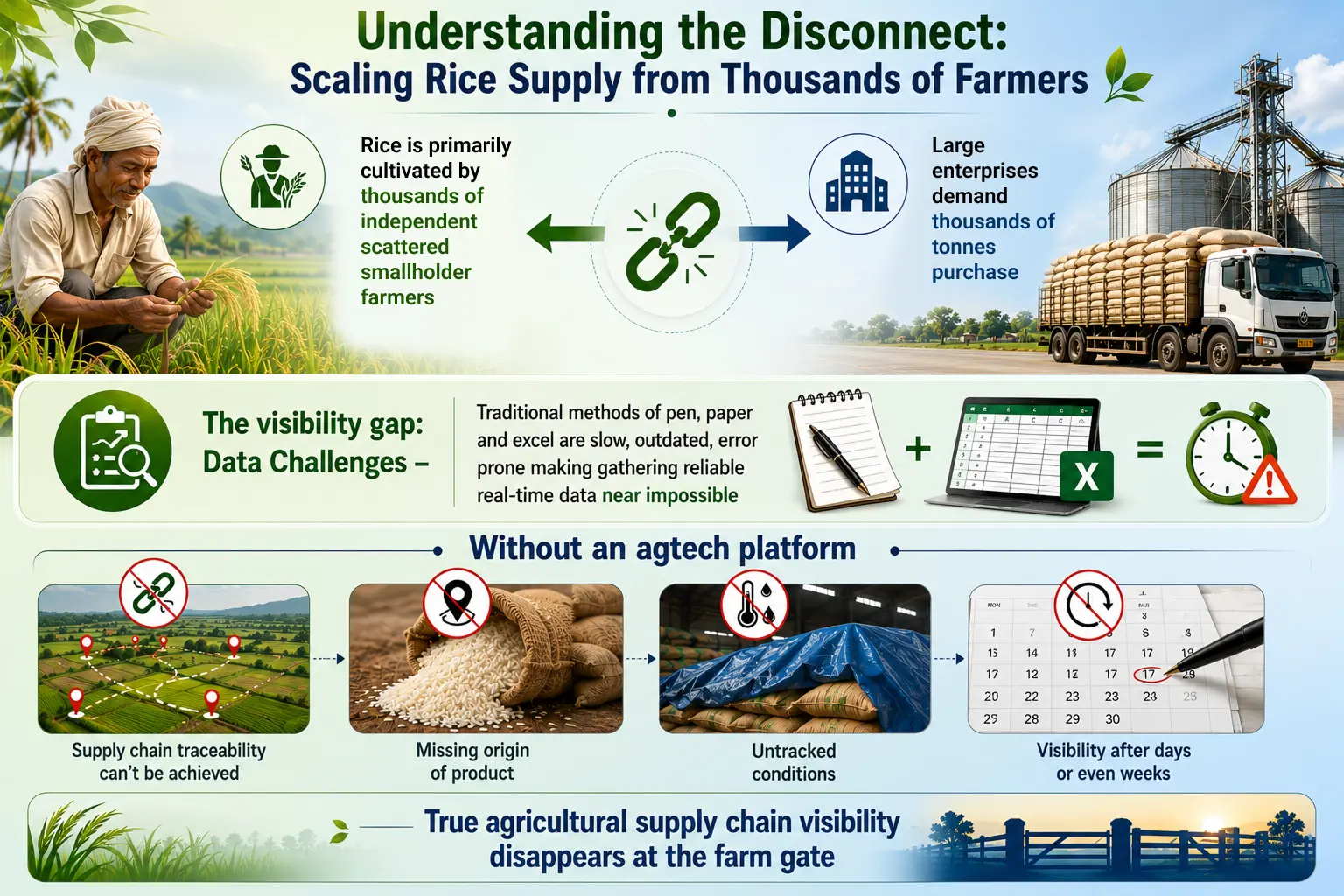
For procurement executives, rice is one of the most unpredictable crops to source. Rice is predominantly grown in Asia, with India and China accounting for 90% of the production. Unlike the massive, consolidated industrial farms found in the West, agriculture in these regions is dominated by smallholder farmers, resulting in extreme fragmentation at the very beginning of the supply chain, which is the primary challenge.
Rice Is Grown on Plots Under Two Hectares, and That Makes Aggregated Visibility Nearly Impossible
When an enterprise buys thousands of tons of rice, we are looking at a supply chain built on thousands of independent farmers. Gathering reliable, real-time data across these tiny, scattered plots with traditional pen, paper and excel is near impossible. Without a dedicated rice supply chain technology platform, true agricultural supply chain visibility disappears at the farm gate.
Export Bans, Monsoon Failures, and the 54% Supply Gap: Why Concentration Risk in Rice Is a Board-Level Issue
As rice production is dominated by specific geographies in Asia the geographical concentration poses an imminent risk for the supply chain. To put it into perspective, of the total rice exports India controls 40%. Sudden monsoon failures can instantly decimate regional output. When local yields drop, governments frequently respond with aggressive export restrictions or total bans to protect domestic food security, especially as rice is the major diet in Asia. For instance, recent regional restrictions have triggered a global supply gap of up to 54% for certain varieties. Managing this concentration risk is no longer just a task for local buyers; it is a critical, board-level priority.
The United States Department of Agriculture has predicted rice output of about 538 million tons for 2026-27. This is the first dip in 11 years. The largest fall is predicted in India, Myanmar and the US. The factors that could play a major role in this fall include a below-average monsoon in India and a spike in energy and fertilizer costs due to the war in Iran. Considering record consumption and trade, this creates a massive supply gap for global brands.
How Plot-Level Monitoring Works Across Fragmented Rice Networks at Scale
To secure their supply chains, agribusinesses must move past regional estimates. They need granular visibility from the actual fields.
What Plot-Level Monitoring Actually Means and Why It Changes Procurement Decisions
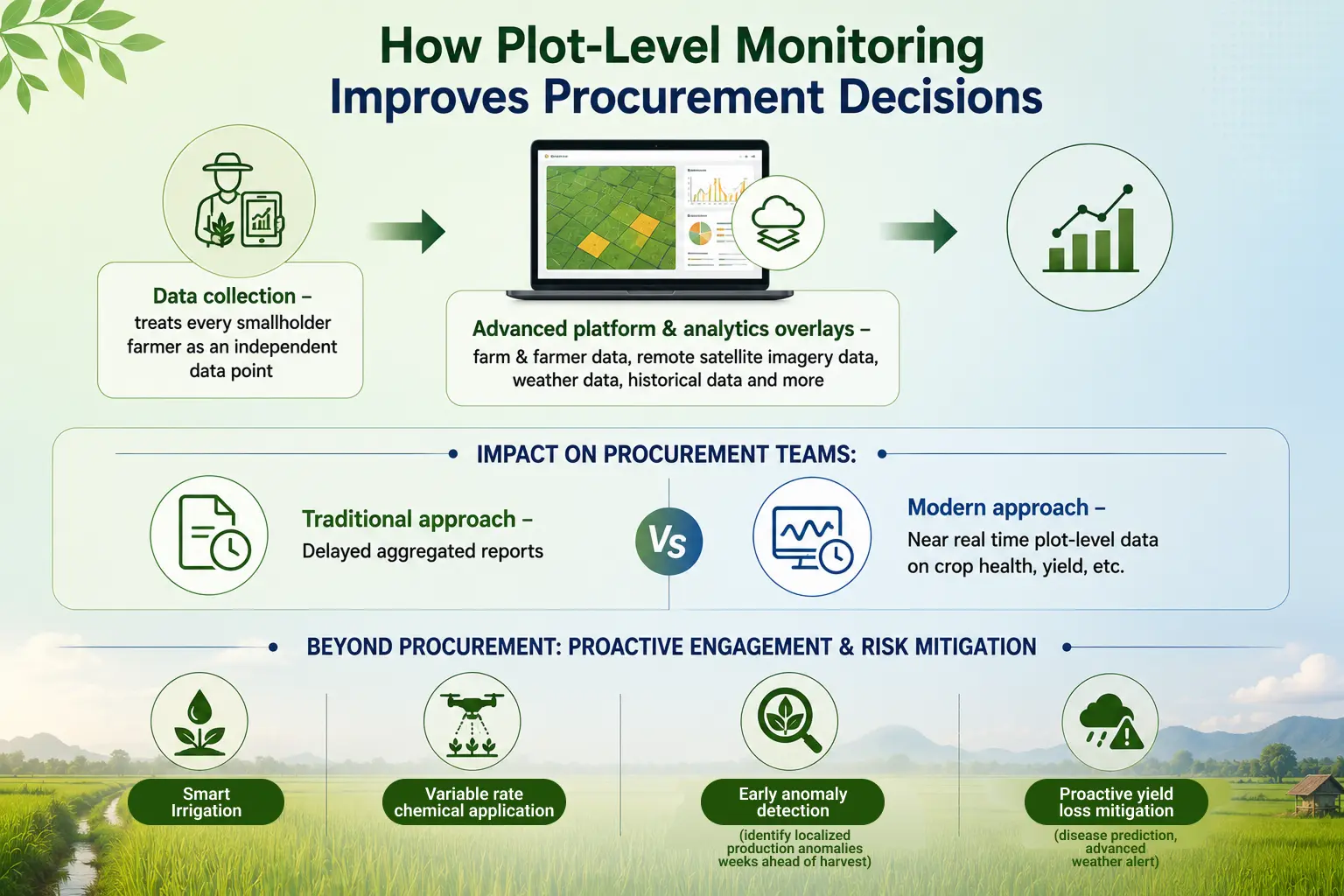
Plot-level crop monitoring treats every smallholder farm as an independent data point. Advanced platforms analyze high-resolution satellite imagery, local weather data, and soil metrics for each specific plot.
This changes everything for procurement teams. Instead of relying on delayed, aggregate district reports, buyers get near-real-time updates on crop health and growth variations across individual farms. This allows teams to identify localized production anomalies weeks before the harvest begins.
It doesn’t stop here! Procurement teams can engage with farmers and offer data-driven insights on irrigation, chemical application, and more to improve yields. They can also proactively mitigate yield loss by leveraging disease predictions and advanced weather alerts.
Cropin's 30 Million Acre Deployment: How Enterprise-Scale Rice Monitoring Works in Practice
Scaling digital monitoring across millions of smallholders requires an enterprise-grade agtech supply chain visibility platform. Cropin has successfully deployed its technology across 30 million acres globally, proving that large-scale smallholder digitization is fully achievable.
The platform continuously monitors millions of fragmented plots simultaneously. Cropin’s conceptualized advanced deep learning AI models process massive streams of satellite data and environmental indicators to give global agribusinesses an active, transparent view of their upstream supply base.
From Farmer Geotagging to Procurement Dashboard: How the Data Pipeline Actually Works
The journey to visibility begins in the field, where local agents use mobile phones to draw digital boundaries or polygons marking each smallholder farm. The farmer details are also captured digitally, linking a farmer to a verified land. Once the farm is geotagged, Cropin’s engine automatically pairs the coordinates with multi-spectral satellite sensors and localized weather feeds. The platform validates remote data using ground-truth data. The AI models overlay multiple datasets to derive insights into crop growth stage, health, moisture levels, yield estimates, and disease early warning system alerts.
This raw field data is automatically converted into clean, actionable insights on an enterprise procurement dashboard, giving corporate buyers a single, unified source of truth.
Rice Crop Stage Tracking: From Transplanting to Harvest, Flood Risk, and Pest Alerts
Rice requires precise water management and specific environmental conditions during its growth cycle. Every stage presents unique challenges that can impact final yields.
The Six Critical Crop Stages in Rice and Why Each One Creates a Procurement Risk Point
The rice lifecycle moves through six distinct phases: vegetative, tillering, stem elongation, panicle initiation, flowering, and maturity. Each stage is vulnerable to specific risks.
For example, water stress during tillering limits the number of grain-bearing pans, while cold spikes during flowering lead to empty hulls. By tracking critical events with an AI agricultural supply chain optimization engine, enterprises can easily pinpoint exactly when and where a crop is slipping behind its expected timeline.
Flood Risk Monitoring for Transplanted Rice Paddy: How Satellite Data Predicts Inundation Risk Before It Hits
While rice requires significant water, excessive flooding can destroy a crop entirely. This is especially true during the critical transplanting phase, when young seedlings are easily submerged and killed.
Cropin’s advanced weather alert helps farmers plan irrigation. While, remote satellite monitoring tracks remote field to provide near real-time visibility for procurement teams. The platform can monitors water anomalies across thousands of plots simultaneously. This allows procurement teams to identify flood risks early, anticipate potential crop losses, and adjust their sourcing plans before a shortage hits.
2Scale West Africa: How Cropin Digitized the Rice Value Chain for Millers and Smallholder Farmers
The real-world impact of this technology is clear in initiatives like the 2Scale project in West Africa. In this region, rice millers traditionally struggled with erratic supply volumes and highly inconsistent grain quality from local smallholder networks.
By deploying Cropin’s digital ecosystem, millers successfully established direct connections with thousands of smallholders. Field teams used the platform to deliver hyper-local agronomic advice, helping farmers optimize their inputs and stabilize production. This digitization effort gave millers a reliable, predictable supply of high-quality paddy, while significantly increasing local farmer incomes.
Space4Good Uses Remote Sensing and Geographic Information System (GIS) for Pest Control in Rice Farming
The collaboration between Space4Good, an Earth observation social enterprise and Cropin on the CropLens project in rice farms in India showcased the importance of precise, scalable agricultural monitoring to drive positive social and environmental outcomes. Space4Good gained access to actionable, data-driven insights, to identify spatial hotspots on the probability of distribution and severity of predicted disease infestation.
The project helped farmers make informed data-driven decisions and implement proactive steps on pest and disease infestation to prevent crop damage. They could increase productivity by 20% and reduce fungicide expense by 15%.
Enterprise Adoption of Cropin Cloud Platform in Rice Fields
A German multinational launched a flood-resistant rice variety with higher nutritional value in India. The company deployed the Cropin platform to digitize and geotag plots. The project compared the client’s rice varieties with non-client varieties and estimated yields of the newly launched seed variety.
In another enterprise-scale adoption, Cropin partnered with Savannah Seeds to develop “Smart Rice”. It digitized farms cultivating 6 varieties of rice. This improved operational efficiency by 40% and reduced time in monitoring field operations by 60%. Alerts (pest & diseases) were resolved swiftly. The team, including managing director, have end-to-end visibility on farm operations at anytime from any location.
Building the Business Case: What Rice Supply Chain Digitization Delivers in Measurable Terms
Investing in technology must deliver clear, bottom-line results. Digitizing the upstream supply chain provides significant returns across every area of operations.
Yield Improvement, Cost Reduction, and Procurement Accuracy: The Measurable Outcomes
By using an enterprise rice procurement software system, agribusinesses achieve massive efficiency gains. Data-driven insights help field teams optimize water and fertilizer use, driving significant yield improvements on smallholder plots.
On the procurement side, having access to accurate, early yield forecasts helps buyers avoid expensive, last-minute spot market purchases. This predictive precision significantly stabilizes procurement margins and lowers overall operational costs.
Traceability and Export Compliance: How Digitized Rice Supply Chains Access Premium Markets
Global regulators and consumers are increasingly demanding complete transparency. To access premium markets, brands must prove exactly where and how their rice was grown.
A digitized supply chain creates a transparent, auditable paper trail from farm to fork. By linking every bag of rice to a verified, deforestation-free plot, agribusinesses can easily comply with strict global regulations, protect their brand reputations, and secure long-term access to high-value markets. This enables businesses to provide immutable sustainability reports that are sought after by younger consumers.
Conclusion:
Managing a global rice supply chain through fragmented smallholder networks is an undeniable challenge, but it is no longer an unsolvable one. Relying on outdated, reactive sourcing models is a recipe for operational disruption and margin loss.
By embracing a rice supply chain AI platform, global agribusinesses can bridge the first-mile visibility gap. Transitioning to a predictive stance allows brands to secure their volumes, mitigate climate risks, and build a truly resilient supply ecosystem that thrives in a volatile world, the foundation of true surety of supply.
Frequently asked questions (FAQs)
What is the biggest challenge in managing rice supply chains across smallholder networks?
The biggest challenge is extreme fragmentation. Because rice is primarily grown on tiny plots under two hectares by millions of independent farmers, gathering reliable data on crop health, input usage, and yield expectations is nearly impossible without a digital platform to unify the data.
How does plot-level monitoring improve rice procurement decisions?
It replaces guesswork with precise field data. Instead of relying on lagging regional reports, procurement teams get near-real-time updates on crop health and growth variations for individual plots. This allows buyers to accurately forecast yields and secure alternative volumes weeks before harvest.
How does Cropin's platform handle rice crop monitoring specifically?
Cropin’s conceptualized advanced deep learning models combine multi-spectral satellite imagery, localized weather inputs, historical data and many other data sets. The platform tracks the specific growth stages of rice, maps farm boundaries, and flags localized weather details and pest risks across fragmented networks at scale.
How do government food agencies use AI platforms for rice production forecasting?
Agencies integrate platforms like Cropin with national AgriStack rice monitoring frameworks. The AI models analyze historical data alongside real-time satellite indices to generate highly accurate regional yield forecasts, helping governments plan food security strategies and manage import/export policies.
Can rice supply chain digitization platforms work in low-connectivity rural environments?
Yes. Cropin’s mobile field applications are engineered to work completely offline in remote areas. Field agents can capture farmer records, geotag plot boundaries, and log crop data without an active internet connection. The data stores securely on the device and automatically syncs to the central cloud platform once network connectivity is restored.
Author Bio

Prateek Srivastva
Prateek Srivastva is a Chief Business Officer at Cropin, a global Agtech leader, bringing over two decades of experience spanning technology, consulting, entrepreneurship, and investment. A seasoned serial entrepreneur, he has successfully established and exited three ventures, including a precision agriculture startup focused on perennial crops across three continents. At Cropin, Prateek is responsible for expanding the company’s presence in the critical EMEA region, managing revenue, investments, and academic partnerships. His extensive expertise in the field has earned him global recognition, with features in esteemed media platforms including Fortune, Forbes, and The Economist.