
Synopsis:
As UK agriculture adapts to climate uncertainty, labor shortages, rising costs, and evolving sustainability goals, AI is becoming a critical driver of smarter farming. This blog explores the 11 AI technologies transforming the industry in 2026, from predictive farm management and crop monitoring to yield forecasting, supply chain intelligence, and sustainability reporting. It also highlights how Cropin’s AI-powered platform enables agribusinesses to optimize resources, improve productivity, strengthen resilience, and make data-driven decisions for more efficient and sustainable agricultural operations.
The UK’s agricultural sector is entering a new era where data, automation, and intelligent decision-making are becoming essential for long-term success. From unpredictable weather patterns to increasing production costs and evolving sustainability regulations, agribusinesses are navigating a complex operating environment that demands greater precision and resilience.
Artificial intelligence in UK agriculture is helping businesses address these challenges by transforming how farming is planned, monitored, and managed. AI-powered technologies can analyze and integrate vast volumes of field, weather, satellite, and operational data to generate actionable insights that improve productivity while reducing waste. These tools strengthen the decision-making expertise of humans with timely recommendations that support better outcomes across the agricultural value chain.
This blog explores the leading AI technologies shaping UK agriculture in 2026, how they solve critical industry challenges, and why they have become essential investments for forward-looking agribusinesses.
The Growing Role of AI in UK Agriculture
Agriculture has always relied on experience, observation, and seasonal planning. Today, AI complements these strengths by providing continuous intelligence based on real-time data collected from farms, satellites, sensors, and connected equipment, historical data, weather data, and more.
It helps agribusinesses identify emerging risks, optimize resources, and improve operational planning before issues affect productivity. This proactive approach helps businesses make informed decisions throughout the crop lifecycle, from land preparation and planting to harvesting and distribution.
As digital farming continues to mature, AI is becoming a strategic capability that enables more consistent production, stronger resilience against climate uncertainty, and improved visibility across agricultural operations.
Why UK agribusinesses are investing in AI
UK agribusinesses are increasingly adopting intelligent technologies to improve operational efficiency while responding to changing environmental and economic conditions. AI enables organizations to analyze multiple data sources simultaneously, helping teams make faster and more informed decisions across farming operations.
Key Challenges Driving AI Adoption in the UK
Labor Shortages
Finding skilled agricultural workers continues to be a significant challenge across the UK. AI-powered automation, predictive planning, and intelligent monitoring reduce manual workloads. It gives existing teams room to focus on higher-value activities that require human expertise.
Climate Variability
Changing rainfall patterns, extreme temperatures, and unpredictable weather events have increased production risks for farmers. AI analyzes historical and real-time climate data to support better planning, helping agribusinesses respond more effectively to changing environmental conditions.
Sustainability Targets
Environmental regulations and sustainability commitments require businesses to optimize resource consumption while reducing their environmental footprint. AI provides measurable insights into emissions, water usage, fertilizer application, and carbon footprint, making sustainability initiatives easy to monitor and improve. It also plays a vital role in adhering to regulations like EUDR.
Rising Production Costs
Input costs, including fertilizers, fuel, labor, and crop protection products, continue to increase. AI identifies opportunities to optimize resource allocation, minimize unnecessary usage, and improve operational efficiency without compromising productivity.
Supply Chain Efficiency
Agricultural supply chains involve multiple stakeholders, making coordination increasingly complex. AI improves forecasting, inventory planning, and logistics visibility, helping businesses reduce delays while improving product availability.
Food Security
Maintaining consistent food production has become a national priority as climate uncertainty and global market disruptions continue to grow. AI supports better yield forecasting, early risk identification, and production planning, contributing to more reliable food systems.
How AI helps improve farm productivity
Modern farming generates enormous volumes of information from machinery, weather stations, satellite imagery, field observations, and operational records. Without intelligent analysis, much of this information remains underutilized.
Today’s AI tools for agriculture convert raw data into practical, actionable recommendations that support better decisions throughout the farming cycle. Agribusinesses can detect crop stress earlier, optimize irrigation schedules, forecast yields more accurately, and improve operational planning using predictive intelligence rather than historical insights.
Platforms such as Cropin combine satellite imagery, weather intelligence, and agronomic expertise with advanced AI models to deliver field-level insights that help businesses improve productivity while supporting sustainable agricultural practices.
11 AI Tools Transforming UK Agriculture
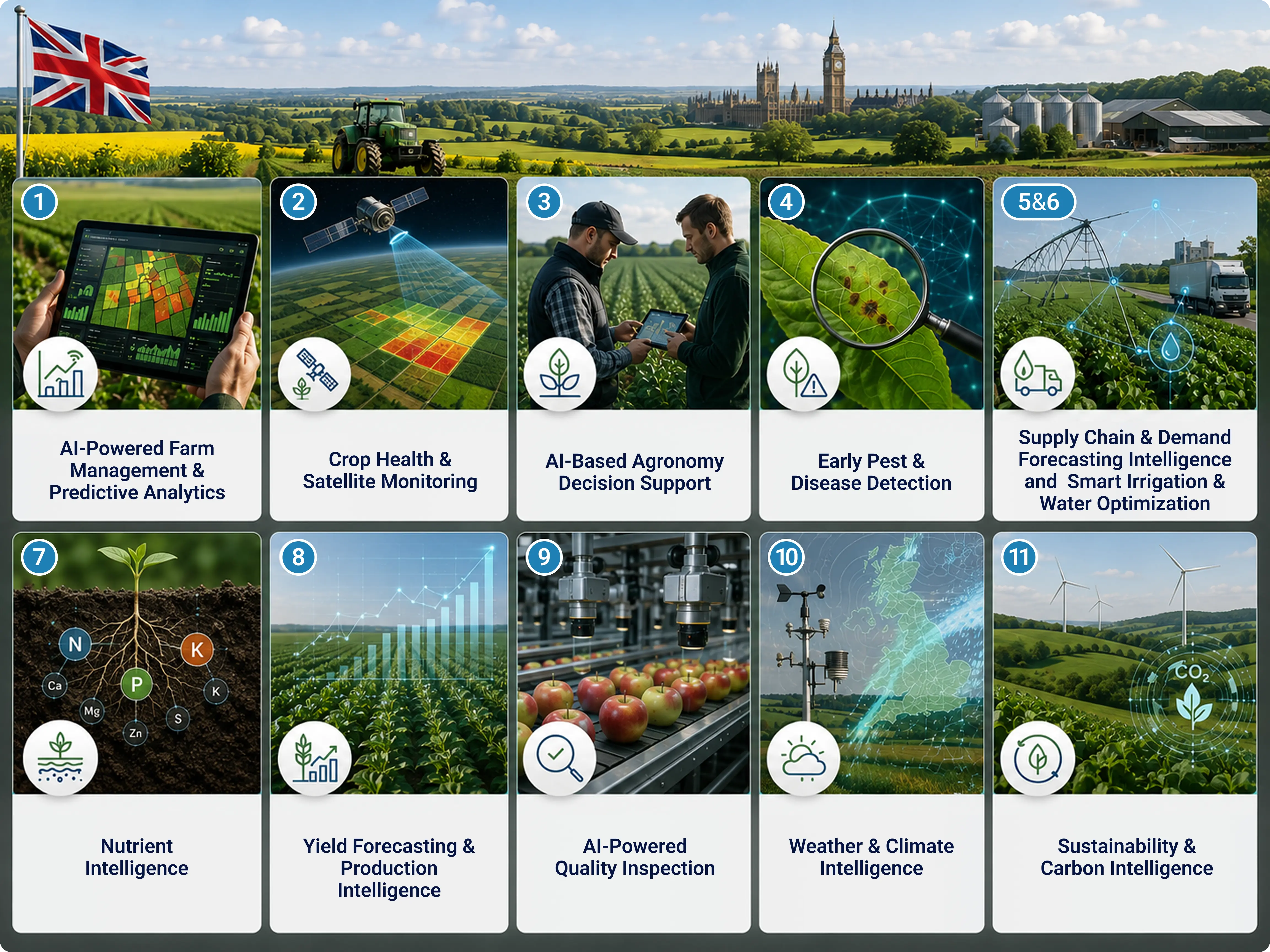
1. AI-Powered Farm Management & Predictive Analytics
Modern farm management platforms bring together operational, environmental, and agronomic data into a single interface. AI analyzes historical trends alongside real-time field conditions to identify potential risks, recommend interventions, and improve seasonal planning.
2. Crop Health & Satellite Monitoring
Satellite imagery overlaid on AI models enables continuous monitoring of crop conditions throughout the growing season. Instead of relying solely on field inspections, agribusinesses can identify stress indicators across large cultivation areas with greater speed and accuracy.
AI detects subtle vegetation changes that indicate nutrient deficiencies, water stress, disease outbreaks, or uneven crop development, allowing timely corrective intervention before problems become widespread.
3. AI-Based Agronomy Decision Support
Agronomy decisions depend on multiple variables, including crop stage, weather conditions, soil characteristics, and historical field performance. AI integrates these datasets to generate recommendations that support more effective crop management throughout the season.
Intelligent decision-support systems strengthen the expertise of agronomists with actionable intelligence. Recommendations leveraging these evidence-based insights improve consistency and reduce uncertainty.
4. AI Pest & Disease Detection
Early identification remains one of the most effective ways to minimize crop losses caused by pests and diseases. AI analyzes satellite imagery, field observations, weather conditions, and historical outbreak patterns to detect potential threats before visible damage is identified.
Advanced alerts allow agribusinesses to mitigate risks with planned interventions, optimize crop protection strategies, reduce unnecessary chemical applications, and minimize production losses.
5. Supply Chain & Demand Forecasting Intelligence
Agricultural supply chains require accurate production forecasts to improve inventory planning, procurement, transportation, and customer fulfillment. AI analyzes production trends, weather data, historical demand, and market conditions to generate more reliable forecasts.
Improved visibility across the supply chain enables businesses to reduce waste, strengthen coordination, and respond more effectively to changing market requirements.
6. Smart Irrigation & Water Optimization
Water management has become increasingly important as climate variability affects rainfall patterns across the UK. AI analyzes weather forecasts, soil moisture data, crop growth stages, and evapotranspiration rates to determine when and where irrigation is required.
This data-driven approach helps agribusinesses optimize water consumption while maintaining healthy crop development and improving long-term resource efficiency.
7. Nutrient Intelligence
Healthy soil is the foundation of consistent crop performance, making continuous monitoring essential for long-term productivity. AI combines soil analysis, satellite imagery, historical field data, and environmental conditions to evaluate nutrient availability and identify areas requiring attention.
These insights help agribusinesses optimize fertilizer application, improve soil health, and reduce unnecessary input costs.
8. Yield Forecasting & Production Intelligence
Accurate yield forecasting supports better planning across production, procurement, storage, and distribution. AI analyzes crop growth patterns, weather conditions, satellite observations, and historical performance to generate reliable production estimates throughout the season. To improve prediction accuracy, advanced AI models use zone sampling, which accounts for field variability by analyzing representative zones instead of treating the entire field uniformly. This approach captures differences in crop conditions more effectively, resulting in improved precision in yield forecasts.
Rather than waiting until harvest, agribusinesses gain early visibility into expected outcomes and can make proactive decisions that reduce operational uncertainty and improve resource planning.
9. AI-Powered Quality Inspection
Maintaining consistent crop quality is becoming increasingly important as buyers and consumers demand higher standards. AI-powered inspection systems use computer vision to assess produce for size, color, shape, maturity, and visible defects with greater speed and consistency than manual inspections.
Automated quality assessment improves grading accuracy, reduces processing time, and helps businesses maintain consistent product standards across large volumes.
10. Weather & Climate Intelligence
Weather remains one of the most influential factors affecting agricultural productivity. AI continuously analyzes local forecasts, historical weather patterns, and climate data to predict conditions that may impact crop performance.
These insights help agribusinesses schedule planting, irrigation, spraying, harvesting, and other field activities more effectively while reducing risks associated with changing weather conditions.
11. Sustainability & Carbon Intelligence
Sustainability has become a strategic priority for agricultural businesses as environmental regulations and corporate reporting requirements continue to evolve. AI enables organizations to monitor emissions, carbon sequestration, resource consumption, and sustainability performance through data-driven measurement.
How Cropin Brings These AI Capabilities Together
One Platform, Every Stage of the Crop Lifecycle
While each AI technology addresses a specific piece of modern agriculture, the real value comes from bringing them together on a single, connected platform. Cropin’s AI-powered AgTech cloud integrates satellite intelligence, predictive analytics, computer vision, weather intelligence, and sustainability insights into one system delivering end-to-end visibility across the agricultural value chain, from farm management and crop health monitoring to irrigation, quality inspection, and supply chain planning.
Sharper Agronomy Decisions
The platform strengthens agronomy decision-making by overlaying multiple data layers on domain-specific AI models, generating contextual recommendations tailored to crop stage, field conditions, and environmental change. This gives agronomists and farm managers the ability to act faster and more precisely, improving both crop performance and operational consistency.
Predicting Risk Before It Shows
Cropin’s DEWS model combines satellite imagery, weather data, and historical trends to predict disease probability and flag crop stress before visible symptoms appear, enabling timely intervention and stronger crop protection. Alongside this, Cropin’s yield estimation models assess crop stage, crop growth patterns, zone sampling, weather, and more to generate accurate production estimates up to 45 days before harvest, giving procurement teams a real runway to plan sourcing, inventory, and supply chain decisions.
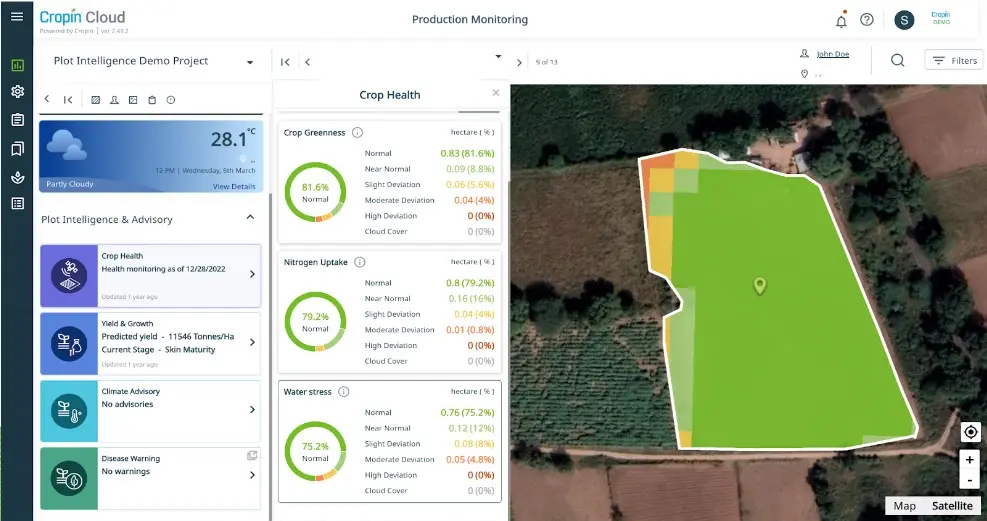
Cropin Cloud Plot Level Intelligence Dashboard
Planning Around Climate
By layering weather intelligence onto satellite observations and predictive models, Cropin helps agribusinesses anticipate climate risk and plan planting, irrigation, crop protection, and harvesting around it, reducing disruption and enabling timely field response.
Sustainability, Measured and Verified
Cropin Cloud’s sustainability dashboard tracks KPIs against organizational goals, including deforestation analysis, carbon footprint, loan disbursement, and water usage at the regional or plot level, with flexible task configuration and scoring. Its unbiased digital dMRV (digital Measurement, Reporting, and Verification) system simplifies compliance validation for evolving regulations and ESG.
The Outcome
By turning fragmented agricultural data into actionable intelligence, Cropin helps organizations improve productivity, optimize resource use, and scale sustainable agricultural operations with confidence.
How These AI Tools Benefit UK Agribusinesses
Improve Operational Efficiency
AI automates data collection, monitoring, and analysis, allowing teams to spend less time on manual processes and more time making informed business decisions. It plugs the inevitable data loss associated with manual data collection. Greater operational visibility also helps identify inefficiencies before they affect productivity.
Support Sustainable Farming Practices
Intelligent technologies enable more precise use of water, fertilizers, and crop protection products, reducing environmental impact from run-off. It supports responsible agricultural practices that align with sustainability goals.
Enhance Crop Quality
Continuous monitoring throughout the growing season helps maintain healthier crops and more consistent quality. Early detection of issues enables timely interventions that protect harvests and reduce losses.
Reduce Production Costs
Predictive insights allow businesses to optimize resource allocation and avoid unnecessary expenditure on inputs or corrective measures. Better planning also improves labor productivity and equipment utilization across farming operations.
Strengthen Food Supply Chains
Reliable production forecasts and improved operational visibility support stronger collaboration between growers, processors, distributors, and retailers. Better forecasting reduces waste while improving product availability throughout the supply chain.
Improve Resource Utilization
AI helps agribusinesses make better use of land, water, labor, machinery, and agricultural inputs by recommending the most effective actions based on field conditions and operational data.
Enable Better Strategic Decision-Making
Access to reliable intelligence allows business leaders to evaluate risks, forecast production, monitor performance, and plan future investments with greater confidence. Data-driven decision-making supports stronger business resilience in an increasingly competitive agricultural landscape.
Emerging AI Trends in UK Agriculture Beyond 2026
Agentic AI for Agricultural Operations
The next generation of AI will move beyond providing recommendations to coordinating complex agricultural workflows. Agentic AI systems will be capable of analyzing multiple data sources, identifying priorities, and recommending coordinated actions across farming operations.
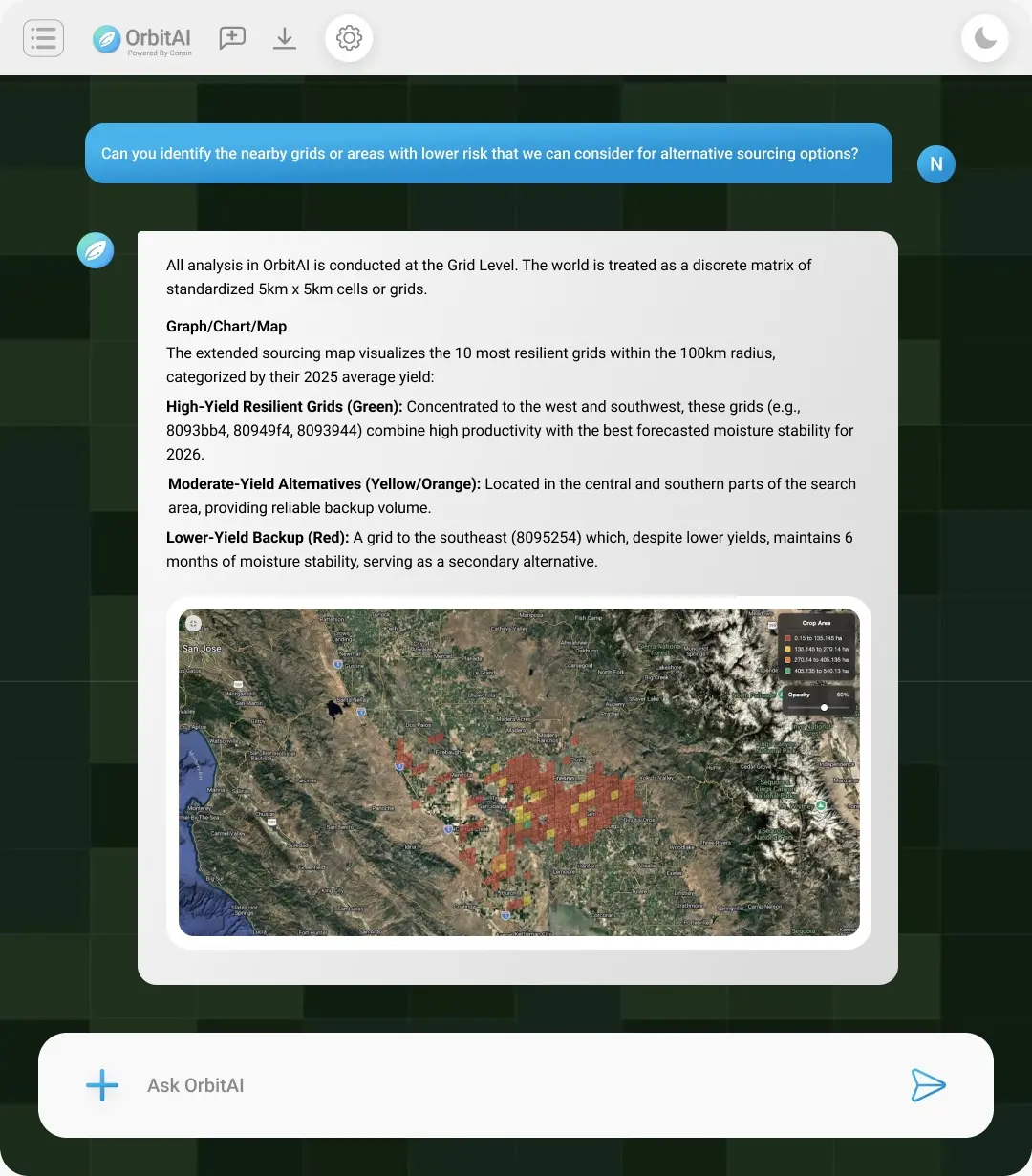
Cropin OrbitAI, the domain native agentic AI for food and agriculture, brings this capability to you. Cropin’s deep-learning models continuously process billions of time-series climate signals, geospatial data, satellite images, and multiple other datasets. With improved query performance and latency, these AI agents deliver contextual recommendations at planet scale in minutes, enabling agribusinesses with autonomous intelligence.
Multimodal AI for Farm Monitoring
Future AI platforms will combine satellite imagery, drone data, weather information, IoT sensors, machinery data, and agronomic observations into a unified intelligence layer. This holistic approach will provide more accurate and context-rich insights for decision-makers.
Edge AI for Real-Time Field Decisions
Processing AI models closer to the field through connected devices will enable faster decision-making without depending entirely on cloud connectivity. Real-time analysis will become increasingly valuable for time-sensitive farming operations.
AI-Powered Sustainability Reporting
As environmental reporting requirements become more comprehensive, AI will simplify data collection and automate sustainability reporting across agricultural supply chains. Businesses will gain greater transparency while reducing administrative effort. It will offer a digital time-stamped proof to validate sustainability claims.
Climate-Resilient Farming Intelligence
Future AI models will provide increasingly sophisticated climate risk assessments by combining decades of historical data with predictive environmental modeling. These capabilities will help agribusinesses strengthen resilience against changing climate conditions while supporting long-term production planning.
Conclusion
AI is transforming UK agriculture by enabling agribusinesses to make informed decisions based on real-time data, predictive insights, and intelligent automation. From improving crop health and optimizing resources to strengthening supply chains and supporting sustainability, these technologies are helping businesses adapt to changing agricultural demands.
As the industry continues to evolve, adopting AI-driven solutions will be essential for improving resilience, increasing productivity, and achieving long-term growth. Organizations that embrace intelligent agriculture today will be better prepared to meet future challenges with greater confidence and operational efficiency.
Discover how Cropin’s AI-powered agriculture cloud platform helps agribusinesses improve farm performance, strengthen sustainability, and make data-driven decisions with intelligent, scalable solutions designed for the future of farming.
Frequently asked questions (FAQs)
What are AI tools in agriculture?
AI tools in agriculture use technologies such as machine learning, satellite imagery, computer vision, predictive analytics, and intelligent farm management to help farmers and agribusinesses monitor crops, optimize resources, forecast yields, and improve operational decision-making.
How are UK agribusinesses using AI?
UK agribusinesses use AI to monitor crop health, strengthen agronomy decisions, predict weather-related risks, optimize irrigation, improve supply chain planning, forecast yields, and support sustainability initiatives through data-driven insights.
Which AI tools improve crop productivity?
AI-powered farm management platforms, predictive analytics, crop monitoring systems, agronomy decision-support solutions, pest and disease detection, yield forecasting tools, and nutrient intelligence platforms all contribute to improved crop productivity.
Can AI support sustainable agriculture?
Yes. AI helps optimize water usage, fertilizer application, carbon monitoring, and resource management while supporting sustainability reporting, ESG compliance, and responsible farming practices through measurable, data-driven insights.
How does AI improve supply chain planning?
AI analyzes production forecasts, weather conditions, market demand, and inventory data to improve planning across procurement, logistics, storage, and distribution, helping reduce waste and improve supply chain efficiency.
What industries benefit most from agricultural AI?
Agricultural AI benefits growers, agribusinesses, food processors, seed companies, procurement teams, cooperatives, retailers, exporters, financial institutions, and organizations focused on sustainable agriculture and food production.
What industries benefit most from agricultural AI?
Agricultural AI benefits growers, agribusinesses, food processors, seed companies, procurement teams, cooperatives, retailers, exporters, financial institutions, and organizations focused on sustainable agriculture and food production.
Author Bio

Haripriya Muralidharan
Haripriya Muralidharan leads content marketing at Cropin Technology Solutions, bringing a unique scientific rigor to brand storytelling. With a Master's in Chemistry from Pune University and research experience in cancer immunology, she discovered her passion in storytelling. For two decades, she has operated at the intersection of content, communication, and brand strategy, specializing in turning complex ideas into impactful narratives. Prior to Cropin, Haripriya leveraged her creative skills at Elsevier’s Chemical Business News Base and shaped multi-format content strategies for B2B marketing at Scatter.