Synopsis:
As climate variability, global production complexity, and rising quality expectations reshape the seed industry, choosing the right seed management system has become a strategic business decision rather than an operational upgrade. This blog explores the essential capabilities global seed companies should expect from a modern seed management platform, from AI-powered production planning and satellite-based field monitoring to climate intelligence, traceability, and predictive forecasting. It also provides a practical vendor evaluation framework while showcasing how Cropin enables leading seed producers to unify global operations, strengthen resilience, and drive data-backed decisions across every stage of the seed production lifecycle.
Climate variability is reshaping seed production in ways that legacy systems were never designed to handle. According to the Intergovernmental Panel on Climate Change (IPCC), rising temperatures, changing precipitation patterns, and the increasing frequency of extreme weather events are already affecting agricultural productivity and food systems worldwide. This makes climate-informed decision-making a business necessity rather than a future consideration.
While traditional seed management systems have helped digitize operational workflows, they often lack the intelligence required to anticipate climate-driven risks and support timely interventions. As seed companies expand their multiplication programs and work with distributed grower networks, visibility across every stage of production becomes critical.
At Cropin, we see digital intelligence as the key to transforming seed operations with greater visibility, traceability, and efficiency. By combining AI, satellite intelligence, weather data, and field-level insights, Cropin enables seed companies to make informed decisions, improve production outcomes, and build resilience against climate variability.
What a Seed Management System Was Built to Do - and Where It Now Falls Short
The Core Purpose of a Seed Management System
A seed management system is designed to bring structure and visibility to seed production. It enables organizations to plan multiplication programs, manage grower networks, maintain generational records, monitor field activities, maintain quality standards, and establish traceability throughout the seed production lifecycle. By digitizing manual records and standardizing workflows, these systems help production teams coordinate operations more efficiently while improving compliance and reporting.
For many years, these capabilities were sufficient because production environments remained relatively predictable. Historical production data and seasonal planning provided a reliable foundation for operational decisions. However, climate variability has significantly altered this landscape, requiring seed companies to make faster and more informed decisions based on changing field conditions rather than static production plans.
Why Legacy Systems Are No Longer Enough
Modern seed production requires continuous adaptation. Climate conditions can change rapidly during a growing season, affecting crop development, flowering, seed maturity, and harvest schedules. Changes in climate conditions and globalization have, in turn, led to the spread of plant diseases. Yet many legacy seed management systems continue to function primarily as operational record-keeping tools instead of intelligent decision-support platforms.
Most conventional systems rely on periodic field reports and historical production records, creating delays between field events and management actions. As seed production expands across multiple geographies, this limited visibility makes it difficult to identify risks before they begin affecting production outcomes. Standardization of operations across these geographies is another challenge legacy systems cannot handle due to their inherent nature.
Forecasting also becomes increasingly challenging when weather conditions deviate from historical patterns. Without integrating satellite imagery, weather intelligence, and live field observations, production estimates often fail to reflect actual crop conditions. As climate variability becomes more pronounced, organizations require systems that can continuously interpret changing environmental conditions and translate them into actionable production insights rather than simply documenting operational activities.
The Missing Link: Climate Intelligence
Climate variability affects every stage of seed production, from field selection and sowing to harvesting and quality assessment. Managing these changes requires more than digital workflows. It requires systems capable of continuously analyzing environmental conditions and translating them into actionable operational insights.
Cropin addresses this challenge by combining AI, satellite intelligence, weather data, and field-level information to provide continuous visibility across seed production programs. Instead of reacting after production issues occur, organizations can identify risks early, prioritize interventions, and optimize production decisions based on real-time intelligence.
This shift from documentation to predictive decision-making enables seed companies to improve operational resilience while maintaining production consistency across multiple regions.
Why Fake Seed Detection Requires End-to-End Traceability
Counterfeit seeds continue to pose a serious challenge for the agriculture industry, affecting productivity, farmer confidence, and brand reputation. Traditional seed management systems typically record inventory movements and production activities but often lack complete digital traceability across the entire seed lifecycle.
Without connected records linking production plots, certification processes, quality inspections, inventory movements, and distribution, verifying seed authenticity becomes increasingly difficult.
Cropin strengthens traceability by connecting field-level operational data throughout the seed production journey. By maintaining a comprehensive digital record supported by field-level observations and production intelligence, organizations gain greater transparency across their supply chains while strengthening quality assurance and supporting seed authenticity initiatives. In addition, this intelligence helps field agents right from site selection to input resource management, farmer engagement, and early identification and mitigation of risks.
The Four Climate Pressures Every Seed Management System Must Handle in 2026
Climate variability introduces operational challenges that cannot be managed through seasonal planning alone. Seed companies need systems capable of continuously monitoring environmental conditions, identifying emerging risks, and supporting proactive decision-making throughout the production lifecycle. Four key climate pressures are shaping the future of seed production in 2026.
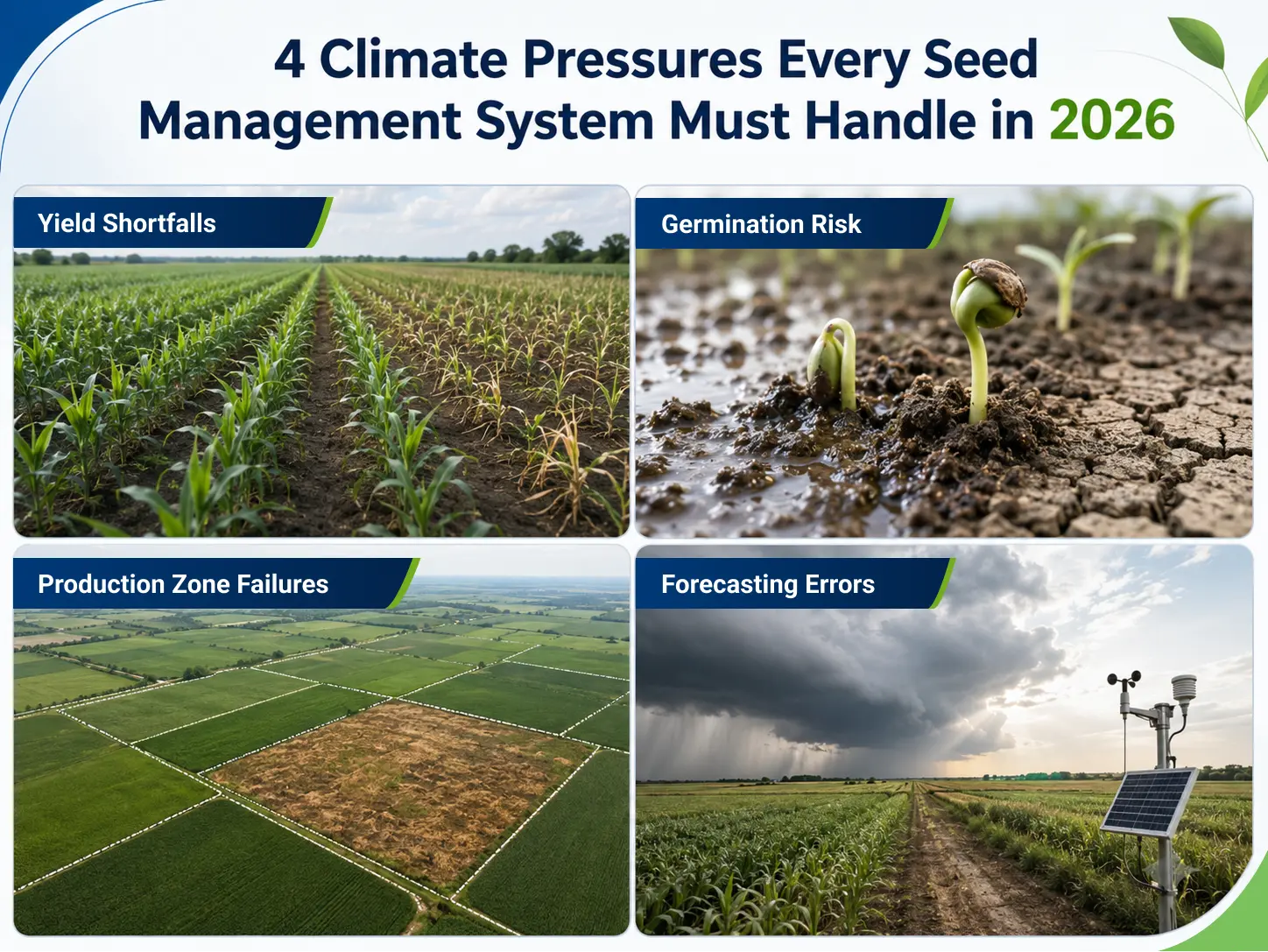
Yield Shortfalls
Localized weather variability has made yield performance increasingly unpredictable. Even neighboring production fields can experience different rainfall patterns, temperature fluctuations, or moisture levels, resulting in uneven crop performance despite following similar agronomic practices.
Cropin combines satellite intelligence, AI-powered analytics, weather data, and operational information to provide continuous visibility into field performance throughout the growing season. This enables production managers to identify underperforming fields early and implement corrective actions before yield losses become significant.
The Cropin App further strengthens this capability by allowing field teams to capture crop stages, inspections, observations, and production activities directly from the field. These real-time updates continuously enrich production intelligence and improve the accuracy of operational decisions. Our 14-day advanced weather forecasts and alerts also helps you plan irrigation and other activities.
With climate change, new diseases threaten yield. Some of these diseases were unheard of in the specific geographies. The Cropin Disease Early Warning System (DEWS) is a probabilistic model, at a crop variety level, that predicts these threats before they strike. DEWS overlays weather data and historical patterns to predict the likelihood of specific diseases well in advance. This intelligence provided daily helps you take proactive mitigative measures like applying targeted fungicides to minimize crop loss and ensure a more secure seed supply.
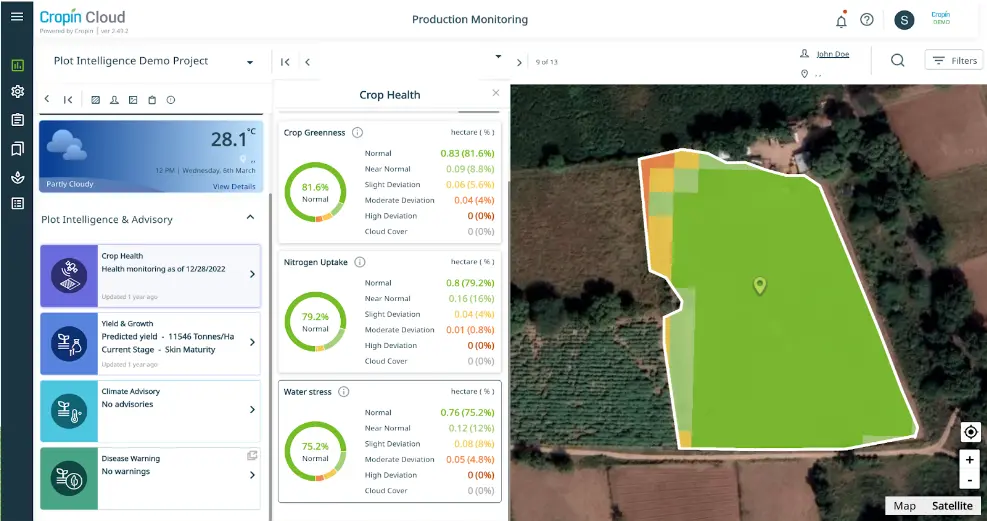
Early Visibility into Yield Estimation - 45 days in advance
Germination Risk
Seed quality depends on stable environmental conditions throughout crop development. Heat stress, irregular rainfall, and prolonged moisture fluctuations can reduce seed vigor and negatively affect germination performance, even when field operations follow established protocols.
Traditional inspection-based monitoring often identifies quality concerns only after scheduled field visits have taken place. By then, opportunities for timely intervention may already be limited.
Cropin continuously evaluates crop development using satellite observations and field-level data captured through the Cropin App. It is then combined with various datasets, including weather forecasts, by our advanced deep-learning models. This integrated approach enables production teams to detect environmental risks earlier, prioritize field interventions, and maintain seed quality standards throughout the multiplication cycle.
Production Zone Failures
Climate variability is gradually changing the suitability of traditional seed production regions. Production zones that consistently delivered reliable yields in previous seasons may experience increasing weather instability, while emerging regions may offer more resilient growing conditions.
Selecting suitable production geographies therefore requires continuous environmental intelligence rather than relying solely on historical performance.
Cropin enables organizations to compare production performance across multiple regions using centralized operational visibility, satellite intelligence, and environmental data. This helps seed companies identify resilient production zones, optimize acreage allocation, and strengthen long-term multiplication strategies across distributed production networks.
Forecasting Errors
Reliable forecasting has become increasingly difficult as weather variability affects crop growth, flowering, maturity, and harvest outcomes throughout the season. Forecasts based solely on historical production records and random field visits often fail to reflect rapidly changing field conditions.
Cropin’s zone sampling improves forecasting by combining AI models with satellite imagery, weather intelligence, and operational data to capture field heterogeneity for improved accuracy of yield estimation. We generate advanced yield estimation and yield re-estimations for continuously updated production forecasts. Instead of relying on static seasonal projections, production managers receive forecasts that evolve alongside actual crop performance.
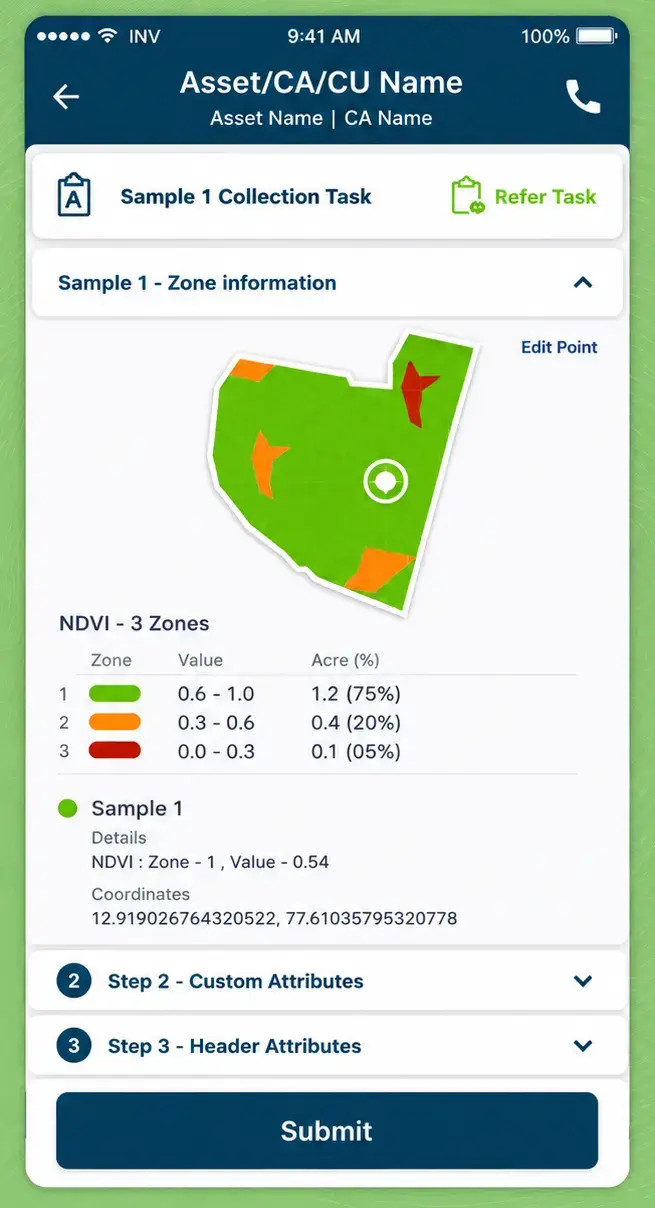
Mobile Display of Zone Sampling on Cropin App
The Cropin App plays an important role by capturing verified field observations throughout the growing season. Every inspection, crop-stage update, and operational activity contributes to more accurate forecasting while enabling organizations to respond proactively to changing production conditions.
The Capabilities That Separate a Climate-Ready Seed Management System From a Legacy One
As climate variability continues to influence seed production, organizations need more than workflow automation to maintain productivity and quality. A climate-ready seed management system should enable continuous monitoring, predictive planning, and timely interventions across distributed production networks. While every organization has unique operational requirements, the following capabilities have become essential for evaluating whether a seed management system is prepared for the future.
Satellite and IoT-Based Field Monitoring
Field visibility is the foundation of effective seed production management. Conventional monitoring methods depend heavily on scheduled field visits, making it difficult to identify risks as they emerge. Continuous monitoring through satellite imagery and IoT devices enables production teams to track crop progress, environmental conditions, and field performance without relying solely on manual observations.
Managing farms at scale means managing complexity at scale. Cropin simplifies that. Start with the basics: audit your land, geotag every plot, and digitize farmer and farm records all flowing into a single cloud platform that gives you location-specific intelligence, wherever you need it. Field teams work faster with multi-modal data collection, and offline functionality means remote areas are never a blind spot. Near real-time visibility, smarter advisories, and consistent adherence to your Package of Practices from the field to the dashboard, every decision is backed by data. The single source of truth and first-mile visibility offered by Cropin Cloud platform ensures end-to-end field monitoring and validation.
Seed Producer’s Digital Transformation
Multi-Geography Production Visibility
Seed production often spans multiple regions, each influenced by different climatic conditions, agronomic practices, and operational challenges. Managing these distributed programs through disconnected systems limits visibility and delays decision-making.
A climate-ready seed management system should provide centralized visibility across all production locations through a single operational dashboard. Cropin enables standardization of global operations while maintaining regional nuances. Cropin brings together field activities, environmental intelligence, grower information, quality inspections, and production progress into one connected platform. This unified view enables production managers to compare regional performance, identify emerging risks, and maintain operational consistency across geographically distributed multiplication programs.
Download the Seed Producer Case Study
Climate Scenario Modeling in Production Planning
Historical production data alone is no longer sufficient for planning future multiplication programs. Climate variability requires organizations to evaluate multiple production scenarios based on changing weather patterns, environmental conditions, and regional performance.
Cropin combines historical production records with weather intelligence, AI-driven analytics, and environmental insights to support more informed production planning. By evaluating different climate scenarios before the season begins, seed companies can optimize field selection, allocate acreage more effectively, and reduce the impact of localized climate risks on overall production outcomes.
Automated Replanning Workflows
Production plans rarely remain unchanged throughout the growing season. Delayed sowing, unexpected rainfall, crop stress, or changes in field conditions often require organizations to adjust operational activities quickly.
Legacy systems generally depend on manual coordination whenever production plans need to be revised. This can delay field execution and reduce operational efficiency.
Cropin provides continuously updated operational and environmental intelligence. Field teams receive alerts and can plan updated activities, inspections can be rescheduled, and production managers gain visibility into changing priorities without relying on disconnected communication channels. This enables seed producers to replan workflows and respond more to safeguard production.
Risk Alerts to Drive Mitigation
Climate-related risks often develop gradually before becoming visible in the field. Early identification allows production teams to take preventive action rather than managing losses after they occur.
Cropin supports proactive risk management through Disease Early Warning System (DEWS) capabilities and weather intelligence that monitor environmental conditions associated with disease development and crop stress. Weather alerts, field intelligence, and AI-powered insights alert production managers about potential risks in advance. This helps them plan and prioritize interventions where they are needed most. This enables organizations to reduce production losses while maintaining seed quality across diverse production environments.
How East-West Seed Upgraded Their Seed Management System to Handle Climate at Scale
The Challenge
As one of Asia’s leading tropical vegetable seed companies, East-West Seed manages extensive seed multiplication programs across multiple countries and production regions. Coordinating field operations, maintaining production visibility, and ensuring consistent decision-making across geographically distributed teams became increasingly challenging as operations expanded.
Manual reporting processes limited real-time visibility, while disconnected operational data made it difficult to monitor production progress and respond quickly to emerging field conditions. Climate variability further increased the need for timely insights that could support consistent production outcomes across diverse growing environments.
The Cropin Solution
East-West Seed partnered with Cropin to digitize and strengthen its seed production operations through the Cropin Seed Production platform. By integrating the Cropin App into field operations, agronomists and production teams were able to capture standardized field observations, inspection records, crop stages, and operational activities directly from production plots.
Satellite intelligence, centralized dashboards, and AI-powered insights provided production managers with a connected view of multiplication programs across geographies. This enabled faster decision-making, improved operational visibility, and better coordination between field teams and management throughout the production lifecycle.
The Business Outcomes
By adopting Cropin’s digital seed production platform, East-West Seed achieved measurable improvements across its operations. According to the Cropin case study, the organization digitized thousands of production plots, standardized field data collection, improved visibility across multiple production regions, and significantly reduced dependence on manual reporting processes. Centralized operational intelligence enabled faster interventions, strengthened production planning, and improved collaboration between distributed teams, helping the organization manage complex seed multiplication programs more efficiently at scale.
Is Your Seed Management System Ready for What 2026 Brings?
Climate variability is changing the expectations from every seed management system. Organizations that continue relying on static production plans and fragmented operational data may find it increasingly difficult to maintain productivity, quality, and supply commitments.
A Quick Self-Assessment
Ask yourself the following questions:
- Can your current system monitor production fields continuously instead of relying only on scheduled inspections?
- Can it combine weather intelligence, satellite imagery, and field observations to identify production risks early?
- Can it compare production performance across multiple geographies from a single platform?
- Can it update production forecasts as field conditions change throughout the season?
- Can it provide complete digital traceability to strengthen seed authenticity and reduce counterfeit risks?
- Can field teams capture standardized observations in real time while management receives immediate operational visibility?
If your answer is “no” to several of these questions, your current seed management system may not be equipped to support climate-resilient seed production in 2026. Modern seed companies require intelligent platforms that transform field data into timely operational decisions while strengthening visibility, traceability, and production resilience.
Conclusion
Climate variability is no longer a future concern. It is already influencing how seed companies plan production, manage field operations, and maintain consistent quality across regions. As production environments become increasingly dynamic, traditional seed management systems designed primarily for operational record-keeping are no longer sufficient.
Organizations need connected platforms that combine AI, satellite intelligence, weather data, and field-level insights to support proactive decision-making. By enabling greater visibility, traceability, and climate intelligence, Cropin helps seed companies strengthen operational resilience and build production systems that are prepared for the challenges and opportunities of 2026 and beyond.
See how Cropin’s seed management system is built for climate variability. Discover how AI-powered intelligence can strengthen visibility, improve production planning, and support resilient seed operations. Talk to our team today.
Frequently asked questions (FAQs)
How is agentic AI used in precision agriculture?
Agentic AI powers precision agriculture by continuously sensing zone-level field conditions soil, crop health, moisture and autonomously adjusting irrigation, nutrient application, and interventions at that same granular level, rather than applying uniform treatment across an entire field.
What data does agentic AI need to work on a farm?
It typically draws on soil sensor data, drone and satellite imagery, weather API feeds, historical climate and yield records, and market signals, combining them into a continuously updated picture of farm conditions.
How is agentic AI different from traditional AI in agriculture?
Traditional AI in agriculture typically generates recommendations or predictions using historical data and online information. Agentic AI integrates multiple deep learning models to perceive conditions and derive autonomous, actionable intelligence. It continuously monitors the outcomes of actions and provides insights.
How do multiple AI agents coordinate on a single farm?
Conceptualized models for weather, crop health, yield, and more share data and communicate in real time, negotiating a combined response as a team of domain experts would. AI agents, however, do this continuously and at machine speed.
Is agentic AI the same as autonomous tractors or farm robots?
No. Autonomous tractors and robots are physical execution tools. Agentic AI is the decision-making intelligence layer that can be used to derive insights that direct those tools and many other systems. It is based on continuous data and reasoning, and is not the physical hardware itself.
Author Bio

Shashi Kant
Shashi Kant leads customer experience for the EMEA region at CropIn Technology Solutions, bringing a rare blend of technical depth and client-first thinking to the agri-tech world. With extensive expertise in implementation, pre-sales, and client onboarding, Shashi specializes in turning complex AI-driven data into smooth, successful adoption journeys. He works at the intersection of technology, agriculture, and human experience, ensuring that innovations such as satellite analytics, IoT-driven insights, and machine learning models deliver clear, measurable value. By bridging the gap between corporate sustainability goals and on-ground farming realities, Shashi helps our partners navigate the digital transformation of their food systems. He is dedicated to driving regenerative agriculture practices that benefit both the enterprise and the grower. His areas of interest include deforestation monitoring, soil and crop intelligence, and precision agriculture. Passionate about leveraging technology for sustainable agriculture, Deepak believes that the future of farming will be shaped by the convergence of geospatial intelligence, AI, and actionable field insights to create more resilient and efficient food systems worldwide.