Synopsis:
Legacy seed management systems can no longer keep pace with the demands of global seed production. Climate variability, stricter regulations like EUDR, and increasingly distributed operations require greater visibility, traceability, and predictive intelligence. This blog explores the capabilities that define a modern seed management system, the critical questions to ask when evaluating vendors, and how Cropin’s AI-powered platform helps seed companies streamline planning, strengthen compliance, improve forecasting, and build resilient, data-driven seed production operations across multiple geographies.
Selecting a seed management system is no longer about replacing spreadsheets or digitizing field records. It is about choosing a platform that can support global seed production, adapt to climate variability, and deliver the operational intelligence needed to make confident decisions across distributed production networks.
As multiplication programs expand across countries and seed portfolios become increasingly diverse, global seed companies need more than workflow automation. They need continuous visibility, traceability, and predictive insights that help reduce risks before they affect production outcomes.
At Cropin, we believe a modern seed management system should combine AI, satellite monitoring, weather data, and field-level insights into a connected platform that helps organizations with intelligence to scale efficiently while building resilience for the future.
What a Modern Seed Management System Actually Does
A modern seed management system goes far beyond digitizing operational records. It acts as the central intelligence layer for planning, monitoring, forecasting, and optimizing seed production across multiple geographies. By connecting field operations with real-time environmental data and enterprise workflows, it enables organizations to make informed decisions throughout the seed production lifecycle.
Seed Production Planning and Allocation
Effective seed production begins with accurate planning. A seed management system should help production teams allocate acreage, assign growers, manage multiplication programs, and coordinate production activities across regions. Instead of relying on disconnected spreadsheets or legacy systems, organizations benefit from a centralized platform that provides complete visibility into production plans while enabling faster adjustments when business priorities or environmental conditions change.
Cropin Cloud enables organizations to digitize production planning while maintaining visibility across multiple crops, varieties, growers, and production locations. This creates a connected planning process that supports operational consistency throughout the growing season.
Field-Level Monitoring via Satellite and IoT
Continuous near real-time field visibility has become essential for managing seed production at scale. A modern seed management system should combine field observations with satellite imagery and IoT-enabled monitoring to provide a real-time understanding of crop performance.
Cropin enables seed companies to monitor geo-tagged plots remotely through satellite imagery, eliminating the need for manual scouting at scale. Agronomists can capture standardized observations directly through the Cropin App, while satellite monitoring and environmental data provide additional context. Various datasets are overlaid on Cropin’s deep-learning AI models to derive insights on crop growth, stage & progression, pest and disease pressure, and identify water stress and more. This provides near real-time visibility across geographies, varieties, and seasons from a single platform. The integrated approach improves crop monitoring, supports more accurate yield estimation, and enables earlier identification of production risks.
Quality and Germination Tracking
Maintaining seed quality requires continuous monitoring throughout the production cycle rather than isolated inspections before harvest. A seed management system should provide structured workflows for recording field observations, germination assessments, inspection results, crop stages, and input application while maintaining complete traceability across every production lot.
Cropin connects quality workflows with field operations, enabling production managers to monitor crop development, evaluate germination-related risks, access germination rates, and maintain standardized record-keeping across multiple production locations. With Cropin’s customization capabilities, minor attributes like the presence of plastic in the field can also be recorded. This improves tracking and collaboration between agronomists, quality teams, and production managers while maintaining hierarchical access and supporting consistent seed quality.
Climate Risk and Contingency Management
Climate variability has transformed production planning from a seasonal activity into a continuous process. A modern seed management system should help seed producers anticipate weather-related risks, stimulate impact, evaluate production scenarios, and implement contingency plans before disruptions affect yield or quality.
Cropin combines weather intelligence, satellite observations, and AI-powered analytics to provide proactive risk monitoring throughout the growing season. Capabilities such as the Disease Early Warning System (DEWS) alerts growers when the probability of disease occurrence crosses a threshold. The model overlays weather forecasts, historic data, crop variety and stage to assess disease pressure. It enables production teams to prioritize interventions and strengthen resilience.
Demand Forecasting and Supply Matching
Reliable forecasting is essential for balancing production with market demand. A seed management system should continuously refine yield estimates using field observations, environmental intelligence, and operational data.
Cropin’s yield estimation models accommodate for field heterogeneity through zone sampling, which increases the accuracy of yield forecasts. Advanced yield estimates and re-estimates allow seed producers to continuously examine production and impact of risk. This directly helps reduce buffering. As conditions evolve, organizations can align inventory planning, procurement, and customer commitments with expected production outcomes, improving supply reliability while reducing operational uncertainty.
Regulatory Compliance and Traceability
Seed companies must navigate evolving regulatory requirements around sustainability, quality standards, and supply chain transparency. Monitoring seed production is vital to control input usage and maintain seed quality. Regulations such as the EU Deforestation Regulation (EUDR) are increasing the need for accurate origin tracking, responsible sourcing records, and verifiable production data.
Cropin enables end-to-end traceability by connecting field operations, production records, quality checkpoints, and compliance workflows on a unified platform. This helps organizations maintain digital documentation, improve audit readiness, and build greater transparency across the entire seed production lifecycle.It also empowers seed companies to control counterfeit seeds in the market. The classic example of this use case was observed when PAGREXCO plugged counterfeit potato seeds by deploying the Cropin platform.
The Gaps Most Seed Companies Are Living With Right Now
Even today, many seed companies continue to face operational challenges that limit productivity and visibility. These gaps often become more pronounced as production expands across multiple geographies.
Common Gap
Business Impact
Spreadsheet-based planning
Multiple versions of production data create inconsistencies and slow decision-making.
Limited real-time field visibility
Production risks are identified after they begin affecting crop performance.
Reactive quality checks
Quality issues are often detected too late for effective mitigation.
No climate contingency planning
Production teams struggle to respond quickly to changing weather conditions.
No regulatory traceability readiness
Increases the risk of non-compliance with due diligence regulations such as EUDR, affecting market access.
No near real-time visibility
Impacts timely data-driven decision-making.
While these challenges may appear operational, they directly influence production efficiency, seed quality, forecasting accuracy, and business continuity.
Questions to Ask Any Seed Management System Vendor
Before investing in a seed management system, global seed companies should evaluate whether the platform can support the operational complexity of modern seed production. The right questions often reveal whether a solution is built for today’s challenges or simply digitizes yesterday’s processes.
Can the platform provide continuous visibility across every production field?
Does it combine satellite imagery, field observations, and weather forecasts to support decision-making?
Can production plans be adjusted dynamically when environmental conditions change?
Does the system support operations across multiple countries from a single platform?
Can agronomists, growers, production managers, and quality teams collaborate within the same system?
Is there hierarchical access to information?
Does the platform provide end-to-end traceability across the entire seed production lifecycle?
Can it improve yield estimation using plot-level field intelligence?
Does it provide proactive alerts for climate and disease-related risks?
Can it integrate with existing ERP and enterprise systems without disrupting operations?
Is AI embedded into production planning and forecasting rather than limited to reporting?
Does your platform support compliance requirements?
The answers to these questions provide a practical framework for evaluating whether a seed management system is equipped to support the scale, complexity, and climate realities of global seed production.
How Cropin's Seed Management System Answers Every One of Those Questions
Choosing the right seed management system is about finding a platform that not only addresses today’s operational challenges but also prepares organizations for future growth. Cropin combines AI, satellite intelligence, weather data, and field-level visibility into a connected platform for global seed production that helps seed companies make informed decisions across every stage of seed production.
What Global Seed Companies Need
How Cropin Delivers
Centralized production planning
Digitizes multiplication planning, generation tracking, grower allocation, and production workflows across geographies.
Continuous field visibility
Combines satellite intelligence, Cropin Apps, and GPS-tagged field observations for real-time monitoring.
Accurate yield estimation
Cropin Zone Sampling captures plot-level heterogeneity that improves the accuracy of yield estimation and production insights.
Climate intelligence
Integrates weather intelligence and the Disease Early Warning System (DEWS) to identify risks early.
Multi-country operations
Provides a unified platform to standardize workflows while supporting regional production requirements.
Reliable forecasting
Uses AI-driven analytics, environmental intelligence, and field data to refine production estimates.
End-to-end traceability
Connects field operations, quality checkpoints, and production records throughout the seed lifecycle.
Enterprise integration
Integrates with existing ERP and enterprise systems to create a connected operational ecosystem.
Compliance Validation and Arresting Counterfeits
Geo-tagging and time-stamped data collection provide an unbiased digital Measurement, Reporting, and Verification (dMRV) for validation. Traceability and QR coding help prevent counterfeit seeds from entering the market.
By bringing these capabilities together, Cropin enables seed companies to improve operational visibility, strengthen collaboration, and respond proactively to climate and production challenges.
How Cropin Empowers You to be Future Ready
Seed companies operate at the earliest and most consequential point in the agricultural value chain. Variety selection, trial design, performance benchmarking, and commercial planning all depend on one thing: knowing how a hybrid performs across diverse geographies, soil types, and climate conditions, before the season is lost.
Traditionally, that knowledge has come slowly.
Field trials are expensive, geographically limited, and seasonal. By the time performance data is aggregated, the commercial window has often narrowed.
OrbitAI changes the timeline.
Trained on 15 years of validated agricultural intelligence across 1 billion+ acres, 400+ crops, and 100+ countries, OrbitAI gives seed companies access to multi-season, multi-geography crop performance data at a depth and scale that no field trial programme can match alone. It analyses historical yield outcomes, satellite-observed crop health trajectories, weather exposure, soil variability, and agronomic practice data, and returns variety-level insights in plain language, on demand.
What seed companies use OrbitAI for:
- Research
- Trial site selection
- Early stress detection
- Yield forecasting
- Market intelligence & more
Why OrbitAI, is not a general-purpose AI:
Generic AI models reason from internet-sourced text. They have no verified field records, no satellite observations, no crop-specific agronomic models. OrbitAI is trained exclusively on ground-truth agricultural data, the same data that Cropin has built field by field, season by season, across 102 countries. When a seed company asks OrbitAI about soybean performance under drought stress in Mato Grosso versus Goiás, it draws on observed outcomes from that geography across multiple seasons, not a summary of published papers. consistency became increasingly difficult.
The result is decision intelligence that is crop-specific, location-specific, and seasonally aware, the kind of intelligence that accelerates breeding programs, reduces trial costs, and strengthens the commercial case for new varieties before they reach the market. consistency became increasingly difficult.
Available now. No GIS expertise required. Try Cropin OrbitAI free at orbitai.cropin.com
Case Point: How a Leading Global Seed Producer Unified 30 Countries on One Seed Management System
The Challenge
Managing seed production across multiple countries requires standardized workflows without compromising regional flexibility. A leading Dutch vegetable seed producer operating across 30+ countries faced fragmented field operations, disconnected production data, and inconsistent reporting practices that limited enterprise-wide visibility. As production expanded across diverse climatic regions, maintaining operational consistency became increasingly difficult.
The Cropin Solution
The company partnered with Cropin to establish a unified digital seed production platform that connected field operations, production workflows, and operational data across all regions. By standardizing digital processes while supporting local production requirements, Cropin enabled teams to capture consistent field data, monitor production progress in real time, and improve collaboration across geographies.
The Business Outcomes
With Cropin, the organization successfully unified operations across 30+ countries, managing 40 crops and 500+ seed varieties through a single platform while supporting 170+ users. Centralized visibility enabled production managers to compare regional performance, strengthen operational consistency, and make faster data-driven decisions across global multiplication programs. The result was a more connected and resilient seed production operation capable of scaling efficiently across diverse production environments.
Case Point: How a Leading Global Seed Producer Ensured Nursery-to-Farm-Gate Visibility Across Generations
The Challenge
A leading U.S. seed producer managing operations across California, Arizona, Florida, and Washington needed greater visibility across its seed production lifecycle. Although enterprise systems were already in place, field data remained fragmented across regions, making it difficult to connect nursery operations, field activities, production milestones, and enterprise reporting. Manual reporting processes also delayed decision-making during critical crop stages.
The Cropin Solution
As climate variability continues to influence seed production, organizations need more than workflow automation to maintain productivity and qualityCropin implemented Cropin Grow and Cropin Data Hub to unify production data and standardize field workflows across the organization. The platform enabled agronomists to capture field observations digitally while integrating seamlessly with existing ERP systems. Centralized dashboards provided a connected view of production activities from nursery through harvest, improving visibility and operational coordination.
The Business Outcomes
Within six to eight months, the organization established nursery-to-gate visibility across 34 crops, 859 seed varieties, and 1,746 tracked assets while onboarding 100 growers onto a single platform. Standardized workflows reduced manual reporting, improved collaboration across regional teams, and enabled faster operational decisions supported by real-time production intelligence.
What the Right Seed Management System Looks Like for a Global Operation
As global seed production becomes more complex, the right seed management system should provide far more than digital record-keeping. It should serve as an intelligent platform that connects production planning, field operations, climate intelligence, quality management, and forecasting into a unified decision-making environment.
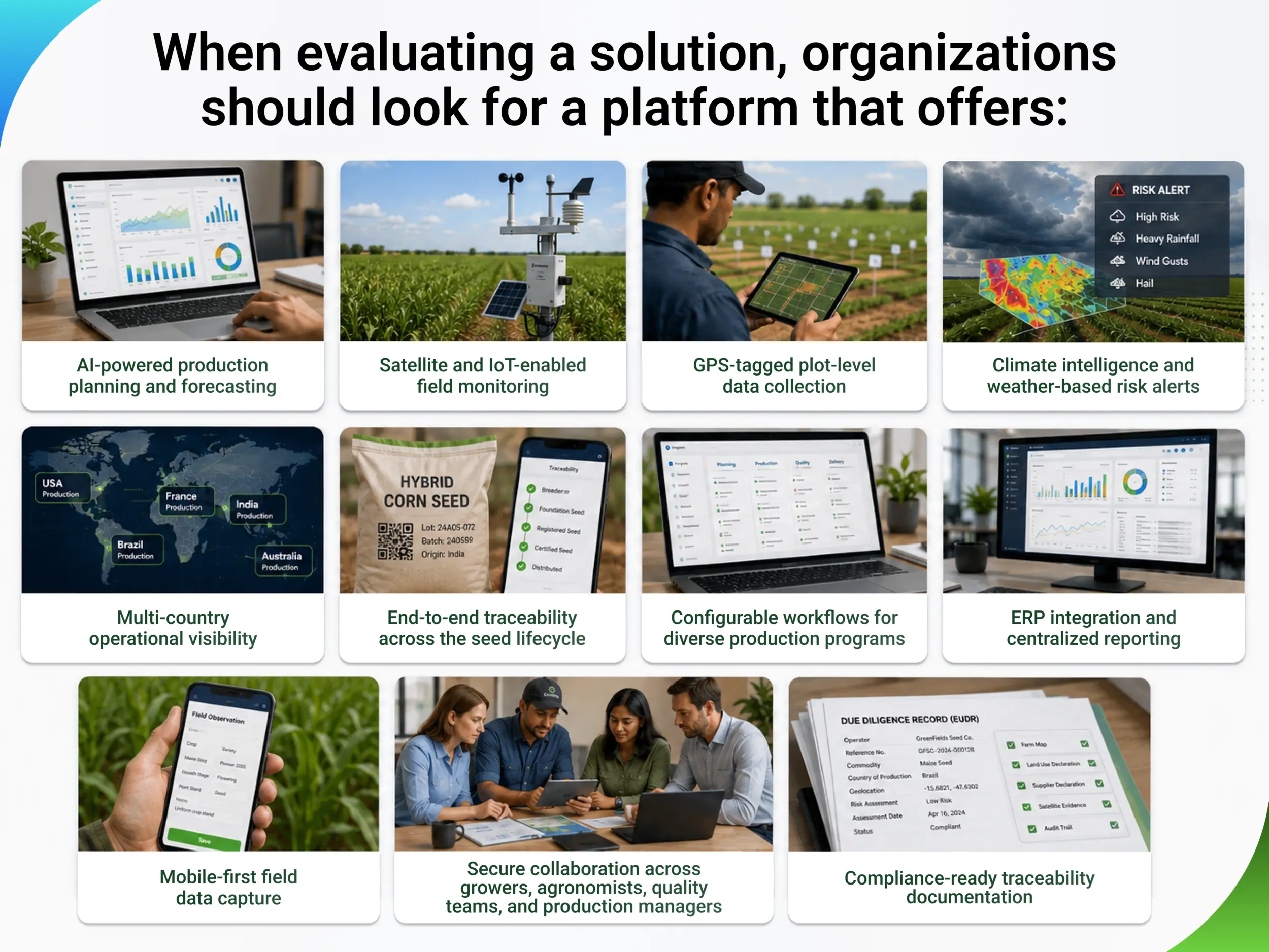
Cropin brings these capabilities together through an integrated cloud platform designed for the scale and complexity of global seed production. By combining operational intelligence with AI-driven insights, Cropin enables organizations to improve productivity, strengthen resilience, and make confident decisions across distributed production networks.
Conclusion
Global seed production demands technology that goes beyond operational efficiency. As climate variability, distributed production networks, and evolving market requirements continue to reshape the industry, seed companies need platforms that provide continuous visibility, predictive intelligence, and end-to-end traceability.
A modern seed management system should connect every stakeholder, every production location, and every critical data point into a single source of truth. With AI-powered insights, satellite intelligence, and connected field operations, Cropin helps seed companies build resilient production systems that are prepared to meet the demands and beyond.
If your answers to the vendor checklist revealed gaps in visibility, climate readiness, or operational intelligence, it is worth seeing what Cropin does differently.
Frequently asked questions (FAQs)
How is agentic AI used in precision agriculture?
Agentic AI powers precision agriculture by continuously sensing zone-level field conditions soil, crop health, moisture and autonomously adjusting irrigation, nutrient application, and interventions at that same granular level, rather than applying uniform treatment across an entire field.
What data does agentic AI need to work on a farm?
It typically draws on soil sensor data, drone and satellite imagery, weather API feeds, historical climate and yield records, and market signals, combining them into a continuously updated picture of farm conditions.
How is agentic AI different from traditional AI in agriculture?
Traditional AI in agriculture typically generates recommendations or predictions using historical data and online information. Agentic AI integrates multiple deep learning models to perceive conditions and derive autonomous, actionable intelligence. It continuously monitors the outcomes of actions and provides insights.
How do multiple AI agents coordinate on a single farm?
Conceptualized models for weather, crop health, yield, and more share data and communicate in real time, negotiating a combined response as a team of domain experts would. AI agents, however, do this continuously and at machine speed.
Is agentic AI the same as autonomous tractors or farm robots?
No. Autonomous tractors and robots are physical execution tools. Agentic AI is the decision-making intelligence layer that can be used to derive insights that direct those tools and many other systems. It is based on continuous data and reasoning, and is not the physical hardware itself.
Author Bio

Prateek Srivastva
Prateek Srivastva is a Chief Business Officer at Cropin, a global Agtech leader, bringing over two decades of experience spanning technology, consulting, entrepreneurship, and investment. A seasoned serial entrepreneur, he has successfully established and exited three ventures, including a precision agriculture startup focused on perennial crops across three continents. At Cropin, Prateek is responsible for expanding the company’s presence in the critical EMEA region, managing revenue, investments, and academic partnerships. His extensive expertise in the field has earned him global recognition, with features in esteemed media platforms including Fortune, Forbes, and The Economist.