
7 Non-Negotiable Agri-Tech Trends for 2026: The New Mandate for Supply Assurance

Table of contents

Synopsis:

In the rapidly evolving world of global food systems, every year is defined by a distinct shift in strategic priorities and technological adoption. As we move into 2026, the convergence of climate volatility, geopolitical friction, and labor shortages has made “Supply Assurance” the new leadership mandate. This blog offers an exclusive peek into the non-negotiable agri-tech trends for 2026, providing a roadmap for how predictive intelligence and autonomous execution will move from the periphery to the core of the global agricultural operating stack.
The calendar year is drawing to a close. For those of us operating at the intersection of technology and agriculture, 2025 has been an exhilarating chapter that tipped the scales towards biological crop protection, regenerative agriculture, indoor farming, and robotics. As 2026 dawns, we stand at the convergence of three forces that are now impossible to ignore: geopolitics, climate volatility, and automation at scale. In many ways, these will shape the agri-tech trends for 2026.
In my 15 years in this sector, I have never seen the leadership mandate change so fundamentally. What used to be episodic disruption: trade shocks, extreme weather, labor instability, and regulatory uncertainty – has become a structural operating environment. In 2026, competitive advantage will no longer come from having the most dashboards. It will come from who can build Supply Assurance: the ability to secure supply earlier, protect margins, meet rigorous compliance, and adapt continuously as conditions evolve.

Why “Business as Usual” No Longer Works in Modern Agricultural Supply Chains
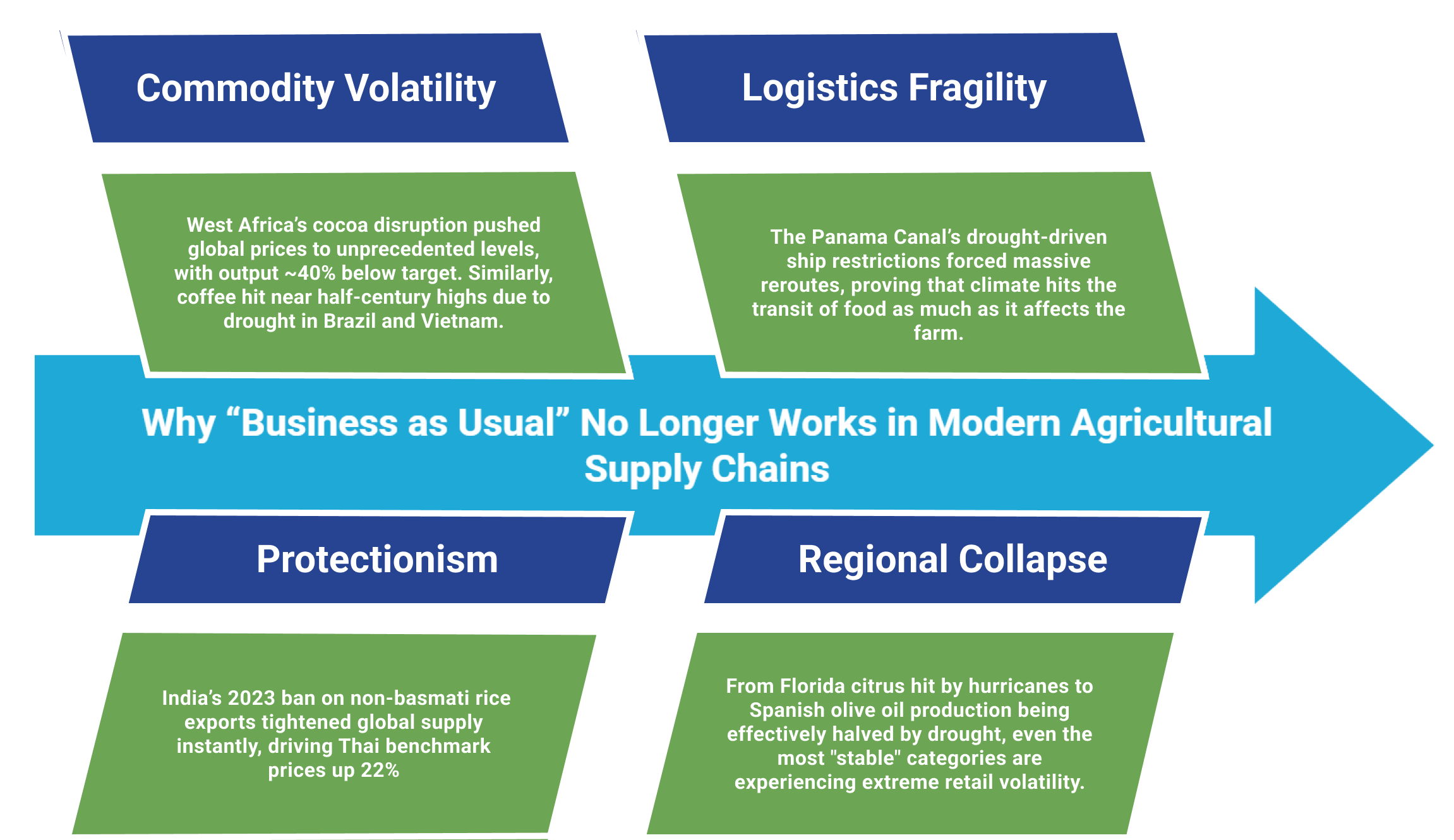
If you want a simple definition of modern food-system risk, look at the simultaneous shocks we’ve witnessed between 2023 and 2025. These weren’t isolated incidents; they were systemic failures.
This isn’t a temporary cycle; it’s the new structural reality. This is why 2026 marks the definitive shift from simple “visibility” to Supply Assurance, making supply predictable, auditable, and resilient.
As this structural rigor takes hold, we are seeing a profound shift in how enterprises engage with technology. The era of fragmented Requests for Proposals (RFPs), seeking a “satellite tool” here or a “weather app” there, is ending. In 2026, the most sophisticated players are issuing RFP that demand a structured strategy from the ground up: solving for the data strategy first, the platform strategy second, and the AI strategy as the ultimate intelligence layer.
Boardrooms are now focused on hard-coding resilience into the balance sheet. So, the Requests for Information (RFIs) of the coming year will specifically target systems that offer “decision-grade” outcomes rather than just “predictive” data. This shift is the first sign of an industry that has matured beyond experimentation and is, setting the trends for 2026.

The 7 Non-Negotiable Agri-Tech Shifts Shaping Supply Assurance

1. Risk-Adjusted Sourcing Becomes Board Discipline

The old playbook optimized for cost and efficiency. The new one optimizes for continuity. Procurement and sourcing leaders are moving away from the “lowest-price-first” model toward origin diversification and scenario-led contracting. In 2026, the board will demand forward signals on production risk and logistics fragility before commitments are made. Strategy is shifting from reactive buying to proactive, risk-adjusted planning that leverages an AI-First Mandate to decode the past, analyze the present, and predict the future.
Historical averages for identifying and securing new production zones are a thing of the past. 2026 will see the emergence of AI to deeply analyze historical climate data, monitor real-time environmental impacts and logistics, and forecast the long-term viability of new regions before capital is committed. The strategy is shifting from reactive buying to proactive buying, factoring the cost of “non-supply” into the procurement equation.

2. Regulation Becomes Operational, Not Rhetorical

The EUDR (EU Deforestation Regulation) is a preview of the future. While implementation timelines for large firms have shifted to December 30, 2026, the direction is clear: evidence-ready supply is now table stakes. Traceability, geolocation evidence, and due diligence are being woven into core operations. With penalty frameworks reaching 4% of EU turnover, compliance has moved from the Corporate Social Responsibility (CSR) report to the Profit & Loss.

3. AI Shifts from “Predictive” to “Decision-Grade”

In the boardroom, the word “predictive” is losing its lustre because leaders don’t buy predictions they buy outcomes. The language that lands in 2026 is Decision-Grade Intelligence.
The shift here is fundamental: we are moving toward risk-adjusted planning. Adoption will be driven by whether AI changes decisions before capital is deployed. By integrating Forecast-to-Action systems, enterprises can dictate acreage allocation, variety decisions, and supplier strategy with mathematical confidence. It’s about “season-ahead signals” that allow an enterprise to leverage insights from the past and present to ruthlessly de-risk the future. Risk-adjusted planning ensures that every procurement hedge and every supply commitment is backed by real-time probability data, not historical guesswork.

4. Agentic Planning: The Operating Model for Volatility

Static annual plans break the moment the season changes. Agentic AI is emerging as the gold standard because these systems don’t just search for data; they act as intelligent agents that understand natural language and bridge information gaps. 2026 will see the rise of Agentic Planning, in which AI supports continuous replanning by simulating scenarios and recommending the “next-best-action” across procurement, quality, and sustainability as microclimates and geopolitics shift in real-time.
An Agentic AI won’t just say “risk is high.” It will tell a grower, with guaranteed accuracy, “There is 80% probability of a specific risk, say that of “X” pest, and to mitigate it, spray fungicide in Zone 3, Block B, at 4 PM tomorrow.” When connected to bots or drones, the action will also be triggered. This level of precise, contextual intelligence can enable large-scale adoption, driving real impact amid climate instability. It’s easy to see why agentic AI can be exponentially faster (an essential component in risk mitigation) compared to gathering information manually for decision-making.

5. Hyper-Automation: The Execution Layer Arrives

The aging agrarian population and chronic labor shortages have moved robotics and drones from “pilot” status to a commercial necessity.
When drones are combined with predictive analytics and machine learning, we see crop monitoring costs drop by up to 85% and pesticide use decrease by approximately 50% through precision spraying. Intelligence now tells machines exactly where to intervene, performing high-stakes tasks like variable-rate spraying, protecting crops with UV light, precise seeding, and automated weeding. This evolution embeds robust, localized decision-making frameworks that insulate businesses from manual errors. By hard-coding efficiency directly into field operations, hyper-automation becomes the cost-effective and safer option for feeding millions while ensuring agriculture remains sustainable.

6. Regen-Ag Scales through Measurable MRV ( Measurement, Reporting, and Verification)

Regenerative Agriculture moves from a narrative to an operating model only when it is measurable and financeable. While precision agriculture provides the data framework for soil testing and variable-rate application, Regen-Ag delivers the critical outcomes: healthier soil, improved biodiversity, and increased carbon sequestration.
However, adoption has historically faced bottlenecks of high upfront costs and yield uncertainty. In 2026, Decision Support Systems (DSS) will overcome these hurdles by leveraging satellite data, crop-specific intelligence, and AI-led predictive analytics to achieve auditable, scalable regenerative outcomes. This fusion turns Regen-Ag into a bankable asset. By providing high-confidence, site-specific recommendations on irrigation and nutrient timing, we can restore natural resources without compromising yield quality or quantity, moving these programs beyond small-scale pilots into the core procurement strategy.

7. Genetics as Supply Strategy

In a volatile climate, seed innovation is no longer a separate silo; it is a core supply strategy. The value of resilience traits such as heat, drought, and disease resistance is surging. In 2026, we will see genetics paired with micro-climate intelligence. Seed varieties won’t just be sold; they will be matched to specific field conditions with “decision-grade” confidence to ensure yield sustainability before the first seed is sown.

Conclusion

The winners of 2026 will be defined by their ability to build a new operating stack:

Decision-Grade Intelligence + Agentic Planning + Autonomous Execution + Audit-Ready Compliance.

In the 15 years I have spent building this sector, it has never been clearer: we are moving away from fragmented proposals toward full-stack data, platform, and AI strategies. This is what Supply Assurance looks like in modern food systems. It is no longer about surviving the next shock; it is about building a system that is inherently resilient to them.

Author Bio

Krishna Kumar

Krishna Kumar is the Founder and Chief Executive Officer of Cropin, the world's most advanced AI platform for Food and Agriculture. He established Cropin in 2010 and pioneered the use of digital technologies and predictive intelligence. Cropin is transforming humankind’s oldest industry – agriculture into a modern, digitally connected sector. Today, Cropin has digitized over 30 million acres and empowered nearly 7 million farmers across 103 countries. Under his leadership, Cropin has introduced cutting-edge innovations, including Cropin Cloud and the industry's first real-time Gen AI platform, Cropin Sage, with the goal of building intelligence around every acre of cultivable land. Passionate about transforming global food systems through tech and data, he has also been recognized as a UBS Global Visionary, World Economic Forum Steering Committee Member, Top 10 Emerging Technologies of 2025, and serves as a non-official member of the National Startup Advisory Council.


Similar blogs

Scroll to Top
?
?
?