

Early-Season Crop Monitoring: Closing the Germination Gap
Why Early Monitoring Matters
- Maize (Corn): Plants emerging 36 hours late produce 29.2% lower yield, while those delayed by 48 hours lose 65.5% of their potential output according to Precision Planting: Day of Emergence (DOE) Corn Study
- Soybean: Weak or patchy emergence can slash yields by 20–25%, as gaps in the stand prevent canopy closure and peak photosynthetic efficiency, as per University of Wisconsin-Madison: Soybean Stand Assessment
- Wheat: Poor stand establishment due to uneven germination leads to 15–20% lower grain weight, particularly in dryland systems as late-emerging tillers succumb to terminal heat stress shows as study by FAO titled Management of Dryland Wheat
- Potato: For the potato processing industry, uniformity is everything. Uneven sprouting results in mixed tuber size, reducing marketable (economical) yield by as much as 30% according to MDPI/ResearchGate: Optimization of Potato Sprout Orientation.
- Across Sorghum (Africa’s Sorghum Belt): Low germination under erratic rainfall leads to stand failures covering 25–35% of the planted area, often with no window for re-sowing due to the short growing season says, ICRISAT: Agrometeorology of Sorghum and Millet
Germination Intelligence Layer - Real-Time Crop Monitoring Technology
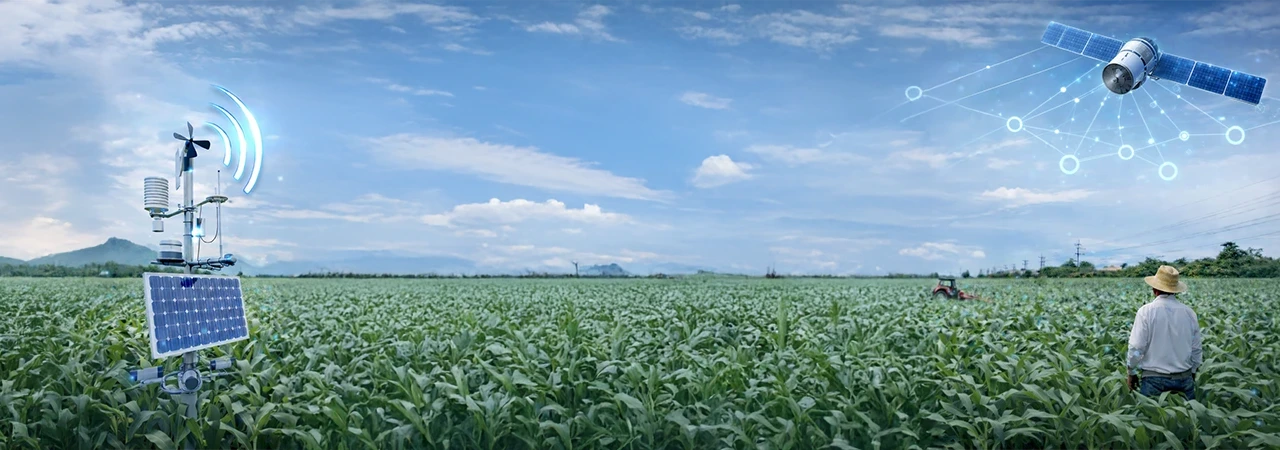
Cropin’s Germination Intelligence Layer closes the visibility gap between sowing and canopy formation. Built on high-frequency satellite data and proprietary deep learning models, it enables enterprises to monitor germination performance during the first 15-20 days of the season.
Crop-Specific Germination Tracking for Maize, Potato, Soybean & More
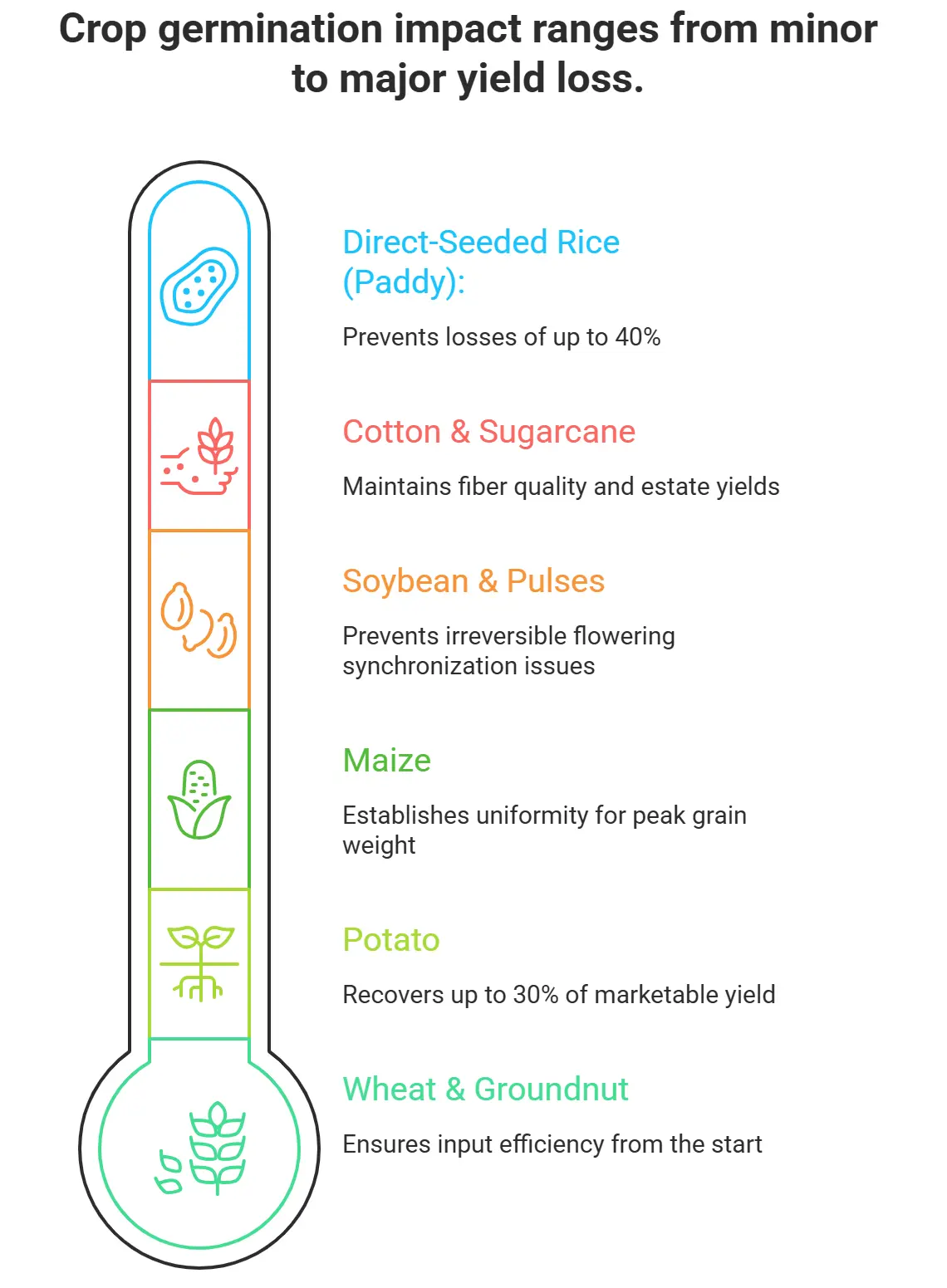
- Potato: Uniform sprouting is the primary driver of tuber size and processing quality. Detecting delays early allows for precision irrigation to recover up to 30% of marketable yield.
- Maize (Corn): Intra-row competition from late emergers causes asynchronous maturity. Our layer ensures hybrid trials and production plots establish with the uniformity required for peak grain weight.
- Soybean & Pulses: These crops are hypersensitive to soil crusting and moisture. Early visibility allows agronomists to intervene before irreversible flowering synchronization issues occur.
- Direct-Seeded Rice (Paddy): Gaps in paddy emergence allow weed flushes to take over within days. Early monitoring enables targeted herbicide control, preventing losses of up to 40%.
- Cotton & Sugarcane: For these long-duration crops, early stand gaps lead to uneven boll maturity or inconsistent stalk density. We guide localized replanting to maintain fiber quality and estate yields.
- Wheat & Groundnut: From tiller development to pegging density, we track the early milestones that define final grain weight and pod fill, ensuring input efficiency from the start.
Seed Variety Performance Tracking with AI-Powered Precision
How It Works - Predictive Prevention
- Good: Healthy, uniform emergence. The crop is on track for projected yield targets.
- Moderate: Slightly uneven germination.Triggers an automated alert for targeted scouting by an agronomist.
- Needs Attention: Weak or failed emergence; immediate action advised - immediate re-sowing while the moisture window remains open.
- Field teams: Agronomists can abandon blanket scouting to prioritize “Red” and “Yellow” plots, increasing field efficiency.
- Procurement and supply-chain: Teams can adjust sourcing forecasts and logistics planning weeks earlier, ensuring Fill Rate Surety.
- Agronomy managers: Seed companies can benchmark seed variety performanceand validate batch-wise vigor across diverse real-world microclimates, ensuring hybrid performance consistency.
- Sustainability: By identifying failed patches early, enterprises prevent the waste of expensive fertilizers and water on non-productive land, saving input resource costs.
ROI Benefits - How Germination Intelligence Improves Crop Yields
- Field teams: Agronomists can abandon blanket scouting to prioritize “Red” and “Yellow” plots, increasing field efficiency.
- Procurement and supply-chain: Teams can adjust sourcing forecasts and logistics planning weeks earlier, ensuring Fill Rate Surety.
- Agronomy managers: Seed companies can benchmark seed variety performance and validate batch-wise vigor across diverse real-world microclimates, ensuring hybrid performance consistency.
- Sustainability: By identifying failed patches early, enterprises prevent the waste of expensive fertilizers and water on non-productive land, saving input resource costs.
Case Studies: Proven Results in Potato, Maize & Soybean Germination
Potato Contracting – North India
Maize Hybrid Trials – Latin America
Soybean Cooperatives – Southeast Asia
Sorghum Resilience Programs – Sub-Saharan Africa
Germination Monitoring Results: Yield Recovery & Cost Savings
| Impact Area | Field-Proven Outcome |
|---|---|
| Yield Recovery | Recover 70–80% of potential yield through early-stage intervention. |
| Operational Efficiency | Reduce scouting and manual verification costs by 20-30% |
| Supply Predictability | Reduce late-season emergency sourcing and shortfalls by 10-15% |
| Resource Optimization | Save upto 25% on inputs by avoiding applications on failed patches. |
| Seed Quality Insight | Enables near-real-time comparison of performance across seed lots and geographies. |
Benefits for Food Processors, Seed Companies & Agricultural Organizations
- CPG and Food Processing Companies : Predict supply availability 2–3 weeks earlier; adjust sourcing or logistics before the harvest curve moves.
- Seed Companies : Validate batch-wise germination across locations, ensuring hybrid performance and seed quality consistency.
- Agri-Input Providers : Quantify the field-level impact of treated vs. untreated seeds or bio-stimulants with measurable, early-stage evidence.
- Farmer Producer Organizations (FPOs) : Empower field agents to detect struggling plots in time to re-sow, improving collective productivity and farmer income.
- Government and Development Agencies : Monitor germination success across districts; target advisories and subsidies where emergence is weakest.
- Banks and Agri-Insurers : Use early germination failure as a predictive indicator of repayment or claim risk, enabling proactive portfolio management.
Satellite-Based Crop Monitoring: The Future of Germination Intelligence
Conclusion
Ready to see your season sooner? to integrate Germination Intelligence into your 2026 procurement strategy.
Author Bio
Swetabh Saurav
Swetabh Saurav is a Product Manager at Cropin, working at the intersection of applied AI, agronomy, and product strategy. His work focuses on shaping agricultural intelligence into practical, usable products by bridging data science with on-ground agronomic realities. With prior experience across e-commerce and publishing, he brings a cross-industry perspective to problem-solving. Swetabh holds an MBA from NMIMS Mumbai and a Computer Science degree from VIT Vellore, and is particularly interested in explainable AI, crop science-led decision-making, and building systems that farmers, field teams, and enterprises can trust.