

Synopsis:
Introduction: Architecting for Simultaneous Shocks
The Outcome-Oriented RFP: Evaluating the Seven Lenses of Supply Assurance
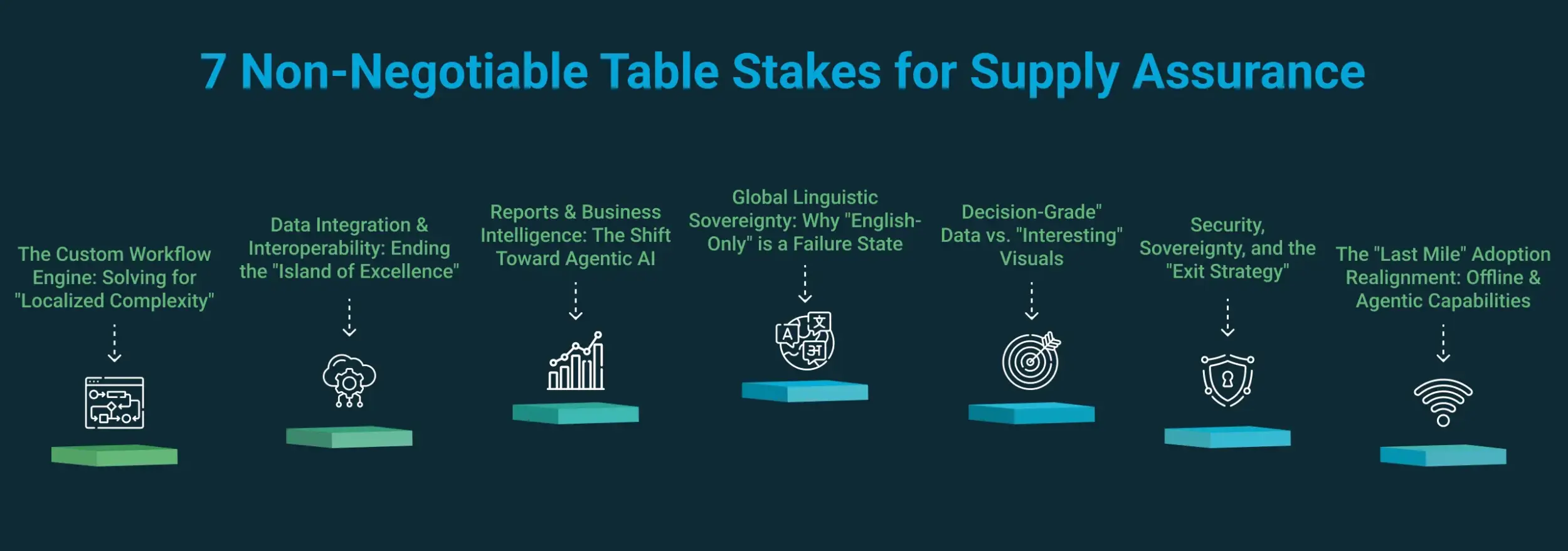
1. The Custom Workflow Engine: Solving for "Localized Complexity"
- The RFP Requirement: Don’t just ask if the platform is “customizable.” Ask: “How does the platform support dynamic, variety and location-specific workflows? Can country-level administrators localize the platform without requiring a code-rewrite?”
2. Data Integration & Interoperability: Ending the "Island of Excellence"
- The RFP Requirement: Prioritize API-First Architecture. A modern platform should not be dealing with manual CSV uploads. Demand that a field-level yield adjustment instantly pushes and pulls data in real-time and triggers a procurement forecast update in your ERP.
3. Reports & Business Intelligence: The Shift Toward Agentic AI
- The RFP Requirement: Evaluate the reporting engine for role-based access and embedded BI. Ask: “Can a procurement head ask the system: ‘Which 5% of my plots are at risk of missing compliance this week?’ and get a data-backed answer instantly?”
4. Global Linguistic Sovereignty: Why "English-Only" is a Failure State
- The RFP Requirement: Multi-language support isn’t a “feature”; it’s a data-integrity requirement. Does the platform support Unicode and local dialects to ensure high adoption among non-tech-native users?
5. "Decision-Grade" Data vs. "Interesting" Visuals
- The RFP Requirement: Demand Actionable Intelligence. Ask: “How does your data change a specific business decision?” If the vendor cannot map their tech to a business result (like a 70% probability of a specific pest infestation in the next 10 days), it is just noise.
6. Security, Sovereignty, and the "Exit Strategy"
- The RFP Requirement: Demand Contractual Data Sovereignty. You must own the raw data and the refined insights used to train the models. Furthermore, ensure a clear Exit Strategy. If the tenure ends, your data should be returned in a structured, usable format, not a disorganized mountain of files.
7. The "Last Mile" Adoption Realignment: Offline & Agentic Capabilities
- The RFP Requirement: Evaluate the Offline Functionality. Does the solution ensure data captured in remote areas is stored and automatically synced once a connection is found? Is it moving toward natural language queries to support non-tech-native field staff?
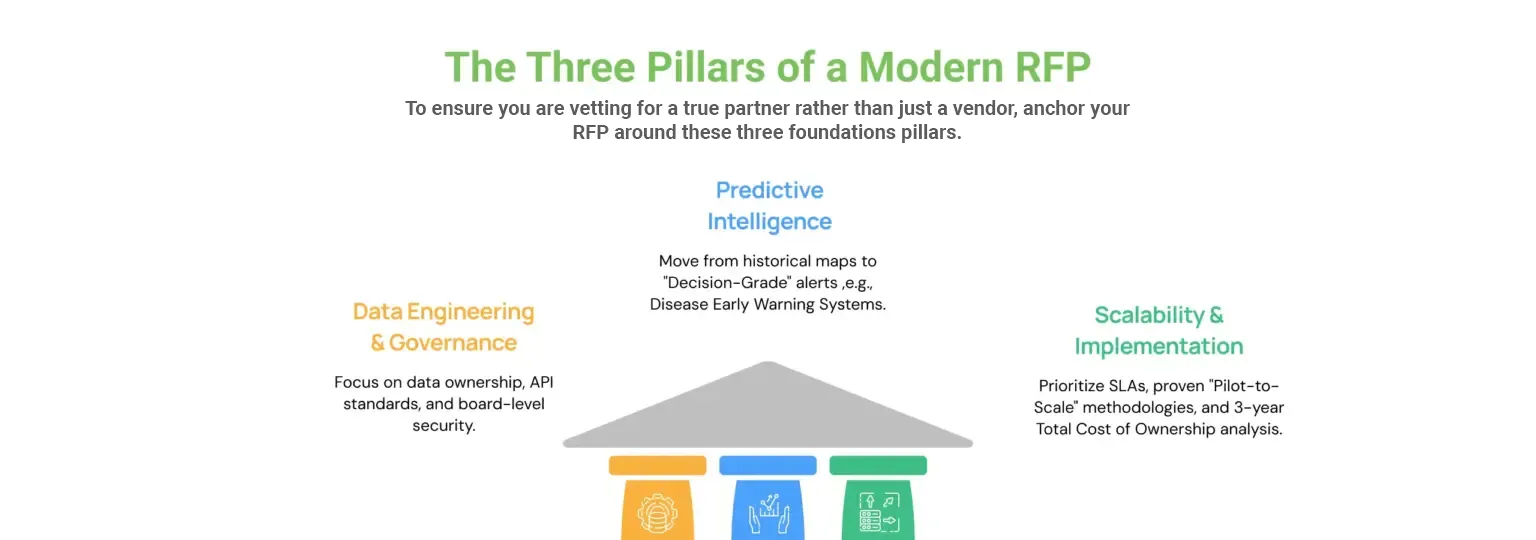
The Three Pillars of a Modern RFP
3. Scalability & Implementation: Prioritize SLAs, proven “Pilot-to-Scale” methodologies, and 3-year TCO analysis.
The "Killer Questions" Cheat Sheet
- The “Exit Strategy”: “If our tenure ends, what is the retrieval process for our data? Is it delivered in a structured, usable format, or a disorganized dump?”
- Ownership: “Do we own the refined insights provided by the models trained specifically on our proprietary data?”
- The Integration Tax: “Which specific ERPs (SAP, Oracle, etc.) and CRMs (Salesforce) have you integrated with natively, and can you demonstrate real-time data sync (not manual CSV uploads)?”
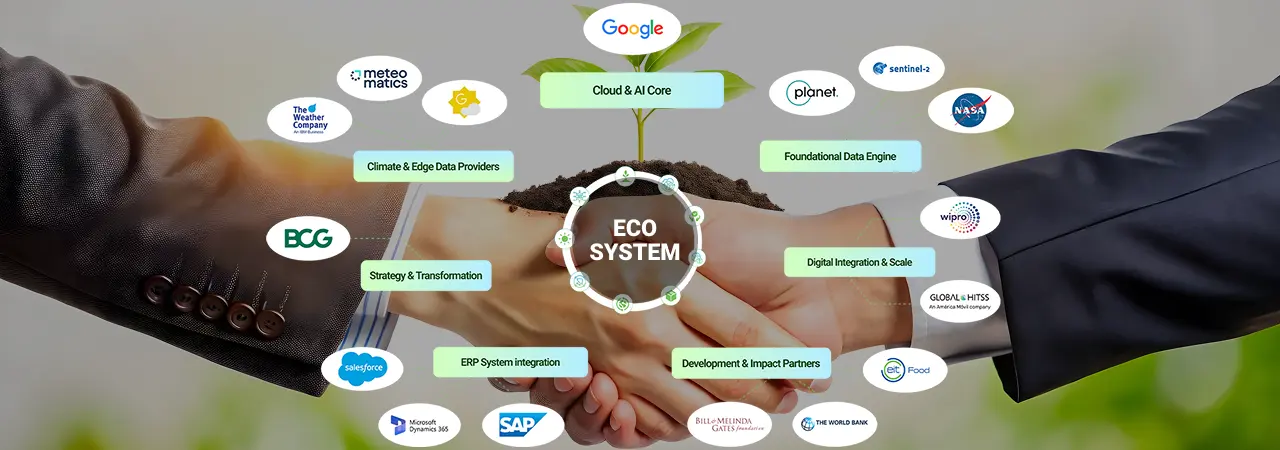
- What are the platforms and data sources you have already integrated in your platform?
- The Last-Mile Reality: “How does the system handle multi-lingual workflows and offline data capture in ‘black zones’ with zero connectivity?”
- Proof of Scale: “Can you demonstrate a successful ‘Pilot-to-Scale’ transition for a footprint involving more than 100,000 hectares?”
Conclusion
Ready to architect your solution?
Author Bio
Krishna Kumar
Krishna Kumar is the Founder and Chief Executive Officer of Cropin, the world's most advanced AI platform for Food and Agriculture. He established Cropin in 2010 and pioneered the use of digital technologies and predictive intelligence. Cropin is transforming humankind’s oldest industry – agriculture into a modern, digitally connected sector. Today, Cropin has digitized over 30 million acres and empowered nearly 7 million farmers across 103 countries. Under his leadership, Cropin has introduced cutting-edge innovations, including Cropin Cloud and the industry's first real-time Gen AI platform, Cropin Sage, with the goal of building intelligence around every acre of cultivable land. Passionate about transforming global food systems through tech and data, he has also been recognized as a UBS Global Visionary, World Economic Forum Steering Committee Member, Top 10 Emerging Technologies of 2025, and serves as a non-official member of the National Startup Advisory Council.