
Synopsis:
The Intelligence Dilemma in Large-Scale Agriculture
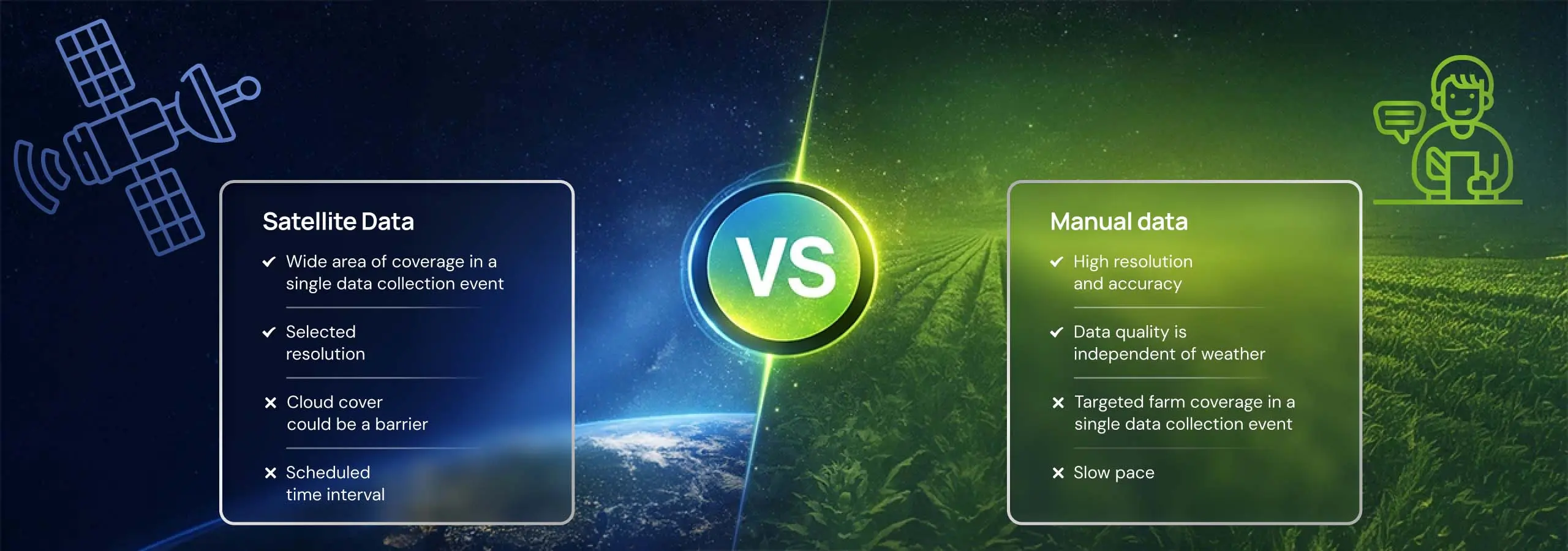
What Satellite Intelligence Does Well
Wide-Area Crop Health Monitoring
Satellites allow you to monitor thousands of acres simultaneously. By using vegetation indices like NDVI or NDRE, enterprises can visualize which regions are thriving and which are lagging. This knowledge can be further augmented by sending field scouts to assess and work on corrective measures. Farmers can determine the need and quantity of fertilization.
Yield Prediction and Trend Tracking
Water and Stress Monitoring at Scale
Pest, Disease & Risk Pattern Detection
What Ground Intelligence Does Well
Hyper-Local Soil and Sub-Surface Insight
Real-Time Micro-Climate Accuracy
Physical Validation and Diagnostic Detail
Zero Latency and All-Weather Reliability
Limitations: Where Ground Intelligence Falls Short
Sparse Sensor Coverage Across Vast Acreage
Maintenance, Deployment, and Cost Burden
Human Scouting Doesn’t Scale
Fragmented, Isolated Ground Data
Point Data Without Spatial Continuity
Limitations: Where Satellite Intelligence Reaches Its Limits
A Case Point: "Zone Sampling" – Where Scale Meets Science
- Satellite Intelligence first maps the field’s heterogeneity, identifying distinct zones of high, medium, and low performance.
- Smart Sampling algorithms then calculate exactly where scouts should go to get a statistically representative sample of the entire field.
- Ground Intelligence (the physical sample) is then collected at these high-priority coordinates.
The Shift Towards an Integrated Approach in Agriculture
Satellite Intelligence for Surveillance and Early Signals
Ground Insights for Validation and Root-Cause Analysis
AI as the Orchestrator of Multi-Source Farm Intelligence
Conclusion
Frequently asked questions (FAQs)
Why do intelligence failures increase as farm operations scale?
What types of agronomic decisions are most impacted by intelligence gaps?
Why does satellite intelligence perform better at regional monitoring than field-level execution?
What are the hidden costs of relying heavily on ground-level intelligence?
How do intelligence blind spots affect multi-region or multi-crop enterprises?
What does “decision-ready intelligence” mean in enterprise agriculture?
How does integrating satellite and ground intelligence reduce enterprise risk?
What role does AI play beyond prediction in agricultural intelligence systems?
How does Cropin support intelligence consistency across regions and seasons?
Author Bio
Haripriya Muralidharan
Haripriya Muralidharan leads content marketing at Cropin Technology Solutions, bringing a unique scientific rigor to brand storytelling. With a Master's in Chemistry from Pune University and research experience in cancer immunology, she discovered her passion in storytelling. For two decades, she has operated at the intersection of content, communication, and brand strategy, specializing in turning complex ideas into impactful narratives. Prior to Cropin, Haripriya leveraged her creative skills at Elsevier’s Chemical Business News Base and shaped multi-format content strategies for B2B marketing at Scatter.