
Synopsis:
This blog underlines a critical paradox: while the seed industry is poised for massive growth, it faces an existential threat from climate volatility, vanishing arable land, and water scarcity. It highlights that digitization and AI-driven intelligence are no longer optional. By leveraging tools like Cropin Cloud, enterprises can accelerate varietal development and secure supply chain resilience, transforming agricultural data into a strategic shield against environmental uncertainty.
The world’s food system is a $5 trillion giant, responsible for 10% of global consumer spending and providing a livelihood for nearly 40% of the world’s workforce. At the literal root of this massive economic engine is the SEED. It is the starting point for a complex journey that nourishes humanity. The world faces a seemingly paradoxical situation: a growing population demanding ever-increasing food production with dwindling resources. Today, the seed industry finds itself at a historic crossroads: it is poised for unprecedented growth, yet it is simultaneously under siege by a rapidly changing environment.
The Seed Industry Paradox: Growth vs. Scarcity
Growth
On paper, the seed industry has never looked more robust. However, a secondary set of data discloses a tough reality to feed a growing population with retreating fundamental resources.
According to MordorIntelligence, the global seed market is on track to surpass $100 billion by 2030. This growth is fuelled by a desperate, rising demand; McKinsey reports that by 2050, the consolidated demand for crops will skyrocket by 100%.
Scarcity
- Arable Land is Vanishing: We are losing fertile land at a rate of over 20%.
- The Looming Water Gap: By 2030, a staggering 40% of global water demand is projected to go unmet, creating a “water-food nexus” that threatens traditional cultivation regions.
- The Productivity Pressure: Humanity must produce more food in the next 50 years than it has in the last 10,000, and we must do it with less land and less water than ever before.
Climate Change Tops the List of Challenges Encountered by the Seed Industry
For seed industry leaders, the challenge isn’t just about long-term demand; it’s about the “here and now” of production volatility. The world has recently witnessed 12 of the hottest months on record, on the trot, severe weather events disrupt consistent seed production, impacting crop yields and driving up production costs year after year.
This climate instability isn’t just an environmental concern; it’s a massive business risk. Unpredictable weather events disrupt seed multiplication, impact genetic purity, and drive-up production costs year after year. As a result, the “Time-to-Market” for new, crucial resilient seed varieties has become the most critical KPI in the industry.
Unfortunately, Climate Change is the top challenge, but not the sole threat! It is further compounded by issues like, Commercialization of fake hybrid seeds and counterfeit seeds, manual monitoring, absence of visibility in adherence to package of practices, forecasting supply demand gaps, data silos, lack of standardization, need for predicable sourcing intelligence, compliance and more.
How can we address all these?
Well, Innovation is the Answer: Seeding a Sustainable Future
As a seed industry leader, you know this struggle intimately. It’s a relentless battle for efficiency, speed, and sustainability you face every single day.
The Innovation Mandate: Digitization as a Lever
The seed industry, concentrated in developed economies, is now at the forefront of rapid innovation. Reducing time-to-market for new, resilient seed varieties is critical. How are leading seed companies navigating this paradox? The answer lies in rapid, tech-driven innovation.
A study by Curious Insights commissioned by Cropin on the adoption of technology within the seed industry highlights the transformative benefits that digitization is already delivering to seed businesses:
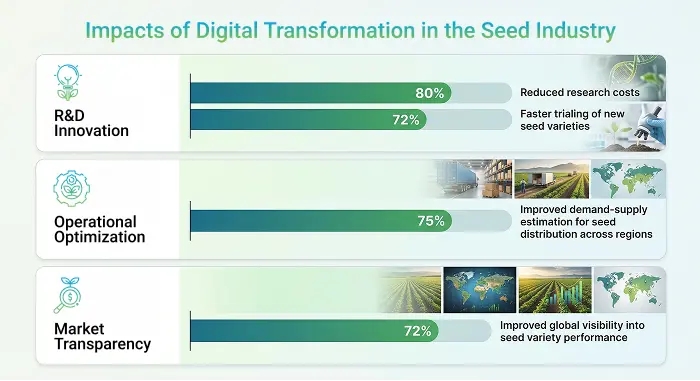
These clearly depict seed producers’ rapid pace of innovation, deploying cutting-edge technology and the brightest talent. Even minor inefficiencies in seed production can have a cascading impact on quality, yield, farmer success, the entire seed ecosystem, and ultimately, the top and bottom lines of businesses. By deploying technology, seed companies can ensure consistent quality, optimize resource allocation, and empower farmers to develop resilience to climate change and cultivate a more abundant future.
Elevating the Ambition
The journey of a seed, from conception to a farmer’s field, is a complex one. The most successful seed companies today are not merely reacting to climate change; they are leaping ahead of it. They are transforming their operations from germplasm research to the moment a seed reaches a farmer’s hand. These leaders are prioritizing predictability and excellence in this transformational journey and are unlocking innovation potential to meet the ever-increasing demand for high-quality seeds.
For seed industry digitization is not an optional, the new reality is intelligence.
Top Strategic Priorities for Modern Seed Enterprises Based On Industry Shifts
- Accelerating Varietal Development: Shortening the breeding cycle to bring climate-resilient and high-yielding varieties to market faster.
- Ensuring Quality & Traceability: Maintaining a transparent, “seed-to-shelf” record to guarantee genetic purity and compliance globally.
- Optimizing Production Risk: Mitigating climate volatility and pests & disease risks to ensure consistent supply for the upcoming season.
- Inaccuracies in Yield Prediction: Improve accuracy of yield estimation to optimize buffer and curtail wastes.
- Controlling Counterfeit: Maintaining digital footprint of seeds to control counterfeit.
- Market-Linked Demand Forecasting: Aligning inventory and breeding programs with real-world shifting demand patterns driven by climate change.
- Regulatory Compliance: Compliance in seed production is a huge challenge as it varies from nation to nation.
Cropin as the Enabler: Transforming Data into Seed Intelligence
Let’s now explore how Cropin the “Harvest Guardians” empowers seed producers to safeguard global yields.
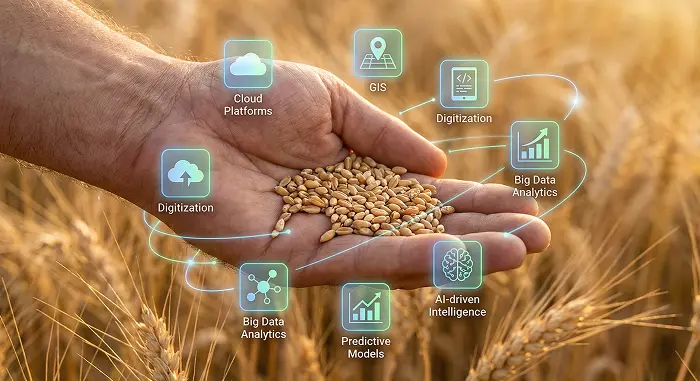
Cropin delivers a specialized suite of AI and Machine Learning (ML) tools designed to optimize seed production and ensure complete transparency across seed value chain. By integrating satellite and ground intelligence Cropin enables:
Standardization of Global Operations
Running seed companies means managing multi-country operations from headquarters. Cropin provides a unified digital layer that standardizes data collection and reporting across diverse geographies, ensuring that a trial in Brazil is evaluated using the same rigorous metrics as a plot in India. Cropin allows standardization while maintaining regional nuances for a clear single dashboard view to make informed decisions. The unified dashboard view provides complete granular visibility across every aspect, providing insights on harvest dates, quantity and quality of produce in each region.
AI-Powered Crop Variety Evaluation
Our platform uses artificial intelligence to monitor crop health in real-time, providing deep insights for variety development. This allows breeders to identify superior traits and environmental tolerances with scientific precision. This intelligence also helps identify best seed varieties for specific geographies and climate.
Accelerating Varietal Development
By shortening the breeding cycle Cropin Cloud platform helps bring climate-resilient and high-yielding varieties to market faster. We streamline field research by digitizing field data enabling you to identify high-performing varieties faster with advanced analytics for simplified health analysis and improved yield estimates. This translates to faster time to market, getting the best seeds to commercialization quicker.
Remote Crop Monitoring
Cropin provides 360-degree remote monitoring of farms reducing the need for constant physical travel while maintaining high-fidelity monitoring of hybrid performance. The platform provides package of practice alerts and digitally captures field activities to ensure transparency. Our models combine vegetation indices data from remote sensing satellites with a range of weather data sources for continuous crop monitoring.
AI-powered Crop Health Analysis
Cropin’s trained and tested cutting-edge Artificial Intelligence and Machine Learning models derives intelligence like crop growth progression, crop health, water stress, yield estimation, amongst other parameters. Using artificial intelligence to monitor and analyse crop health in real-time, we provide insights for seed variety evaluation, development and production.
Predictive Analytics for Yield & Inventory
Cropin’s yield estimation model, is backed by science. It leverages advanced vegetation indices to ensure a truly representative sampling that enhances the accuracy of yield estimation by ~ 30-40%. Our models offer up to 45-days advanced yield estimation with increased accuracies. This intelligence helps seed companies optimize their distribution and avoid the costs of overstocking or stock-outs. Cropin Intelligence offers 22+ deep-learning models, driving predictive insights and AI-led agri transformation.
Disease Early Warning Systems (DEWS)
Cropin’s Disease Early Warning System (DEWS) a probabilistic model provides disease alerts well in advance using historical disease occurrence data, real-time and forecasted weather and Cropin’s Crop Knowledge Grid. Cropin DEWS can predict the potential outbreak of over 65 diseases across 20 different crops and their varieties. It allows you to raise alert once the probability reaches a threshold empowering you to take proactive measures and safeguard your yield.
AI-Driven Precision Farming for Growers
Our models assess shifting conditions across the season to derive insights for optimizing inputs like irrigation and fertilizer. These “precision advisories” are shared directly with farmers, ensuring the seed’s genetic potential is fully realized on the field.
Regional Intelligence for Evolving Markets
Cropin helps you to identify suitable current and future regions that has potential to cultivate better-quality seeds. Armed with this intelligence you can take diversification decisions before investing a single dollar to derisk seed production. By integrating historical sales data, yield forecasts, and geopolitical indicators, our ML models help seed companies forecast demand. This ensures that breeding and inventory planning are aligned with the actual needs of evolving markets.
Operational Excellence
From regional intelligence to plot-level monitoring, Cropin empowers organizations to transition from reactive management to proactive, data-driven excellence. For seeds compliance is key. Cropin empowers you to monitor farm activities for adherence to best practices, providing evidence of compliance. You can maintain end-to-end traceability for buyers to verify seed origin and certification. The platform also enables you to plug seed loss during production and distribution.
Cropin Sage
Powered by Google Gemini, the gen-AI platform helps you decode past, present and future and simplify decision making.
Conclusion
In conclusion for seed companies, the integration of satellite and ground data to derive data-driven insights isn’t just a technical upgrade, it’s a competitive necessity. By leveraging Cropin’s AI-first approach, seed innovators can move from “guessing” the future to “seeding” it with confidence. Cropin the world’s largest deployed AI platform for food and agriculture processes agricultural data across the seed value chain, from initial research and development through to final distribution.
Author Bio

Haripriya Muralidharan
Haripriya Muralidharan leads content marketing at Cropin Technology Solutions, bringing a unique scientific rigor to brand storytelling. With a Master's in Chemistry from Pune University and research experience in cancer immunology, she discovered her passion in storytelling. For two decades, she has operated at the intersection of content, communication, and brand strategy, specializing in turning complex ideas into impactful narratives. Prior to Cropin, Haripriya leveraged her creative skills at Elsevier’s Chemical Business News Base and shaped multi-format content strategies for B2B marketing at Scatter.