
Beyond the Pilot: Why Your Agri-Food RFP Needs an AI-First Data Strategy

Table of contents

Synopsis:

For agri-food enterprises, the digital transformation of the “last mile” requires technology that delivers more than just data; it must deliver decision-grade outcomes. Drawing from Cropin’s experience in pioneering the world’s largest deployed AI-platform for food and agriculture, this blog outlines the non-negotiable “table stakes” that procurement teams must evaluate to build resilient, predictable, and auditable supply chains.

Introduction: Architecting for Simultaneous Shocks

The new structural reality of the modern food-system risk is characterized by simultaneous shocks leading to systemic failures. In the boardroom, this has triggered a definitive shift. We are moving past the era of simple field-level “visibility” and entering the era of Supply Assurance, for auditable, predictable, and resilient supply chains.
Today’s leaders are no longer looking for “interesting” digital pilots; they are looking to hard-code resilience into their balance sheets. This maturity is reflected in the evolution of the RFP (Request for Proposal). We are seeing a move away from isolated inquiries about “yield maps” toward comprehensive strategies for digital transformation.
To architect a resilient future, enterprises must solve for three things in order: the Data Strategy first, the Platform Strategy second, and the AI Strategy as the ultimate intelligence layer. Drawing from Cropin’s experience across hundreds of global implementations, I want to share the structural “table stakes” your procurement teams should consider to ensure your technology investment translates into a permanent competitive advantage.

The Outcome-Oriented RFP: Evaluating the Seven Lenses of Supply Assurance
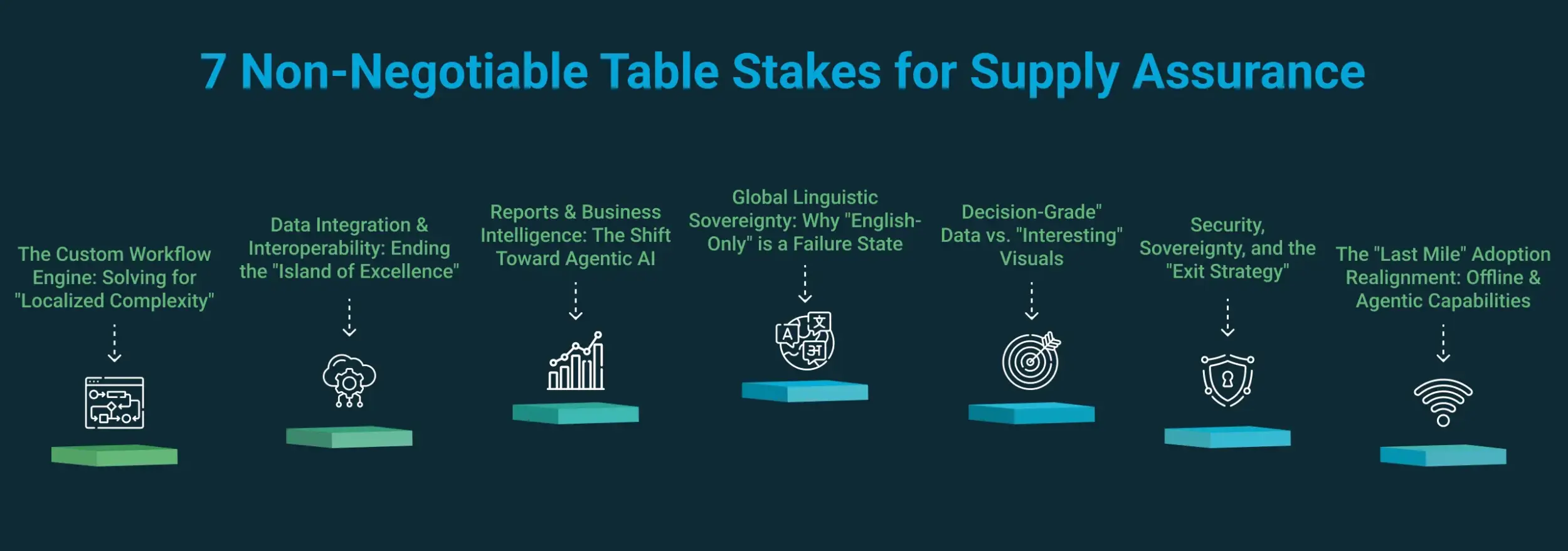
In an era of perpetual disruption, procurement teams must undergo a fundamental shift in mindset: move away from purchasing “software features” and begin investing in Supply Assurance. This requires looking past the user interface to evaluate a technology partner through a structural lens. Based on our global deployment experience, there are seven critical areas where your RFP must demand rigor to ensure your digital transformation translates into long-term ROI and operational resilience.

1. The Custom Workflow Engine: Solving for "Localized Complexity"

In my time leading Cropin, we have built thousands of custom workflows. This isn’t just a technical feat; it is a necessity of the trade. In agriculture, every geography has its own “agronomic heartbeat”, its own growing programs, which differ even from those of its neighbours.
For a global food processor sourcing potatoes, the growing program in Idaho is highly mechanized and weather-dependent. Just across the border or in South Asia, that same variety might face entirely different irrigation schedules, pest threats, and labor practices.
The CEO’s Perspective : If a system cannot adapt to these local nuances, field agents will simply stop using it. You need a platform that allows for localized flexibility while maintaining standardized data for a unified global view.
  • The RFP Requirement: Don’t just ask if the platform is “customizable.” Ask: “How does the platform support dynamic, variety and location-specific workflows? Can country-level administrators localize the platform without requiring a code-rewrite?”

2. Data Integration & Interoperability: Ending the "Island of Excellence"

Most enterprises already operate within massive legacy ecosystems like SAP, Salesforce, Microsoft Dynamics, or custom IoT stacks. If your new platform cannot “talk” to this existing infrastructure, you aren’t building a solution; you are building an “Island of Excellence” that stays isolated from your business logic.
The CEO’s Perspective: A modern platform must serve as the central nervous system for all agri-data. Effective integration can reduce internal data engineering efforts by up to 80%. At Cropin, we have integrated multiple platforms, including SAP, IBM, Salesforce, Microsoft Dynamics, Homologous, IoTs, Drones, and more, as well as legacy enterprise systems, into our ecosystem.
  • The RFP Requirement: Prioritize API-First Architecture. A modern platform should not be dealing with manual CSV uploads. Demand that a field-level yield adjustment instantly pushes and pulls data in real-time and triggers a procurement forecast update in your ERP.

3. Reports & Business Intelligence: The Shift Toward Agentic AI

Once data is integrated, the challenge shifts from collection to comprehension. Rigid, static dashboards are a liability in a dynamic market. Every enterprise has a unique information hierarchy, where a field officer and a C-suite executive need vastly different levels of aggregation to act.
The CEO’s Perspective: We are moving toward Agentic AI, where the system doesn’t just show a graph, but answers a query.
  • The RFP Requirement: Evaluate the reporting engine for role-based access and embedded BI. Ask: “Can a procurement head ask the system: ‘Which 5% of my plots are at risk of missing compliance this week?’ and get a data-backed answer instantly?”

4. Global Linguistic Sovereignty: Why "English-Only" is a Failure State

Adoption is the only metric that matters. A “usability gap” often emerges when global platforms prioritize scale over localized utility. True digital transformation fails when we overlook the unique operational realities of a region at the design stage. In our experience, data fidelity is directly tied to language.
The CEO’s Perspective: While English is a global business language, it is the native tongue of less than 10% of smartphone users. If a field officer is forced to use a language they aren’t comfortable with, the data they enter becomes a “best guess” rather than “ground truth”.
  • The RFP Requirement: Multi-language support isn’t a “feature”; it’s a data-integrity requirement. Does the platform support Unicode and local dialects to ensure high adoption among non-tech-native users?

5. "Decision-Grade" Data vs. "Interesting" Visuals

There is a massive gap between a satellite map that looks “interesting” and data that is Decision-Grade. I have met teams with 50 different dashboards showing “greenness” across their supply chain. When I asked which one helped them decide to move $5M in procurement funds to a different region, the answer was “none.”
The CEO’s Perspective: Avoid investing in visuals that people admire but never use to change a business outcome. At Cropin, in addition to standard reports, we provide hundreds of custom reports. Our hierarchical reporting engine with embedded, customizable BI (powered by Sisense) dashboards ensures visualizations deliver clear, near-real-time insights aligned with specific business logic.
  • The RFP Requirement: Demand Actionable Intelligence. Ask: “How does your data change a specific business decision?” If the vendor cannot map their tech to a business result (like a 70% probability of a specific pest infestation in the next 10 days), it is just noise.

6. Security, Sovereignty, and the "Exit Strategy"

In the age of AI, your data is your competitive moat. We have seen enterprises realize too late that their proprietary data was being used to train a vendor’s global models, effectively subsidizing their competitors’ intelligence.
The CEO’s Perspective: Data ownership is no longer a legal footnote; it is a defensive strategy.
  • The RFP Requirement: Demand Contractual Data Sovereignty. You must own the raw data and the refined insights used to train the models. Furthermore, ensure a clear Exit Strategy. If the tenure ends, your data should be returned in a structured, usable format, not a disorganized mountain of files.

7. The "Last Mile" Adoption Realignment: Offline & Agentic Capabilities

Agriculture is perhaps the only industry where the most critical data entry happens in remote fields with zero connectivity. A “cloud-only” strategy is a recipe for data loss in rural “black zones.”
The CEO’s Perspective: To plug the leaks in your data lake, the platform must be designed for the reality of the field: intuitive, offline-capable, and user-friendly
  • The RFP Requirement: Evaluate the Offline Functionality. Does the solution ensure data captured in remote areas is stored and automatically synced once a connection is found? Is it moving toward natural language queries to support non-tech-native field staff?

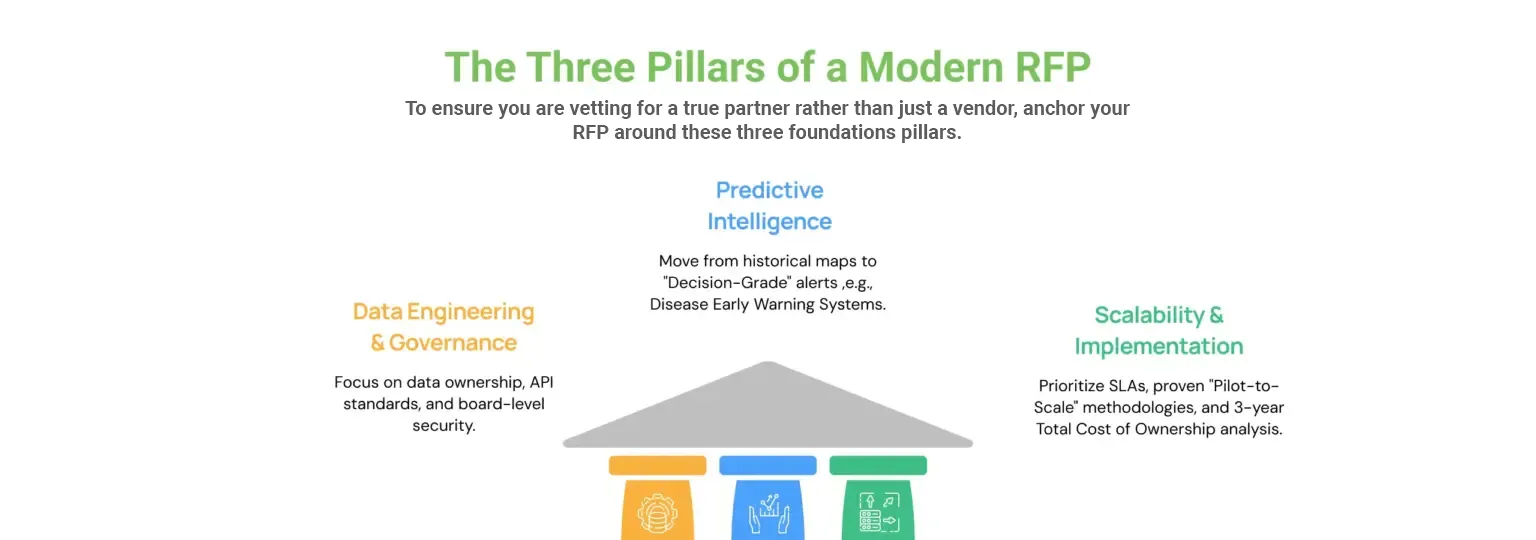
The Three Pillars of a Modern RFP

To ensure you are vetting for a true partner rather than just a vendor, anchor your RFP around these three foundational pillars:
1. Data Engineering & Governance: Focus on data ownership, API standards, and board-level security.
2. Predictive Intelligence: Move from historical maps to “Decision-Grade” alerts (e.g., Disease Early Warning Systems).

3. Scalability & Implementation: Prioritize SLAs, proven “Pilot-to-Scale” methodologies, and 3-year TCO analysis.
The "Killer Questions" Cheat Sheet

If a potential partner cannot answer these questions with technical specificity, they likely lack the enterprise-grade maturity required for a global rollout.
On Sovereignty & Security:
  • The “Exit Strategy”: “If our tenure ends, what is the retrieval process for our data? Is it delivered in a structured, usable format, or a disorganized dump?”
  • Ownership: “Do we own the refined insights provided by the models trained specifically on our proprietary data?”
On Interoperability:
  • The Integration Tax: “Which specific ERPs (SAP, Oracle, etc.) and CRMs (Salesforce) have you integrated with natively, and can you demonstrate real-time data sync (not manual CSV uploads)?”
  • What are the platforms and data sources you have already integrated in your platform?
On Adoption & Scale:
  • The Last-Mile Reality: “How does the system handle multi-lingual workflows and offline data capture in ‘black zones’ with zero connectivity?”
  • Proof of Scale: “Can you demonstrate a successful ‘Pilot-to-Scale’ transition for a footprint involving more than 100,000 hectares?”

Conclusion

Procurement is your first line of defense against supply chain chaos. Today, climate shocks and geopolitical shifts are the new normal, and your technology choice has moved from an IT decision to a core business strategy.
By shifting your RFP from a “feature hunt” to an Architectural Blueprint, you ensure your technology investment creates a permanent competitive advantage. We’ve moved beyond the pilot phase. It’s time to architect for resilience, predictability, and a future where your supply chain is as intelligent as your boardroom.

Ready to architect your solution?

Visit Cropin RFP to qualify your project scope or engage with our Solutions Architects for a technically aligned proposal that meets the demands of the modern food system.

Author Bio

Krishna Kumar

Krishna Kumar is the Founder and Chief Executive Officer of Cropin, the world's most advanced AI platform for Food and Agriculture. He established Cropin in 2010 and pioneered the use of digital technologies and predictive intelligence. Cropin is transforming humankind’s oldest industry – agriculture into a modern, digitally connected sector. Today, Cropin has digitized over 30 million acres and empowered nearly 7 million farmers across 103 countries. Under his leadership, Cropin has introduced cutting-edge innovations, including Cropin Cloud and the industry's first real-time Gen AI platform, Cropin Sage, with the goal of building intelligence around every acre of cultivable land. Passionate about transforming global food systems through tech and data, he has also been recognized as a UBS Global Visionary, World Economic Forum Steering Committee Member, Top 10 Emerging Technologies of 2025, and serves as a non-official member of the National Startup Advisory Council.


Similar blogs

Scroll to Top
?
?
?