
Crop intelligence
Coffee origins under climate pressure.
Heat, erratic rain and blister blight threaten coffee yield and quality. Cropin tracks crop condition, disease risk and traceability on nearly 800,000 digitized acres, from Ethiopia to Brazil.
What Cropin tracks
Quality, traceability and deforestation-free sourcing.
Connect plot observations, Earth observation, weather and crop-specific models to production, sourcing and risk workflows.
Coffee needs mild heat, high rainfall, volcanic soil and shade.
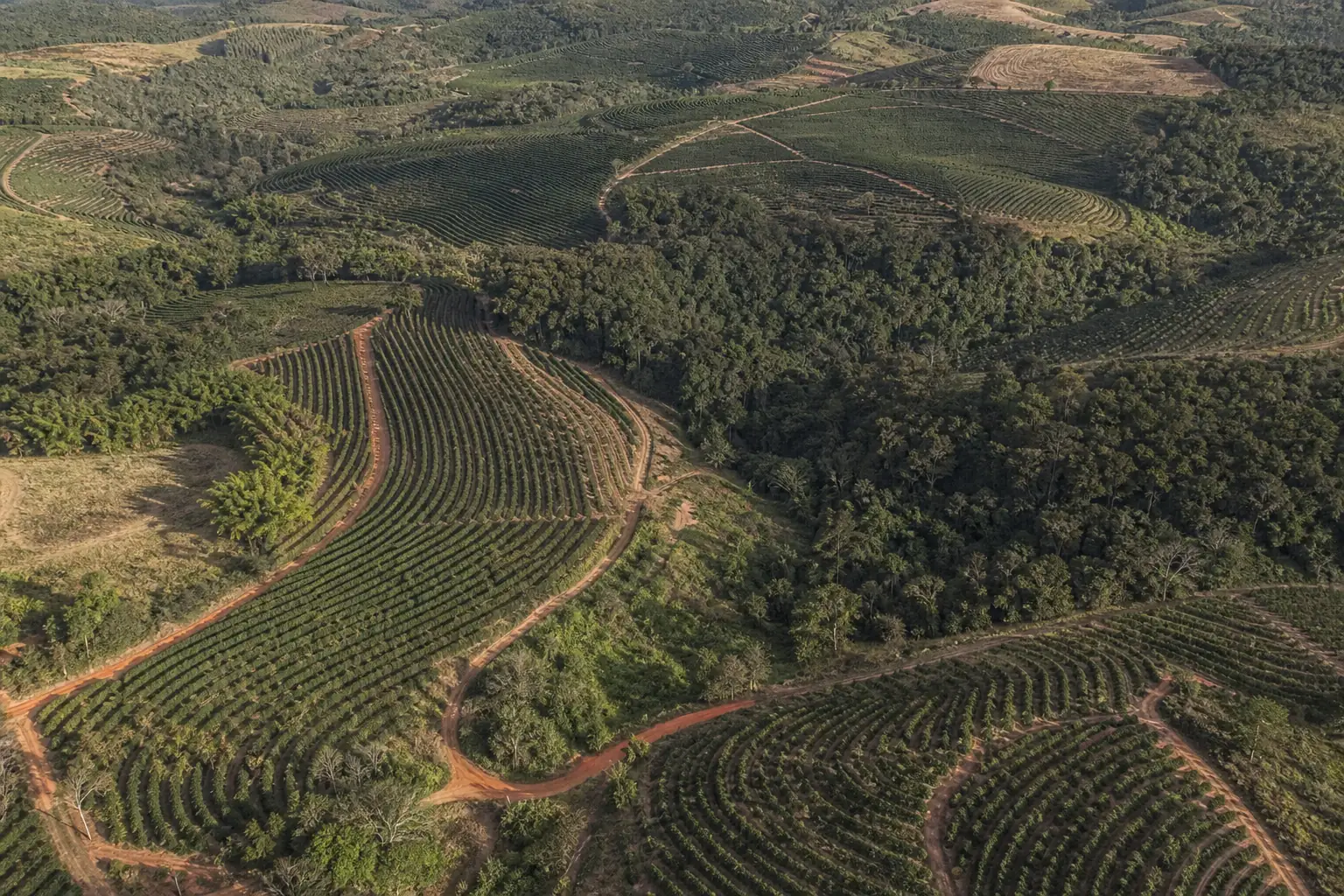
Coffee plants thrive in the “Coffee Belt,” located between the Tropics of Cancer and Capricorn. They require specific conditions, including mild temperatures, high rainfall, rich volcanic soil, and shade. This makes it extremely susceptible to climate change, making the journey from cherry to bean complex. Each step significantly influences the final flavor profile.
The global coffee market is valued in the hundreds of billions of dollars, is one of the world’s most valuable and traded agricultural commodities. The coffee industry provides livelihoods for an estimated 25 million small-scale farmers and millions more in related sectors, from processing and exporting to retail. It is a vital engine for economic development in many producing countries.
Coffee crop stages, in order
- 1Pruning and renewalCanopy · vigor · structure
- 2Vegetative growthShade · nutrition · water
- 3Bud initiationRain trigger · uniformity
- 4FloweringWeather · pollination · timing
- 5Cherry setRetention · crop load
- 6Cherry developmentSize · water · health
- 7RipeningColor · sugar · uniformity
- 8Harvest readinessSelective pick · quality
By 2050, much less land may be suitable for coffee.
Coffee is extremely sensitive to climate change. Rising temperatures, erratic rainfall, and more frequent droughts and frosts threaten growing regions. It’s projected that by 2050, the amount of suitable land for coffee cultivation could be drastically reduced. The coffee plant is vulnerable to several devastating pests and diseases. Coffee farmers are highly susceptible to global price fluctuations.
- How programmes use Cropin on coffee
- Monitor field activities for intensive quality control
- Ensure traceability of origin
- Enable compliance and deforestation free sourcing
- Support procurement planning and productivity
- Crop models in use
- Crop yield, Irrigation advisories
- On disease and pest early warning
- Blister blight
Sucafina digitized 300,000 coffee farmers on Cropin.
- 85+ field staff captured data from 30,000+ farmers
- 300,000Farmers digitized
- 332,000+Plots of land monitored
- 93,000+Plots optimized
- 60,000+Hectares of land audited
797,996acres of coffee digitized on Cropin across all programmes
Deployed in 19 countries
Uganda, Rwanda, Burundi, Congo, Ethiopia, Kenya, Nigeria, Tanzania, Togo, China, India, Indonesia, Myanmar, Philippines, Vietnam, Mexico, Panama, Papua New Guinea, Brazil
Further reading
Frequently asked questions
What are Cropin’s coffee solutions, and what challenges do they address?
Cropin provides digital solutions for end-to-end coffee farm management, covering field monitoring, traceability, and advisory services. We help tackle challenges like pest and disease outbreaks, climate variability, quality control, and supply chain inefficiencies, helping farmers and agribusinesses optimize yield and reliability.
How does Cropin help improve sustainability in the coffee value chain?
Cropin enhances sustainability by enabling traceability, supporting deforestation-free sourcing, and providing data-driven insights for resource management. Farmers receive guidance on irrigation, fertilizer use, and crop protection, while businesses ensure compliance with sustainability standards and responsible sourcing practices.
What are the key challenges faced by coffee growers that Cropin aims to solve?
Coffee growers face pests and diseases like blister blight, fluctuating weather, yield unpredictability, and market volatility. Cropin addresses these through real-time alerts, predictive insights, farm digitization, and operational guidance, helping farmers and agribusinesses act quickly and maintain crop quality and profitability.
What digital technologies does Cropin use for coffee farm management?
Cropin uses satellite imagery, IoT sensors, weather forecasting, AI-powered insights, and mobile-based farm management apps. These technologies enable real-time monitoring, predictive disease alerts, yield estimation, and traceability, ensuring efficient operations and data-driven decisions across coffee farms.
How does the platform handle the unique challenges of high-altitude coffee farming?
Coffee is often grown in mountainous regions where traditional satellite signals can be distorted by terrain. Cropin’s advanced geo-spatial models account for elevation and slope, providing accurate weather alerts and crop health monitoring tailored to the specific micro-climates of high-altitude coffee clusters.
What role does AI play in predicting coffee yields and "Surety of Supply"?
Coffee yields are highly sensitive to “biennial bearing” and climate shocks. Cropin’s AI models analyze historical flowering patterns and real-time moisture stress to provide yield estimations months in advance. This allows coffee exporters to manage price volatility and secure procurement contracts with mathematical confidence.
How does Cropin help coffee farmers manage the diseases and pests?
The platform’s Disease Early Warning System (DEWS) tracks the specific heat-unit accumulations that trigger pest breeding cycles. By providing farmers with timely “In-App” advisories, Cropin helps them apply protective measures exactly when they are most effective, reducing berry damage and preserving cup quality.
How does the platform facilitate "Carbon Neutral" coffee initiatives?
By verifying regenerative practices such as shade-grown coffee and optimized nutrient management via satellite, Cropin provides the data foundation needed to quantify carbon sequestration in coffee agroforestry systems. This allows brands to back their “Carbon Neutral” claims with verifiable, field-level evidence.
Other crops on the platform
Coffee runs on the same platform as 400+ other crops: field records, satellite observation, weather and crop models, read together through the Crop Knowledge Grid.