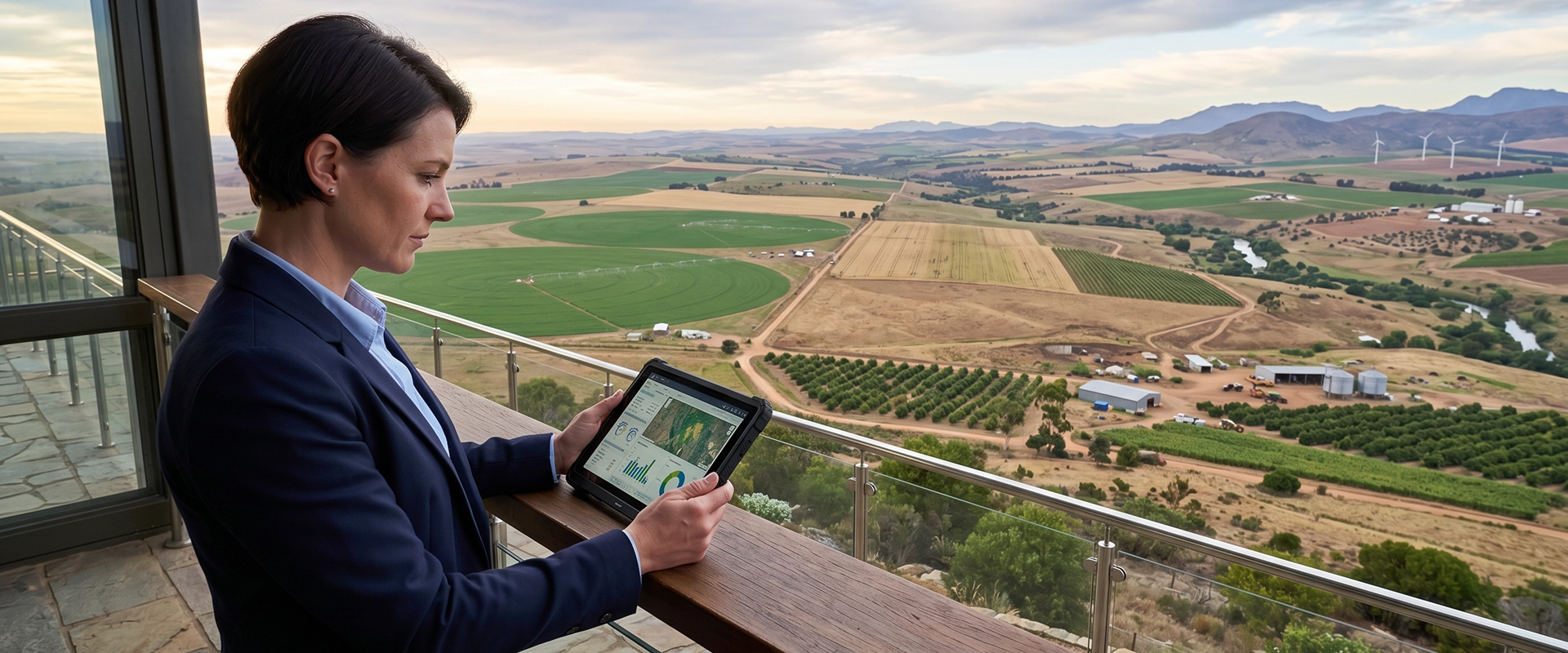
Global agriculture is navigating a period of unprecedented volatility. For large-scale agri-enterprises, the challenge is no longer just about “going digital,” it is about managing the complexity of diverse geographies, fluctuating climates, and the urgent mandate for sustainable sourcing.
Digital farm intelligence platforms today combine diverse datasets, such as satellite imagery, weather data, and field operations, to provide a unified view of farm performance and risks. They are accelerating the adoption of digital agriculture across global value chains.
In a market crowded with about 30,000 agri-tech vendors, the differentiator is no longer “features.” The true measure of a Digital Farm Intelligence Platform is its ability to convert fragmented data into a unified, predictive engine for decision-making that defines true outcomes.
Why Digital Farm Intelligence Platform Evaluation Matters for Global Agri Enterprises
As agriculture becomes increasingly data-driven, global agri enterprises are under pressure to improve productivity, ensure sustainability, and manage risks across geographically distributed operations. Digital farm intelligence platforms have become central to enabling precision agriculture, helping organizations optimize inputs and maximize yields.
For an enterprise operating across continents, fragmented data isn’t just an inconvenience; it’s a risk. Choosing the wrong platform leads to “data silos” where data is captured but never utilized. According to McKinsey, while digital agriculture can increase productivity by up to 25%, the real value lies in predictive certainty. The right platform doesn’t just record what happened; it tells you what will happen next, enabling real-time interventions that protect margins and ensure Surety of Supply.
However, not all platforms deliver the same value, and choosing the wrong solution can result in fragmented data, low user adoption, and limited ROI. On the other hand, the right platform enables real-time decision-making, enhances supply chain visibility, and drives measurable outcomes across the value chain.
Core Capabilities of Enterprise Digital Farm Intelligence Platforms
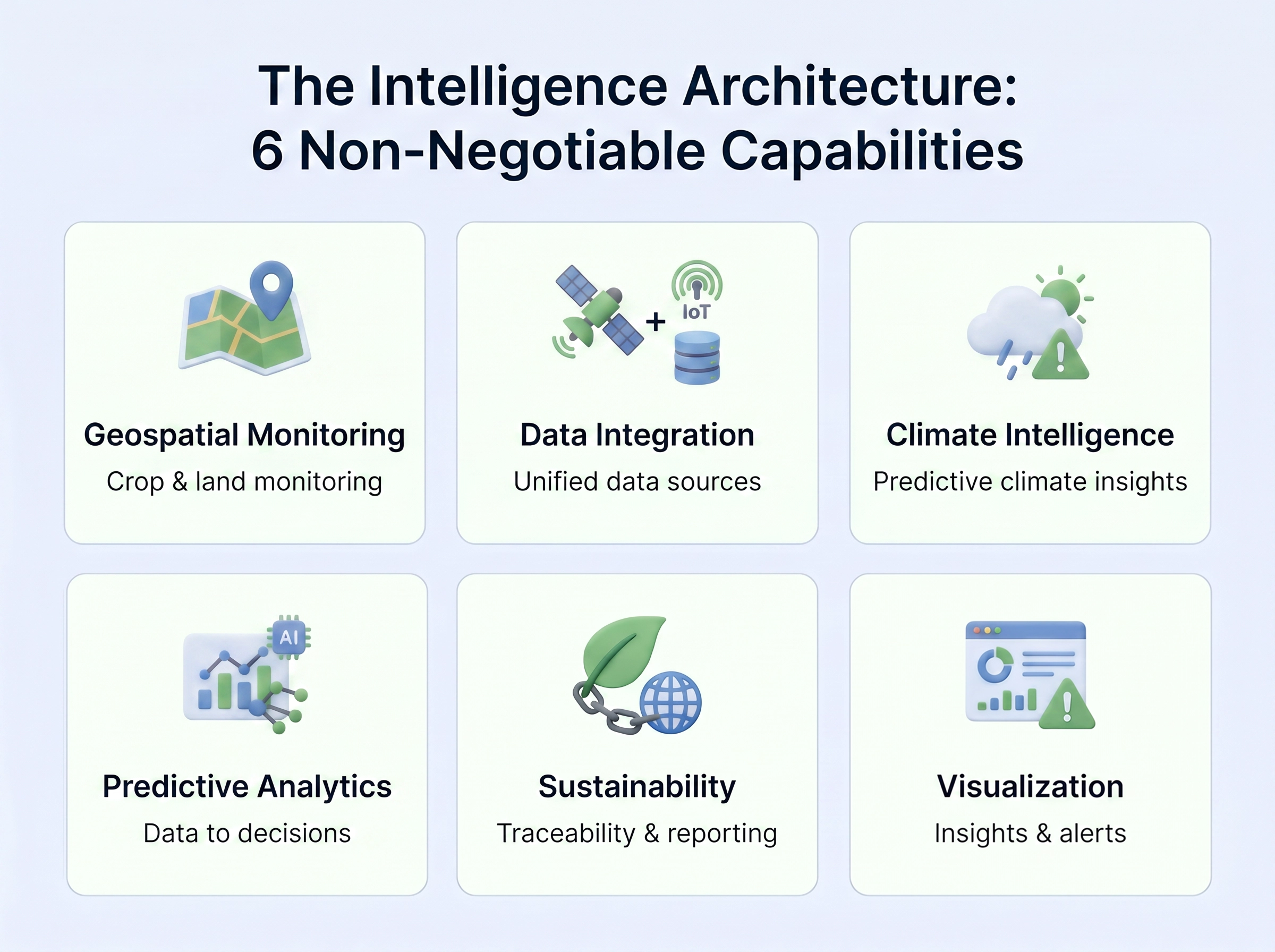
The Intelligence Architecture: 6 Non-Negotiable Capabilities
When assessing the capabilities of enterprise platforms, focus on these six pillars:
1. Geospatial and Crop Monitoring
GIS capabilities should provide real-time visibility into crop health and land use patterns at a global scale, strengthening digital farming initiatives.
2. Multi-Source Data Integration
It must unify disparate datasets like high-resolution satellite imagery, IoT sensors, and legacy ERP systems into a Single Source of Truth. Enterprises need consistent insights across regions and operations, strengthening overall farm management efficiency.
3. Weather and Climate Intelligence
Generic weather feeds aren’t enough. Enterprises require predictive climate models that anticipate regional risks like droughts or pest outbreaks before they impact yield.
4. Predictive Analytics and Decision Support System
Predictive analytics should bridge the gap between raw data and actionable decision support. From yield forecasting to irrigation planning, AI-powered recommendations help enterprises move from reactive to proactive decision-making, forming the backbone of a modern agriculture analytics platform.
5. Sustainability and Traceability Reporting
With shifting global regulatory and consumer pressure, end-to-end traceability and carbon footprint/water usage and sustainability reporting must be “built-in,” not bolted on.
6. Intuitive Visualization and Alerts
Dashboards must be intuitive enough for field teams yet robust enough for executive-level reporting, ensuring smart agriculture practices are scalable.
Digital Farm Intelligence Platforms vs Traditional Farm Management Software
A common mistake is confusing Farm Management Software (FMS) with Farm Intelligence. Traditional FMS is a digital ledger focused on record-keeping and tracking inputs, schedules, and related activities. In contrast, a Digital Farm Intelligence Platform is a predictive engine. It leverages AI, remote sensing, and the “Digital Twin” of the farm to provide
- Near real-time field data
- AI-driven insights
- Remote monitoring via satellite and IoT
- Integration across the entire agri value chain
Unlike standalone agriculture apps, it doesn’t just manage tasks; it optimizes outcomes. These platforms are designed to deliver enterprise-wide intelligence and scalability.
Key Challenges Global Agri Enterprises Face When Selecting Farm Intelligence Platforms
To avoid the trap of “feature-overload,” enterprises should focus their assessment on these critical friction points:
The Integration Test: Can it Talk to Your Legacy?
Data integration is the foundation. Evaluate the platform’s API flexibility and its ability to ingest both structured and unstructured data. A platform that creates a new silo is a step backward.
The AI Reality Check: Is it Explainable?
Not all AI is created equal. Look for AI models where the logic is sound, accuracy is verified across geographies, and the insights are continuously improving through machine learning.
The Scalability Factor: The "First Mile" Reality
The world’s best software is useless if field teams don’t use it. Assess the user experience (UX) for those on the ground. Does it work in low-connectivity areas? Is it intuitive for non-technical users? If it doesn’t solve a problem for the farmer, it won’t provide data for the enterprise.
How to Assess Farm Management Capabilities in Digital Farm Intelligence Platforms
Farm management capabilities define how effectively a platform translates corporate strategy into field-level execution, thereby improving operational efficiency and providing end-to-end, near-real-time visibility across the supply chain. A robust platform must move beyond passive record-keeping to become a proactive engine for field coordination, ensuring that data captured at the “First Mile” is accurate, verifiable, and actionable.
Key capabilities to evaluate:
- Global standardization with local customization for crop- and region-specific operational nuances
- Multilingual, intuitive interface designed to drive high adoption among end users
- Robust “mobile-first” functionality for offline & remote data capture
- Near real-time visibility into field health and anomalies
- Decision support system for data-driven interventions to mitigate risks
- Field task execution/alerts & advisory workflows
- Global scalability to manage millions of hectares and diverse geographies
How to Assess Data Integration Capabilities in Digital Farm Intelligence Platforms
Data integration is the foundation of any farm intelligence platform. A strong platform should eliminate silos and ensure data consistency across regions and teams.
Enterprises should evaluate:
- Compatibility with existing systems (ERP, supply chain, IoT devices)
- Support for diverse data formats (structured and unstructured)
- API availability and flexibility
- Real-time data ingestion capabilities
- Data standardization and normalization features
- Data security
Evaluating Analytics and AI Capabilities in Farm Intelligence Platforms
AI is a key differentiator, but not all AI is created equal. Platforms should not just provide data, but deliver clear, actionable recommendations that drive outcomes.
Enterprises should look beyond buzzwords and assess:
- Accuracy of predictive models (yield, weather impact, pest risk)
- Transparency of algorithms (explainable AI)
- Customization for specific crop varieties and geographies
- Continuous learning and model improvement
- Actionability of insights
Common Mistakes Global Agri Enterprises Make When Assessing Farm Intelligence Platforms
Many enterprises fall into avoidable traps during evaluation:
- Prioritizing features over business outcomes: Don’t buy a toolbox; buy a solution that can provide measurable outcomes.
- Ignoring scalability requirements: Ensure the platform integrates with your existing ERP and supply chain stack.
- Underestimating Local Nuances: A model that works for corn in the US may fail for sugarcane in India without proper localization.
- Overlooking the “Total Cost of Ownership” (TCO): Consider the long-term costs of implementation, training, and data maintenance.
- Failing to conduct pilot testing: A “sandbox” success doesn’t always translate to a 10,000-hectare reality.
Another common mistake is treating the platform as a standalone tool rather than part of a broader digital transformation strategy.
What Sets Enterprise-Grade Digital Farm Intelligence Platforms Apart
Enterprise-grade platforms stand out through:
- Scalability across geographies and crop types
- Robust data architecture and security
- Advanced analytics and AI capabilities
- Seamless integration with enterprise systems
- Strong support and implementation frameworks
They focus on delivering measurable business outcomes, such as yield improvement, cost optimization, and sustainability compliance.
Cropin: Defining the Standard for Enterprise Agri-Intelligence
When evaluating platforms against the framework of integration, scalability, and predictive accuracy, Cropin emerges as the quintessential fit for the modern global enterprise. We don’t just provide a tool; we provide the AI-first digital ecosystem required to manage the world’s most complex supply chains.
- Born-Digital “Ground-Truth”: While others struggle with the “First-Mile” gap, Cropin’s infrastructure is built to digitize the farm at the source, ensuring that your KDEs (Key Data Elements) are accurate from seed to shelf.
- The World’s Largest Agri-Data Map: Our models are trained on over 10,000 crop varieties across billions of data points, providing a level of predictive accuracy that localized platforms simply cannot match.
- Seamless Enterprise Orchestration: Built for the C-suite and the field alike, the multilingual Cropin platform integrates natively with your existing ERP and supply chain stack, turning “data silos” into a unified intelligence engine.
- Scalability Without Compromise: From a 50-hectare pilot to a million-hectare global operation, Cropin’s cloud-native architecture scales with your enterprise, providing consistent visibility across every geography.
Conclusion
Choosing a Digital Farm Intelligence Platform is no longer just an IT decision; it is a core business strategy. As the industry moves toward AI-first digital transformation, the winners will be those who can harness ground-truth data to build resilience into their global supply chains.
By taking an outcome-driven approach to evaluation, global agri-enterprises can master the complexities of modern farming and lead the transition toward a more sustainable and predictable food system.
What criteria matter most when evaluating digital farm intelligence platforms?
Key criteria include data integration capabilities, AI and analytics strength, scalability, ease of use, and ability to deliver measurable outcomes such as yield improvement and cost reduction.
How do global agri enterprises measure ROI from farm intelligence platforms?
ROI is typically measured through improvements in yield, reduction in input costs, enhanced operational efficiency, and better risk management.
Should enterprises prioritize AI capabilities or data integration?
Data integration should come first. Without unified and high-quality data, AI models cannot deliver accurate insights.
How do you test farm intelligence platforms before full deployment?
Enterprises should conduct pilot projects, evaluate performance against KPIs, and gather user feedback before scaling.
What makes a farm intelligence platform enterprise-ready?
It should offer scalability, robust integration, advanced analytics, strong security, and consistent performance across regions.
Author Bio

Haripriya Muralidharan
Haripriya Muralidharan leads content marketing at Cropin Technology Solutions, bringing a unique scientific rigor to brand storytelling. With a Master's in Chemistry from Pune University and research experience in cancer immunology, she discovered her passion in storytelling. For two decades, she has operated at the intersection of content, communication, and brand strategy, specializing in turning complex ideas into impactful narratives. Prior to Cropin, Haripriya leveraged her creative skills at Elsevier’s Chemical Business News Base and shaped multi-format content strategies for B2B marketing at Scatter.