
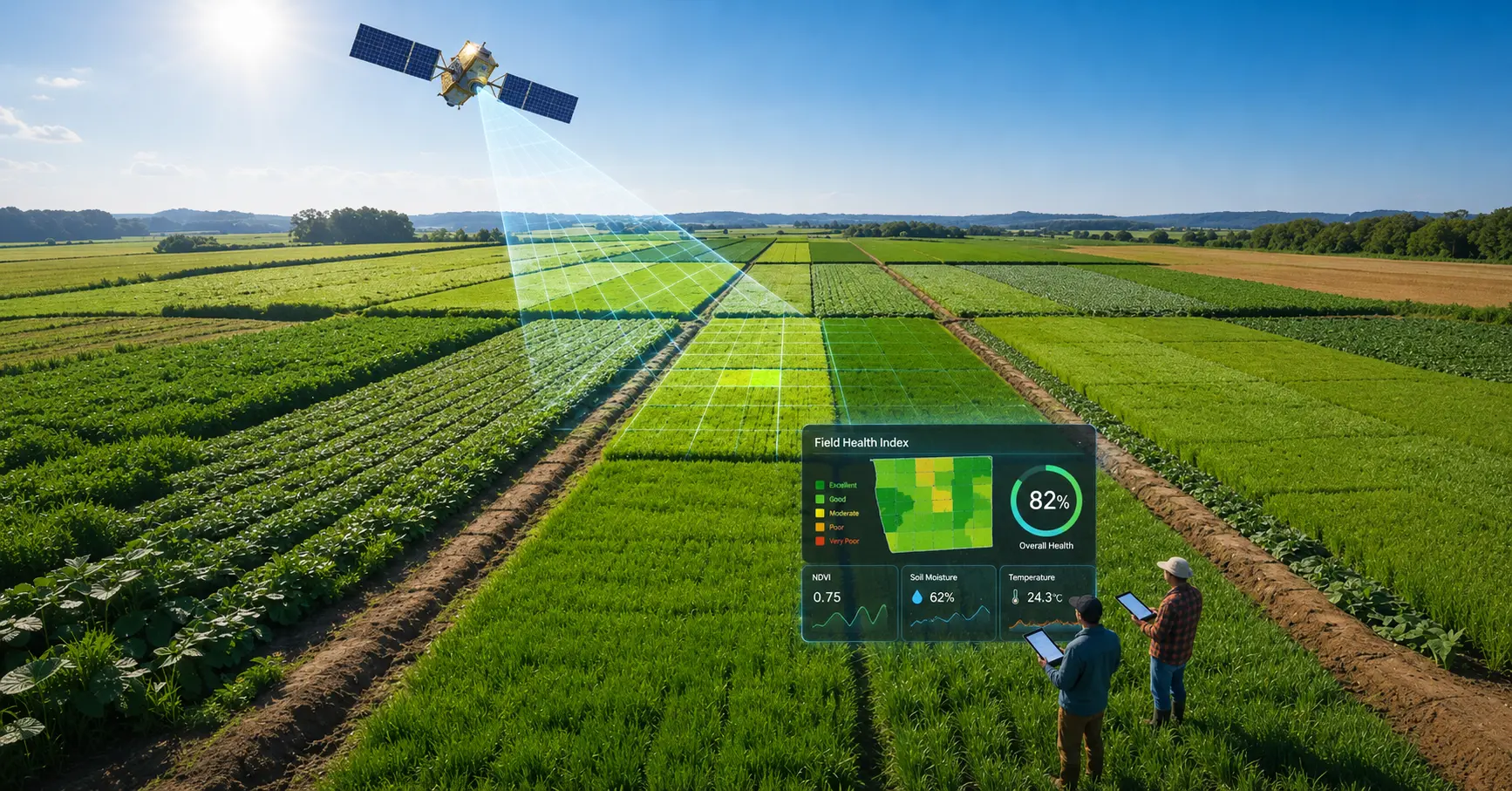
Every season, agribusinesses make thousands of decisions starting from when and what to sow, when to irrigate, when to intervene, when to harvest and so on. Most are still made on experience, intuition, or spreadsheets that were built before the climate change severely started to impact agriculture.
The cost of that guesswork is no longer abstract. Globally, production forecast errors of 30–50% are directly impacting the top line. Agri-enterprises have reported revenue losses of 2–8% over the past decade, and these losses are not due to bad harvests alone. They are from bad decisions made without the right information at the right time.
What’s changing this isn’t better intuition. It’s a fundamentally new power of technology: AI-powered decision systems that turn fragmented farm data into forward-looking, actionable intelligence.
Here are five dimensions where this shift is already happening and why it matters for anyone building or managing agricultural value chains at scale.
1. Sub-Plot Precision: When Crop Decisions Operate at the Level of Individual Fields
For decades, crop monitoring has worked at the wrong resolution. Field scouts cover vast acreages, while the report reaches decision makers days later. By the time a disease outbreak or soil stress signal reaches a decision-maker, the intervention window has often already closed. It is here that the eyes in the sky matter most. Satellite images offer broad coverage at the resolution and frequency one requires.
AI-powered sub-plot intelligence changes the decision timeline entirely. By fusing satellite imagery, geospatial analytics, and deep-learning models trained on tens of millions of acres of real farm data, it becomes possible to detect crop health signals such as disease onset, water stress, and nutrient deficiency, all before they’re visible to the naked eye.
This is not an incremental improvement. It’s a structural change in when decisions get made. The shift is from reactive damage control to proactive, precision intervention. The accuracy benchmarks emerging from field-deployed systems are now crossing the 90%+ threshold across multiple crop types.
The implication for agribusinesses: field intelligence is no longer a lagging indicator. It can be a leading one.
Here is an example. Cropin’s plot-level intelligence is deployed by PepsiCo to monitor crop health across thousands of acres at an individual plot level. Using satellite-derived vegetation indices combined with Cropin’s proprietary deep-learning models trained on one of the world’s largest agronomy datasets, the system identifies stress signals early in the crop cycle and triggers insights for field-level advisories before visible damage occurs. The result: PepsiCo’s farm management teams move from periodic scouting reports to continuous, spatially precise crop intelligence, enabling intervention decisions that are both faster and more targeted.
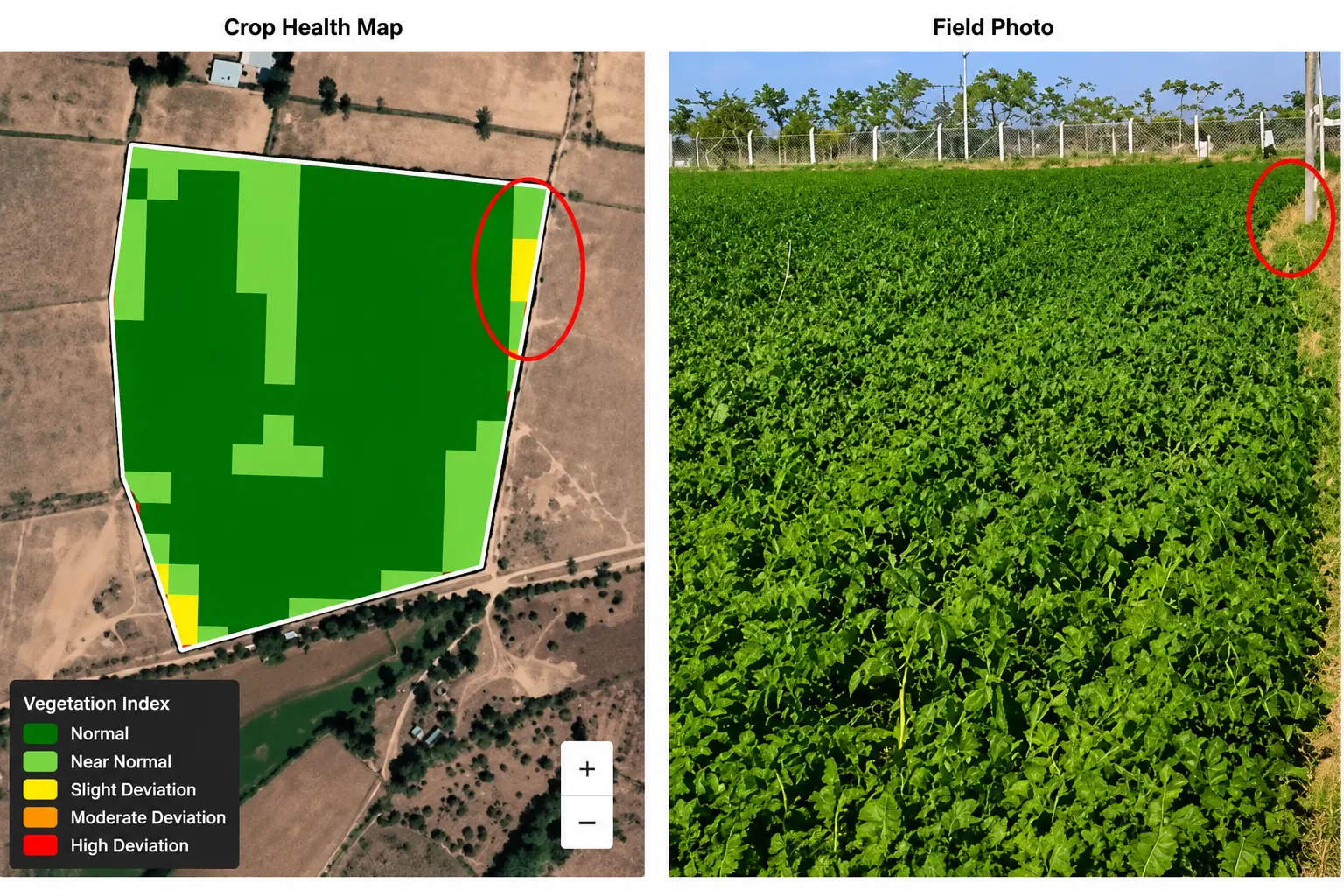
Cropin’s plot-level intelligence dashboard depicting Water Stress
2. Pre-emptive Climate Decisions: From Weather Alerts to Agronomic Action Plans
Climate volatility has moved from a seasonal concern to a permanent operating condition. Extreme weather events, shifting pest pressure windows, and erratic rainfall patterns are disrupting production in ways that historical averages simply cannot model.
The problem with most climate advisory systems today is that they stop at the alert. They tell you a frost is coming. They don’t tell you what to do about it specific to your crop, your growth stage, your soil type.
The next generation of climate-smart decision systems closes this gap. By integrating AI with real-time weather data, soil health inputs, and crop-specific agronomic knowledge, these systems deliver not just warnings but decision pathways: adjust irrigation scheduling, delay sowing by a defined window, apply targeted preventive treatment before the risk materializes, and so forth.
Enterprises deploying this approach, including development agencies working with smallholder farmers across South Asia, have demonstrated measurable improvement in both climate resilience and resource efficiency. The technology is no longer theoretical.
One unexpected frost or drought can erase a season’s investment. The ability to model climate impacts before they arrive is now a core risk management capability, not a nice-to-have.
Here is a case point. Working with the Asian Disaster Preparedness Center (ADPC), Cropin has deployed climate-smart agricultural advisory systems across smallholder farming communities in Bangladesh and Sri Lanka regions where climate risk is acute and agronomic support infrastructure is thin. The platform integrates hyper-local weather forecasting with Cropin’s crop growth models to translate incoming climate risk into specific, field-level action recommendations. The intelligence provided includes adjusted sowing dates, irrigation interventions, and disease early warning and management protocols. This moves smallholder farmers and the development agencies supporting them from generic weather alerts to decisions they can actually act on and save the harvest, and ultimately improve food security.
3. Predictive Yield Intelligence: Turning Farm Data into Supply Chain Certainty
For food retailers, CPG companies, and commodity traders, the supply chain begins at the farm, and the most persistent source of volatility is yield unpredictability. Traditional yield data is backward-looking: it tells you what happened last season. What the industry needs is forward-looking forecasting intelligence: what will happen this season, at what volume, from which geography.
AI-powered yield prediction models are now mature enough to do this with meaningful accuracy. By combining historical yield data, real-time satellite inputs, weather pattern modeling, and soil profiles, it’s possible to generate season-ahead production estimates at the plot level. Not regional averages, but field-specific forecasts that feed directly into procurement, logistics, and sourcing decisions.
The enterprise implications of this are significant. Global food retailers are already deploying predictive yield systems to streamline sourcing and reduce supply-side surprises. When you know what’s coming in from the field weeks or months ahead, you can plan allocations, manage contracts, and reduce costly last-minute procurement with far greater confidence.
Yield uncertainty has always been priced into agricultural supply chains as a cost of doing business. AI prediction models are beginning to make that uncertainty optional.
The yield estimation framework of Cropin, the most advanced AI platform for food and agriculture, is a sophisticated, AI-first ecosystem that replaces static forecasting with dynamic, multi-dimensional intelligence. By integrating remote sensing, deep learning, and a deep-science crop knowledge graph, the platform provides high-accuracy predictions 30–45 days before harvest. The hybrid model processes over 40 satellite-derived indices and 40 weather parameters simultaneously, hypertuning insights at the crop, variety, and location levels. This system is uniquely adept at analyzing how fluctuating weather impacts critical biological phases, such as pollination. To ensure ground-truth precision, Cropin’s Zone Sampling scientifically captures field heterogeneity, surpassing traditional limitations by accounting for natural variations. This integrated approach allows global agri-enterprises to move from reactive management to predictive mastery, ensuring surety of supply through optimized procurement decisions made well before the harvest begins.
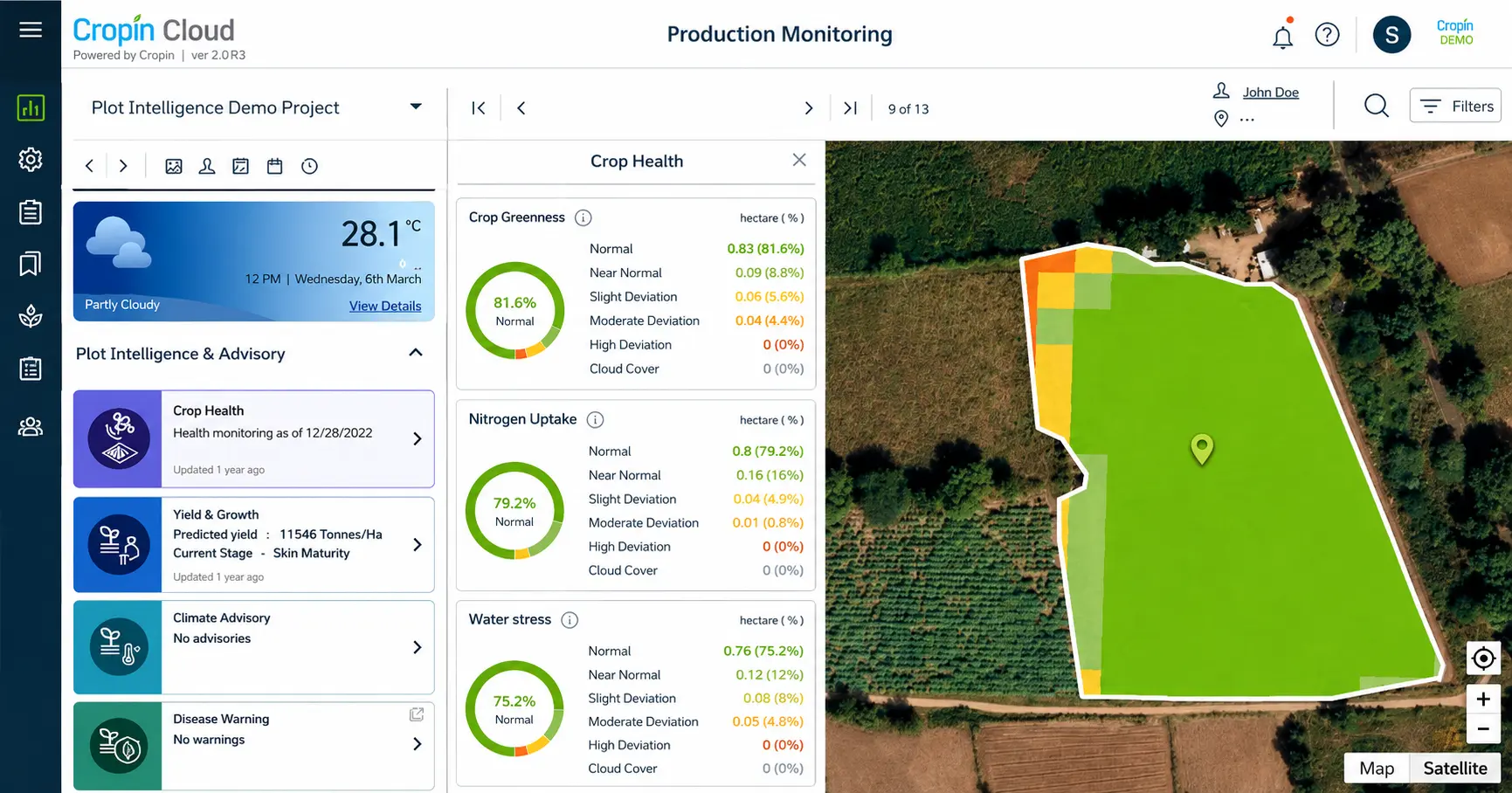
Cropin’s dashboard showing 45-advance Yield Estimation
4. Generative AI for Agri-Intelligence: Natural Language as the New Interface for Farm Data
Historically, making sense of agricultural data required a specific combination of agronomic expertise, data analytics capability, and time and resources that are neither cheap nor scalable. Complex queries about crop performance, risk exposure, or sourcing diversification required teams, not tools.
Generative AI is changing this. Purpose-built agricultural language models trained not on generic internet text but on deep domain knowledge spanning hundreds of crops, thousands of varieties, and decades of agronomic data, can now allow enterprise stakeholders to query complex, multi-variable agricultural datasets in plain language and receive actionable, contextualized answers in seconds.
The practical impact goes beyond convenience. These systems can decode historical patterns, analyze current field conditions, and project future yield and production outcomes in a unified interface. For enterprises managing large, geographically dispersed operations, this compresses decision cycles that previously took days into interactions that take minutes.
The agronomic knowledge that used to live in the heads of a few specialists can now be operationalized across an entire enterprise. That’s a different kind of competitive advantage.
Here is how technology can be deployed. CropIn Sage is Cropin’s purpose-built generative AI system for agriculture. It is designed not as a general-purpose assistant but as an agri-intelligence engine grounded in Cropin’s Crop Knowledge Grid, one of the world’s most comprehensive agricultural AI databases covering hundreds of crop varieties across global geographies. Enterprise users can ask Sage natural-language questions about crop performance across a sourcing region, the risk profile of a specific variety under a projected weather scenario, optimal harvest timing given current field conditions, and more. They receive structured, contextualized answers drawn from both real-time field data and multi-season historical intelligence. For agri-enterprises, Sage reduces the barrier to acting on complex agricultural data from “hire a team of analysts” to “ask the right question.”
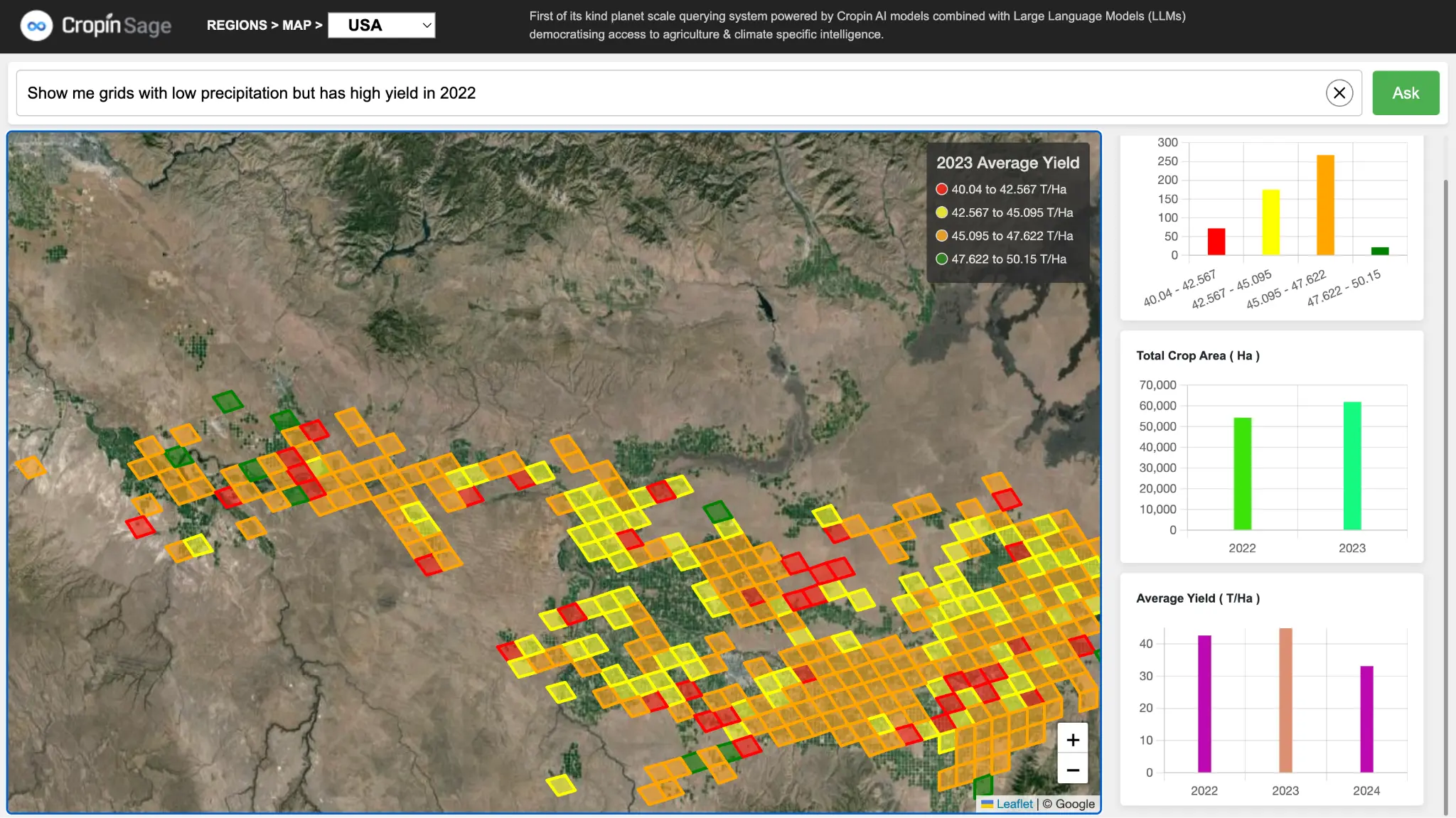
Cropin Sage answering a query
5. Country-Scale and Regional Intelligence: Macro Sourcing Decisions Backed by Field-Level Data
Individual farm decisions are one thing. The harder problem and the one that most agri-intelligence platforms have historically struggled with is enabling strategic decisions at scale: which geographies to source from, where to expand procurement, how to hedge against regional climate or geopolitical risk before a disruption becomes a crisis.
AI-driven regional intelligence addresses this by aggregating plot-level data into country-scale and regional heatmaps for yield, risk, and climate trends. This enables predictive zoning, identifying which areas will likely over-produce, under-produce, or face stress conditions in an upcoming season and turns that intelligence into inputs for crop planning, contract farming decisions, and input allocation.
The cocoa supply chain disruption in West Africa is a recent example of what happens without this foresight: a geography-concentrated crop, a climate event, and a global supply shock that blind sided brands and buyers. Regional AI intelligence doesn’t eliminate these risks but it gives enterprises the lead time to diversify before the disruption, not after.
Premium food brands are now using this approach to build resilient, sustainably sourced supply chains across complex, multi-country geographies with verified, traceable outcomes at a scale that manual sourcing methods cannot match.
Global sourcing decisions have always required local intelligence. AI is finally making it possible to have both simultaneously.
Cropin’s Maize Intelligence Report demonstrates what regional AI analysis looks like in practice. Built on satellite-derived crop monitoring data, multi-season yield histories, and climate modeling across key maize-growing regions in Kenya. Kenyan farmers sow maize in March with the onset of rains, and harvest begins in late September, resulting in high harvest potential. But unpredictable weather and disease have consistently posed challenges for both farmers and the nation’s food security. In addition to identifying producing regions, total acreage, and yield estimates, the study provides detailed, granular insights into crop health, weather, and anomalies, offering invaluable insights into the dynamics of maize cultivation. It empowers stakeholders with actionable insights for decision-making and sustainable growth. Government agencies, agribusinesses, and commodity trading companies can leverage this intelligence to optimize operations, mitigate risks, and enhance food security.
Conclusion
Agriculture has always been complex. What AI-powered decision systems change is not the complexity, it’s who bears the cognitive burden.
When intelligence is embedded at every level from individual plot to country-scale geography the decisions that define a season don’t have to rest on the judgment of a single agronomist or the memory of a spreadsheet. They can rest on evidence: real-time, multi-source, and continuously learning.
Independent analysis of enterprises that have made this shift is already showing the returns, both in operational efficiency and in the quality of decisions made under uncertainty. The guesswork era in crop management isn’t winding down. For agribusinesses that have adopted AI decision systems, it’s already over.
Author Bio

Deepak Murugan
Deepak Murugan is a Geospatial AI and Remote Sensing Specialist at Cropin, where he works at the intersection of satellite intelligence, AI, and agriculture to enable data-driven decision-making across global farming ecosystems. With a strong foundation in geospatial analytics and agricultural intelligence, Deepak contributes toward building scalable solutions for crop monitoring, resource optimization, climate resilience, and sustainability adaptation. His areas of interest include deforestation monitoring, soil and crop intelligence, and precision agriculture. Passionate about leveraging technology for sustainable agriculture, Deepak believes that the future of farming will be shaped by the convergence of geospatial intelligence, AI, and actionable field insights to create more resilient and efficient food systems worldwide.