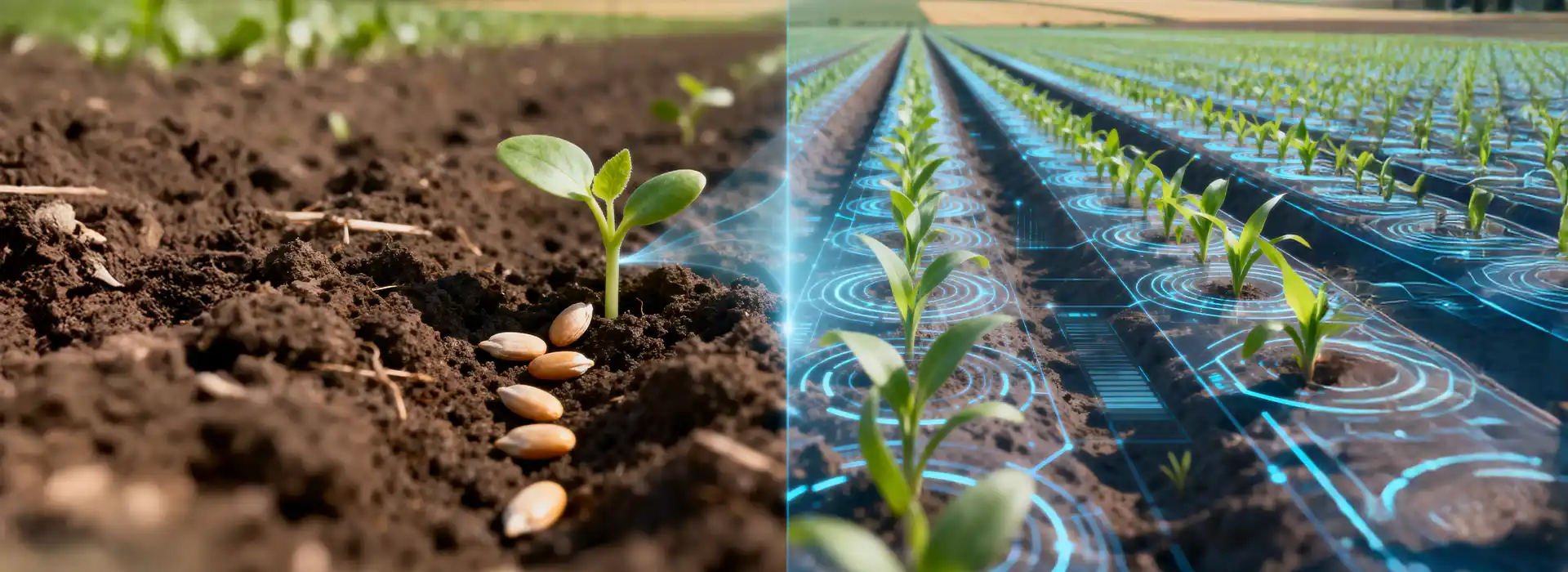
A single seed holds more data than most people realize. Embedded in its genetic code are instructions shaped by thousands of years of natural selection. These instructions determine how a plant will germinate, grow, and produce under conditions that are shifting faster than traditional agriculture can adapt to, amid climate change chaos. The stakes are unambiguous. The global seed market stands at $46.7 billion in 2025 and over 80% of the world’s food originates from plants grown from seeds.
And yet, seed industry leaders now rank climate change as their single greatest operational challenge. Recent data from Plant Science Today (2025) reveals that heat stress during flowering can cause up to a 70% reduction in seed set. When the “parent” fails, the entire downstream food supply chain starves before it even begins. The question is no longer whether seed production must transform, but whether the tools exist to transform it fast enough. Today, a new class of technology is learning to read, interpret, and act on that data before a seed ever touches soil. It is the Digital Twin to Seed Production.
What Climate Change Is Doing to Global Seed Production - and Why It Cannot Wait
The International Seed Federation (ISF) Seed Sector Survey 2024 highlights that 45% of seed industry leaders now cite climate change as their number one operational challenge. The vulnerability of seed production is significantly higher than that of commercial grain because the requirements for seed purity, vigor, and viability are far more stringent.
How rising temperatures are shrinking seed viability windows
Seed production is a precision operation.
- Parent lines (male and female) must flower in synchrony.
- Pollination must happen within narrow windows.
- Seed filling requires stable temperatures at the right moment.
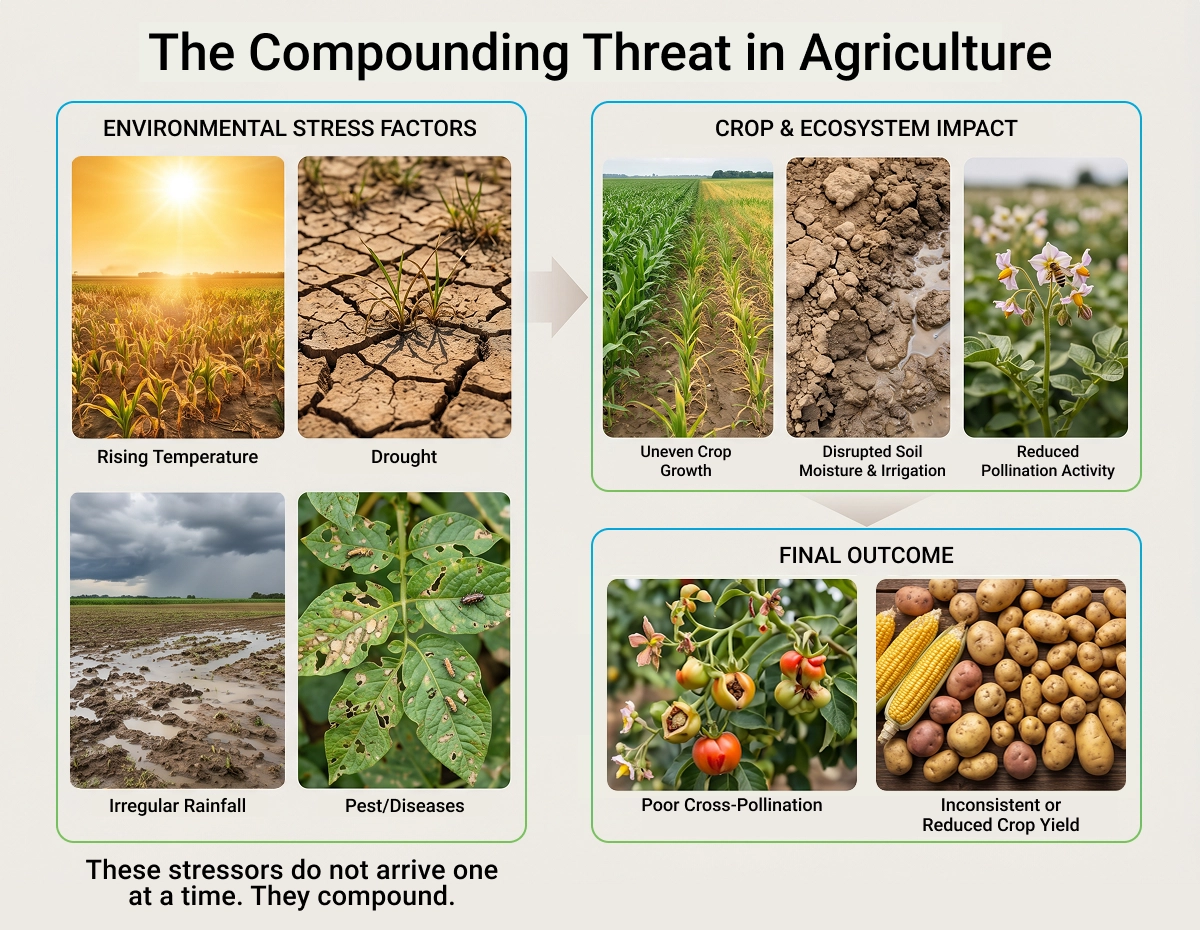
Climate change is collapsing those margins. Heat stress during flowering and seed filling can reduce seed set by 50-70% in sensitive varieties. For producers managing large-scale seed production, just one anomalous heat event at the wrong growth stage can eliminate an entire season’s output.
The compounding threat: drought, irregular rainfall, and pollinator disruption
Defining the Digital Twin of a Seed: From Genome to Harvest in a Virtual Environment
What exactly is a digital twin of a seed? Unlike a static simulation or a traditional crop model, a digital twin is a dynamic, bi-directional virtual representation. It is continuously updated with real-time data, alongside its physical counterpart, and can simulate future states. Applied to seed production, this means a living model of a crop’s entire production cycle: from the genetic profile of parent lines to the environmental conditions at every multiplication site, to the predicted quality of the harvested seed lot.
The four data layers that make up a seed's digital twin
A high-fidelity digital twin has four distinct data layers:
- Genomic layer: Captures hereditary traits of parent and progeny (genetic potential of seed variety)
- Environmental layer: Integrates soil data, past, present & forecasted hyper-local weather data, and moisture
- Phenotypic layer: Tracks observable crop development (germination rates, plant vigor, and pollination timing)
- Operational layer: Records agronomic inputs (irrigation schedules, fertilizer applications, and field interventions).
Together, these layers allow the twin to reflect not just what a crop looks like today, but what it is likely to do under any number of future conditions.
Digital twin vs. conventional simulation: what makes it a twin (looking at a map vs using a live GPS with traffic updates)
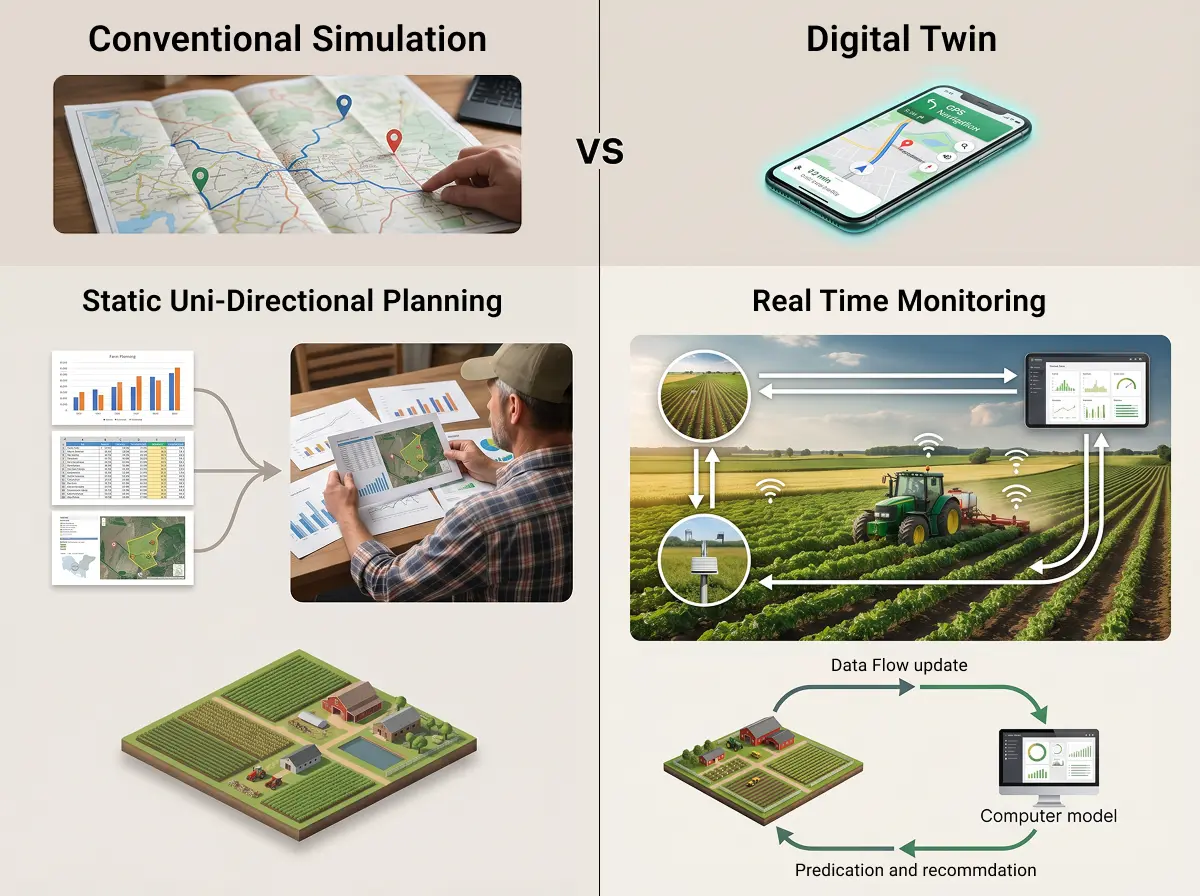
Conventional agronomic stimulation predicts what might happen but is static. A digital twin is different. It maintains a bidirectional relationship with its physical counterpart. Data flows in from the field; updated predictions and recommendations flow back. When conditions deviate from the model, the model updates. This continuous feedback loop is what makes a digital twin genuinely actionable for in-season seed production management, not just a one-time planning exercise before the season begins.
How Digital Twins Optimize Every Stage of the Seed Production Lifecycle
The true power of a digital twin lies in its ability to provide “decision support” across the entire production calendar, reducing the margin for error in a high-stakes industry.
Pre-season: simulating planting windows and site suitability before sowing
Before a single multiplication plot is established, the digital twin can run thousands of scenario simulations.
- Which geographies have an optimal combination of temperature, day-length, and rainfall for this variety?
- What is the probability of a late-season heat event?
- What sowing date maximizes the overlap between male and female parent flowering windows?
These questions were answered through experience and field intuition. Now they are answered through simulations. The accuracy of these models improves with every additional season of data.
In-season: real-time monitoring of parent lines, pollination timing, and stress signals
During the production season, the digital twin functions as an early-warning system. It flags anomalies such as:
- Soil moisture deficit developing at a critical growth stage
- Temperature rise during pollen shed
- Emerging pest or disease pressure signals.
Seed production managers receive timely, granular alerts that allow them to intervene before stress translates into yield loss or quality degradation. This is the shift from reactive to proactive that seed production has long required.
Post-harvest: predicting seed vigor, storability, and certification outcomes
Intelligence doesn’t switch off at harvest. By analyzing in-season stress loads, digital twins can predict:
- Seed vigor
- Germination percentages
- Expected storability before laboratory testing
- End-to-end digital record for validation for certification
For seed companies managing large inventories across multiple crops and geographies, this capability compresses quality assurance timelines and reduces the risk of releasing seed lots that fall short of certification standards.
Compressing the breeding cycle
Developing a new seed variety typically takes a decade and can cost upwards of $100 million. Digital twins, combined with AI-driven genomic selection, are beginning to compress that timeline by simulating thousands of “virtual field trials,” allowing breeders to reach “genetic gain” faster and reducing time-to-market of climate-resilient varieties.
Building Climate-Resilient Seed Systems: How Digital Twins Enable Scenario Planning at Scale
Stress-testing seed varieties against future climate projections
The IPCC’s worst-case scenario projects a global temperature increase of up to 4.3°C by 2100. Digital twins allow seed producers to stress-test current variety portfolios against projected climate scenarios before those conditions materialize.
They allow global seed leaders to:
- Perform geographic repositioning
- Identify varieties to be multiplied today
- Decide on parent lines worth investing in now
Geographic repositioning: Identifying where viable production zones are moving
As traditional multiplication geographies become too hot or dry they become less reliable. Seed producers must identify new regions. Before any physical investment is made, digital twins can model new locations by assessing:
- Climate fit
- Soil suitability
- Water availability
- Operational feasibility
Seed companies are already repositioning production latitudinally and to higher elevations to escape heat and drought risk. The digital twin makes that repositioning systematic rather than speculative.
The Data Infrastructure That Powers a Seed's Digital Twin
The quality of a digital twin is determined by the quality of the data that feeds it. The foundation of accurate models is multi-season, multi-geography crop data covering germination behavior, stress responses, input sensitivities, and yield outcomes across hundreds of environments. Without a deep knowledge base, the twin is modeling from assumptions rather than evidence.
The infrastructure that delivers data to the model spans the full observational stack, including:
- Ground sensors capture the microclimate around individual plant rows
- Satellites continuously monitor the field health of production landscapes at scale
- Field data is fed into agtech platforms.
- Weather data from open and paid sources
All of this converges in a cloud-based agri-intelligence layer where it is cleaned, conceptualized, and fed into the model in real time. Computational demands are significant. So is the value of what comes out.
From Data to Decision: How CropIn's Agri-Intelligence Platform Enables Seed Production Intelligence
At Cropin, we have built the world’s most comprehensive Agri-Intelligence platform to turn this vision into a reality. Our Crop Knowledge Grid serves as the foundational “brain” for multi-crop, multi-geography digital twin modeling. Here is why the world’s leading seed enterprises choose Cropin.
Cropin's Crop Knowledge Grid as the foundation for production modeling
Cropin’s Crop Knowledge Grid is one of the world’s most comprehensive agricultural AI databases built on over 10,000 crop varieties, millions of acres of farmland, and multi-season agronomic data from real production environments globally. Our digital twins are built on a foundation of validated crop intelligence that already understands how a given variety responds to drought, heat, and variable soil conditions. For seed producers, this means you have accurate data to train models and do not need to build them from scratch.
So, with Cropin, you act on insights from day one.
Connecting field-level production data to supply chain outcomes
Cropin’s platform connects field-level production data to enterprise-level supply chain visibility. For a seed company managing plots across multiple countries, the same agri-intelligence layer that monitors parent line performance in the field also feeds inventory forecasts, quality predictions, and logistics planning. The digital twin is not a standalone analytical tool. It is seamlessly integrated into the business’s operational fabric to enable informed decision-making at every level, from the plot to the procurement desk.
Real-world Deployment
Cropin platform is the choice of many global seed production giants to manage millions of hectares, moving them from “opaque” sourcing to plot-level intelligence. Our 15 years of experience validate our expertise.
The seed is the most data-rich object in global agriculture. The seed industry is only beginning to realize what it can accomplish when it builds a twin worthy of that complexity. To thrive in this high-potential, high-risk environment, the industry must master the data. Moving forward, the “Digital Twin of the Seed” will be the industry standard, and every bag of seeds will carry its “Digital Birth Certificate”, a complete record of its virtual and physical journey.
Want to explore how Cropin's Crop Knowledge Grid and agri-intelligence platform for your Seed Production
What is predictive agriculture, and how does it improve supply chain efficiency?
Predictive agriculture uses AI and data analytics to forecast crop yields, demand, and risks. It improves efficiency by enabling better planning, reducing waste, and optimizing resource use across the supply chain.
How does predictive analytics reduce risks in global food supply chains?
It identifies potential disruptions, such as weather events or logistics delays, in advance, allowing businesses to take proactive measures and minimize impact.
What are the economic benefits of implementing predictive agriculture?
Businesses benefit from cost reduction, improved yield quality, reduced waste, and higher profitability, resulting in strong ROI.
How does predictive agriculture support climate-smart and sustainable farming?
It helps farmers adapt to climate variability, optimize resource usage, and reduce environmental impact, supporting sustainable agriculture practices.
Which industries and businesses benefit most from predictive agriculture?
Agribusinesses, food processors, retailers, exporters, and supply chain operators benefit significantly from improved forecasting, efficiency, and risk management.
Author Bio

Haripriya Muralidharan
Haripriya Muralidharan leads content marketing at Cropin Technology Solutions, bringing a unique scientific rigor to brand storytelling. With a Master's in Chemistry from Pune University and research experience in cancer immunology, she discovered her passion in storytelling. For two decades, she has operated at the intersection of content, communication, and brand strategy, specializing in turning complex ideas into impactful narratives. Prior to Cropin, Haripriya leveraged her creative skills at Elsevier’s Chemical Business News Base and shaped multi-format content strategies for B2B marketing at Scatter.