There’s a question keeping sourcing directors, sustainability heads, and compliance teams at chocolate manufacturers and CPG companies up at night right now: Can we actually prove where our cocoa comes from?
Not in a general sense. Not in a “we work with certified cooperatives” sense. In the specific, geo-referenced, plot-level, timestamped sense that the European Union Deforestation Regulation (EUDR) now legally demands.
For most of the industry, the honest answer is: not yet. And the clock has already started.
As of December 31, 2026, the EUDR is no longer a “future requirement”, it is mandatory for operations in the European market. For the cocoa industry, the stakes are existential. If you cannot prove that your beans didn’t come from land deforested after December 31, 2020, your product is effectively barred from one of the world’s largest cocoa consumer markets.
This isn’t just about paperwork; it’s about solving the “First-Mile Gap.” It is the difference between surviving a regulatory audit and facing crippling trade bans.
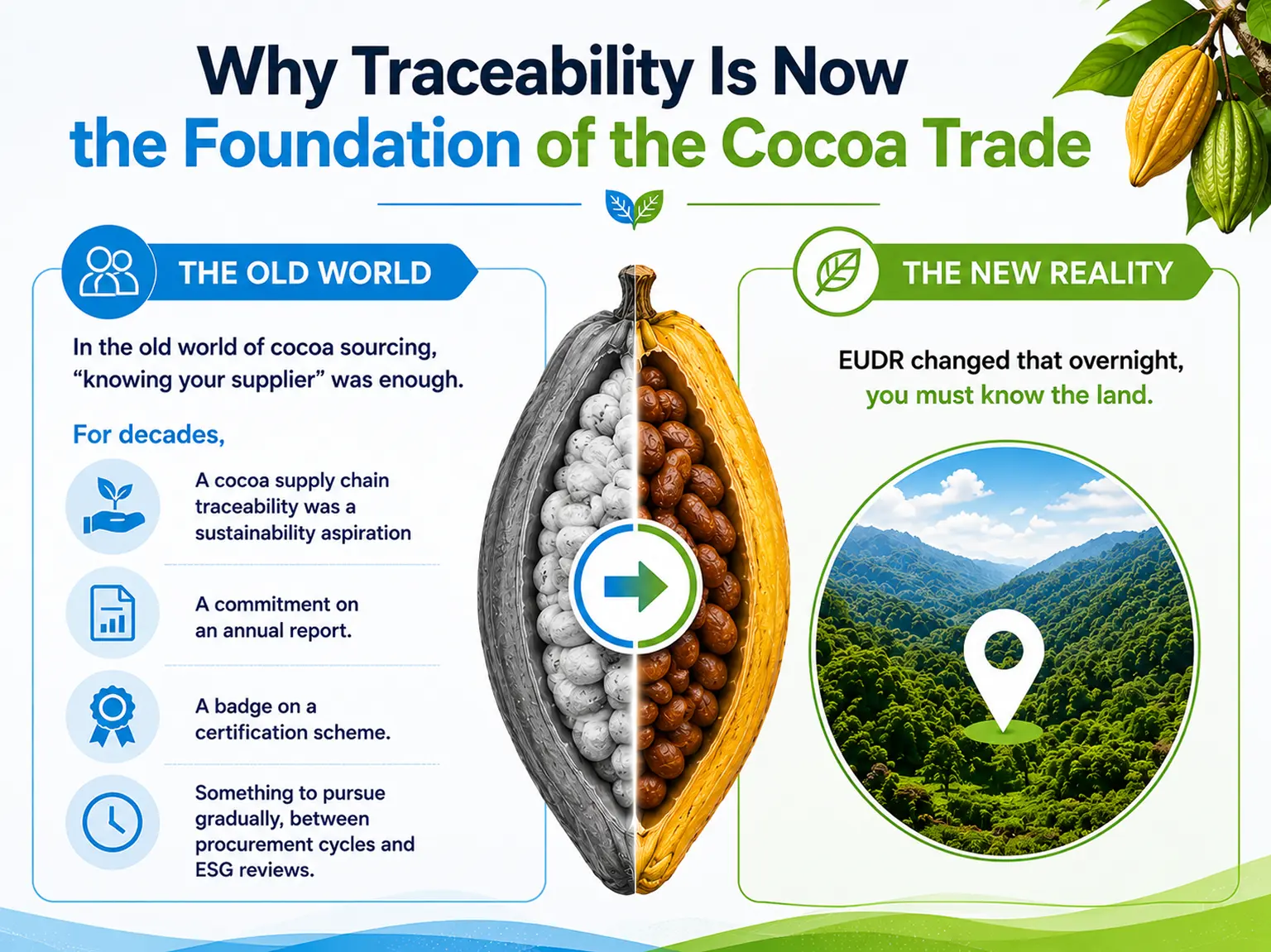
Why Traceability Is Now the Foundation of the Cocoa Trade
What the EUDR Demands
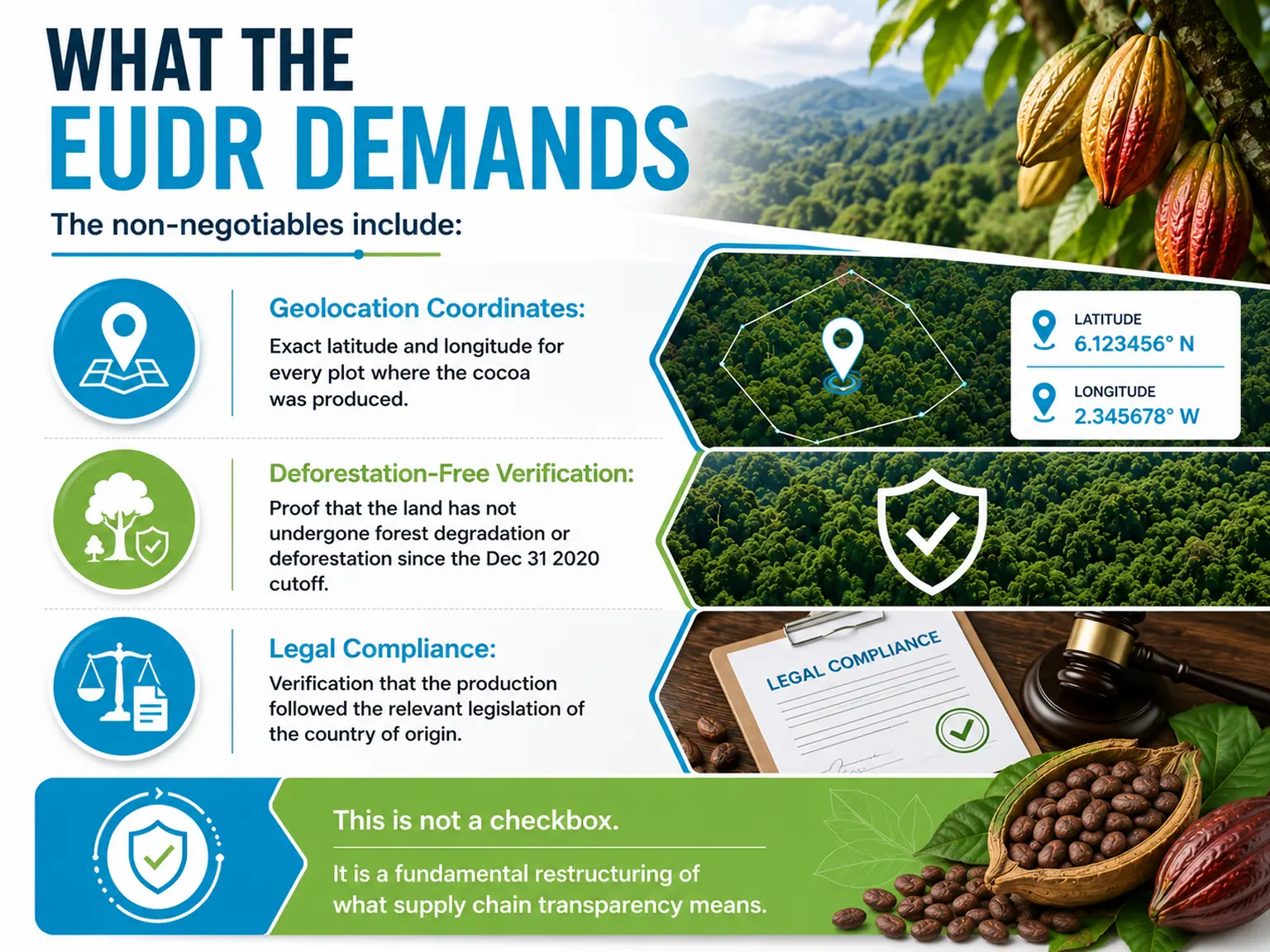
The EUDR, set to roll out on December 31, 2026, for large companies, is unambiguous. Cocoa, along with cattle, coffee, palm oil, soy, wood, and rubber, placed on the EU market, must not have contributed to deforestation or forest degradation anywhere in the world after December 31, 2020. Agribusinesses must now provide a due diligence statement with verified, geo-referenced, plot-level data for every shipment entering the EU. Non-compliance carries penalties of up to 4% of annual turnover, and products from non-compliant companies may be barred from entering the EU market entirely.
Why Cocoa Is the Hardest Commodity to Trace
Here’s what makes cocoa uniquely difficult. Most large chocolate manufacturers and CPG companies have invested heavily in sustainability programs. The problem is structural, in the architecture of the cocoa supply chain itself. Unlike soy, which is often linked to centralized industrial hubs, cocoa is a smallholder crop. Over 70% of the world’s cocoa comes from West Africa, predominantly Côte d’Ivoire (roughly 43% of global cocoa production) and Ghana. Most of the remaining cocoa comes from Southeast Asia. The vast majority is grown by smallholder farmers on plots often in remote areas with poor road access, limited connectivity, and no formal land records. These farms often lack formal titles, GPS coordinates, or even basic digital records.
Cocoa expansion has been the primary driver of forest loss. The farms are real. The deforestation risk is real. But data linking a specific bean to a specific farm has historically been absent. The structural problem isn’t a lack of willingness; it’s the sheer complexity of digitizing millions of first-mile participants.
What Is Cocoa Supply Chain Traceability and Why Does It Matter Now?
Cocoa supply chain traceability means the ability to follow a cocoa product backward through every stage of its journey. Simply put, trace the chocolate bar on a European shelf back to the specific farm plot where the beans were harvested, and verify that the specific land was not deforested after December 31 2020.
This matters because EUDR compliance isn’t self-certified. It demands evidence. Geo-referenced farm polygons. Documented land use history. Satellite-verified deforestation status. A due diligence system that can be interrogated, audited, and sustained over time. Only 30% of upstream suppliers currently use traceability systems. And only 7.5% of soft commodity manufacturers globally can demonstrate deforestation-free supply chains with verifiable documentation. For cocoa, those numbers are even starker.
The First-Mile Gap: Where Data Disappears
Here’s what makes cocoa uniquely difficult. Most large chocolate manufacturers and CPG companies have invested heavily in sustainability programs. The problem is structural, in the architecture of the cocoa supply chain itself. Unlike soy, which is often linked to centralized industrial hubs, cocoa is a smallholder crop. Over 70% of the world’s cocoa comes from West Africa, predominantly Côte d’Ivoire (roughly 43% of global cocoa production) and Ghana. Most of the remaining cocoa comes from Southeast Asia. The vast majority is grown by smallholder farmers on plots often in remote areas with poor road access, limited connectivity, and no formal land records. These farms often lack formal titles, GPS coordinates, or even basic digital records
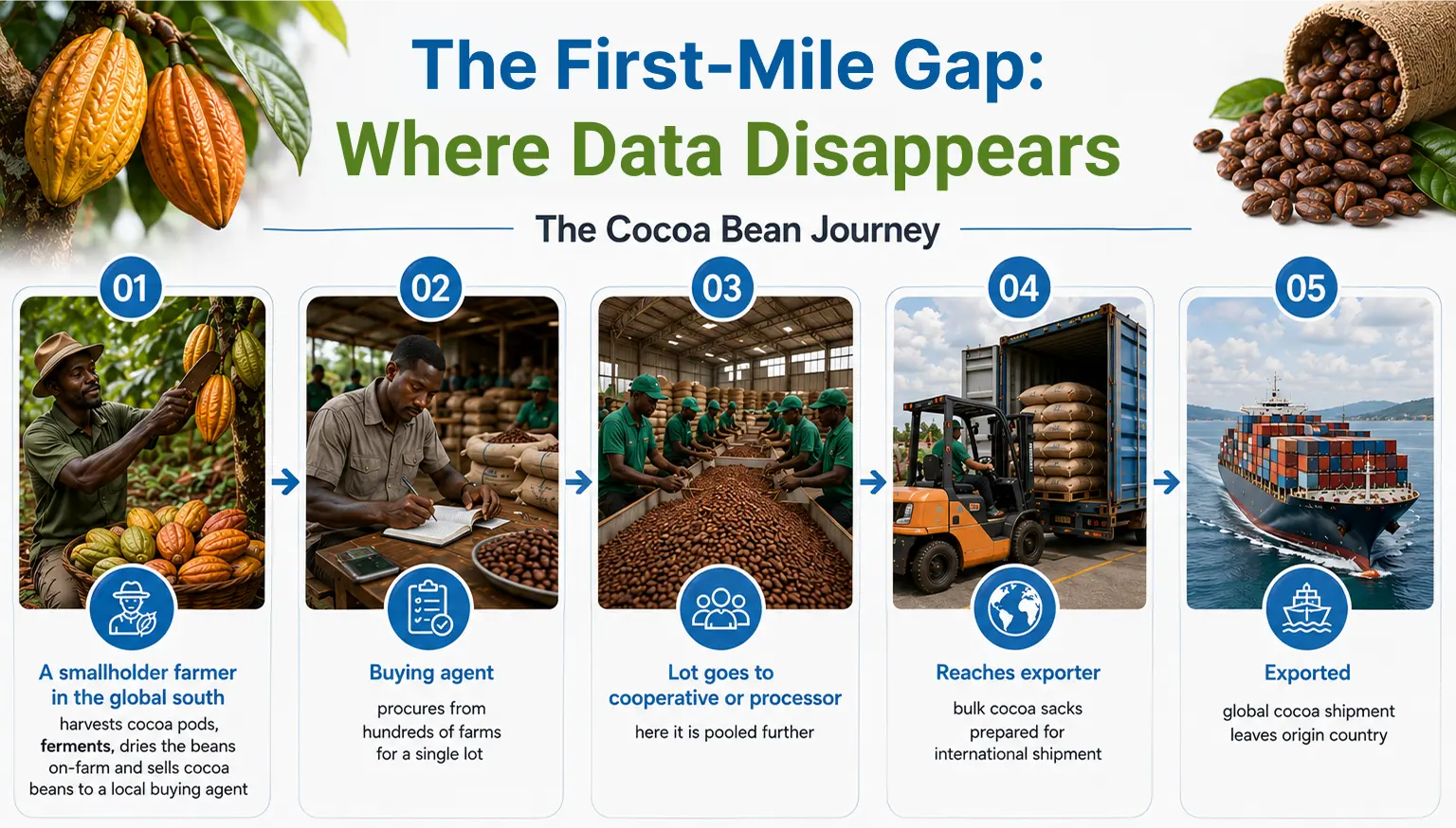
The “first mile” in cocoa is the distance (physical and informational) between a smallholder farmer’s plot and the point where beans enter a formal supply chain through a buying agent, cooperative, or aggregator. It is the segment where the most value is created. And almost all traceability data is traditionally absent.
By the time it reaches an exporter, the link between the beans and the farm of origin has been severed, often irreversibly. This isn’t negligence. It’s the operational reality built over generations on convenience, informality, and trust, not documentation. The result is a structural information gap that conventional audit-and-certification approaches were never designed to close.
Why Cocoa Is Structurally Unique and Harder to Trace Than Any Other Soft Commodity
Cocoa is shade-grown, often intercropped with other trees, making it difficult for standard optical satellites to distinguish between a healthy cocoa plantation and natural forest cover. This makes satellite deforestation monitoring for cocoa a specialized task that goes beyond simple “greenery” checks.
Soy can often be traced to a large farm or cooperative with formal land records. Coffee from many origins has established direct trade models with documented farm relationships. Cocoa has neither of these structural advantages at scale.
Cocoa supply chains dominated by aggregation model are specifically designed for volume efficiency, not provenance preservation.
- Farms are remote, small, numerous, and dispersed.
- Farm boundaries are rarely mapped
- Farmer identities are inconsistently recorded
- Land tenure is frequently informal
The only way to close the first-mile gap is to build the data record at the farm itself, before the beans ever leave.
How Cropin Closes the First-Mile Gap
Closing the first-mile gap in cocoa requires a data architecture built from the ground up, starting at the farm, integrating satellite data to generate verifiable evidence. It must connect every step of the supply chain in a single, auditable record. This is precisely what Cropin’s platform is designed to do.
How Cropin Builds the Farm Record That Makes Traceability Possible
Every credible cocoa traceability system begins with a single, verifiable fact: which farm did this cocoa come from, and where exactly is it? Cropin’s approach starts right here.
Field teams use Cropin Grow to geo-tag farm boundaries, capture farmer identity data, and record plot-level attributes. It is designed to capture data in low-connectivity, remote environments, where the vast majority of cocoa farms are. This farm record is the origin for every downstream data point reference.
Deforestation Monitoring at Plot Level: How Cropin's LULC Satellite Intelligence Verifies Deforestation-Free Sourcing
Geo-tagged farm boundaries establish where a farm is. But EUDR requires more: proof that the land has not been the site of deforestation since December 31, 2020. That requires a historical analysis of the same farm.
It is here Cropin’s dynamic Land Use Land Cover (LULC) deep learning engine takes over. Drawing on Hansen Global Forest Change Maps, Tropical Moist Forest Maps, and PALSAR SAR imagery, the model verifies deforestation status at the plot level, back to December 2020, exactly as EUDR mandates. The data layers are not simply overlaid. Cropin’s LULC engine applies a two-step verification process specifically designed to handle the challenge of cocoa agroforestry systems, which can visually resemble natural forest canopy from satellite imagery. The model first combines forest layer data from LULC analysis with the selected reference maps to build a comprehensive picture of forest cover. It then integrates Cropin’s proprietary crop knowledge graph built across 500 crops and over 10,000 varieties, to specifically identify cocoa and other plantation crops, ensuring that agroforestry systems are not misclassified as forest loss and that actual deforestation is accurately identified.
The result: for every geo-tagged cocoa farm plot in a sourcing area, Cropin can generate a verified, plot-level deforestation risk status going back to December 31 2020. Beyond basic compliance, the platform also delivers advanced deforestation classification, acreage overlap analysis, and year-of-deforestation identification, providing a comprehensive, audit-ready picture of regional deforestation trends that procurement teams and regulators require.
Cropin dMRV: Transparent, Time-Stamped Verification Across the Full Cocoa Supply Chain
Traceability without auditability is not compliance. EUDR requires that due diligence documentation be maintained for a minimum of five years and be available on demand for regulatory inspection.
Every observation (satellite or field) is logged through Cropin’s digital Monitoring, Reporting, and Verification (dMRV) system. Every farm visit, every satellite observation, every deforestation verification, every field data capture is time-stamped, geo-referenced, and stored as a structured, immutable record. This isn’t end-of-cycle reporting. It’s a continuously updated evidence trail that procurement teams, sustainability auditors, and regulators can query at any point.
The result: an immutable proof of deforestation-free sourcing
In Practice: How Loacker Built a Verified, Farm-to-Fork Value Chain with Cropin
The architecture works. Loacker, the premium Italian confectionery brand with presence in 100+ countries, partnered with Cropin to build end-to-end digital traceability across its Italian hazelnut supply chain of
- 80+ regional grower partnerships
- 6 regions
- 130,000 plants across 360 hectares
Cropin Grow digitized farm operations and geo-tagged every plot. Cropin tracked each hazelnut lot from the collection centre, through processing and packaging linking every batch to its farm of origin.
The outcome:
- 85+ farmers
- 95+ plots
- 225+ audited acres
- 2,000+ tonnes of harvest with fully verified traceability
For cocoa agribusinesses, the challenge is structurally identical. Cropin Cloud platform can deliver the same verified, farm-to-fork visibility at origin, at scale.
Conclusion
The EUDR is not just a regulatory hurdle; it is a market filter. Agribusinesses that fail to bridge the First-Mile Gap risk total exclusion from the European market and massive financial penalties. However, those who embrace cocoa supply chain traceability gain more than just compliance. They gain a more efficient, resilient, and transparent supply chain that is ready for the future of global trade.
Frequently asked questions (FAQs)
What is first-mile traceability in cocoa supply chains?
Primarily due to the millions of smallholder farmers involved, the remote nature of the farms, and the lack of existing digital infrastructure at the source.
Why is cocoa the hardest commodity to trace?
Re-sowing decisions, irrigation intelligence, and pest intervention. Missing the window for any of these by even 48 hours can lead to significant yield penalties.
What food traceability software do agribusinesses need for cocoa?
They need a platform that combines mobile-first farmer digitization (KYC), GPS polygon mapping, and satellite-based deforestation monitoring (LULC) to meet EUDR requirements.
What does farm-to-fork traceability mean in cocoa?
It means every actor in the chain, from the grower to the chocolate brand, can verify exactly where, when, and how the cocoa was produced.
How does satellite monitoring support traceability?
It provides an automated, objective way to verify that a specific GPS coordinate has not been deforested since the EUDR cutoff (Dec 31 2020).
How can agribusinesses achieve first-mile traceability for smallholders?
By deploying digital tools that enable field agents to map farm boundaries, register farmers, and sync this data with satellite monitoring platforms like Cropin.
Author Bio

Shashi Kant
Shashi Kant leads customer experience for the EMEA region at CropIn Technology Solutions, bringing a rare blend of technical depth and client-first thinking to the agri-tech world. With extensive expertise in implementation, pre-sales, and client onboarding, Shashi specializes in turning complex AI-driven data into smooth, successful adoption journeys. He works at the intersection of technology, agriculture, and human experience, ensuring that innovations such as satellite analytics, IoT-driven insights, and machine learning models deliver clear, measurable value. By bridging the gap between corporate sustainability goals and on-ground farming realities, Shashi helps our partners navigate the digital transformation of their food systems. He is dedicated to driving regenerative agriculture practices that benefit both the enterprise and the grower. His areas of interest include deforestation monitoring, soil and crop intelligence, and precision agriculture. Passionate about leveraging technology for sustainable agriculture, Deepak believes that the future of farming will be shaped by the convergence of geospatial intelligence, AI, and actionable field insights to create more resilient and efficient food systems worldwide.