
When the Prime Minister calls out a problem, the country listens. And when he calls for a reduction in chemical fertilizer use, the intent is clear, the urgency is real, and the political will is present.
I have spent fifteen years working across agriculture in over 100 countries and watched economies stumble, not because farmers were unwilling to change, but because the systems around them weren’t ready. India’s fertilizer transition must be a phase-by-phase, strategic shift, one that safeguards farmer livelihoods, food security, economic growth, and soil health for the long term.
More importantly, this cannot be a challenge left to farmers alone. It demands a combined action plan from governments, policymakers, agri-food businesses, agtech players, research organizations, academia, and agronomists. An inclusive coalition with a shared, long-term vision.
The Scale of the Problem: A Staggering Commitment
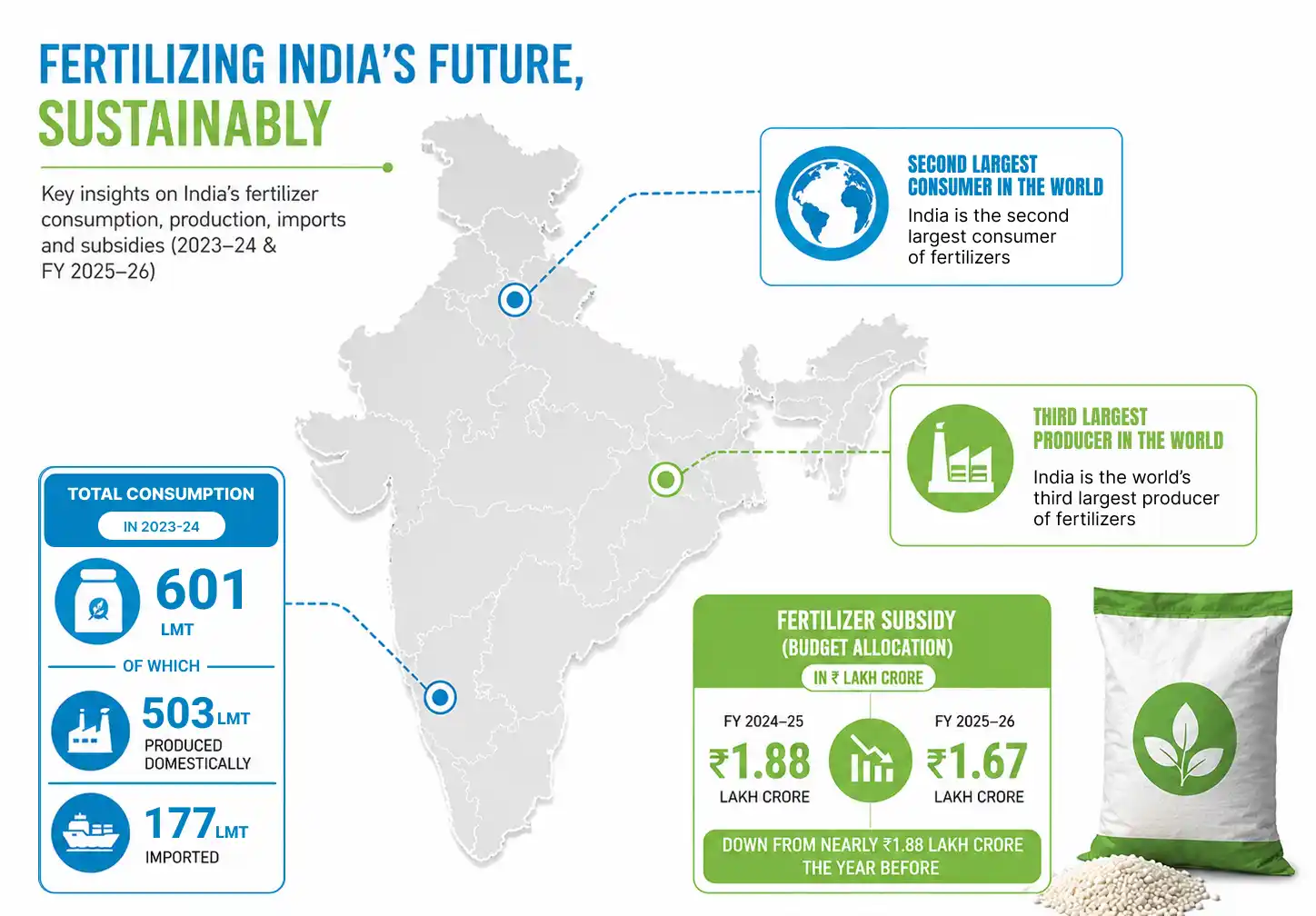
India is the world’s second-largest user and third-largest producer of fertilizers. In 2023–24, total consumption stood at 601 LMT, of which 503 LMT was produced domestically, and 177 LMT was imported. The government allocated ₹1.67 lakh crore for fertilizer subsidies in FY 2025–26, down from nearly ₹1.88 lakh crore the year before.
We are paying more, not farming better. Soil organic carbon across many agricultural regions has fallen from around 1% in the 1950s to just 0.3–0.4% today, a quiet crisis unfolding beneath our feet. India’s per-hectare fertilizer use remains well above the global average, yet our rice and wheat yields continue to lag behind China, Egypt, Vietnam, and several other developing economies.
More input is not producing better output. That is the contradiction this moment demands we resolve.
With that context, let us look at the strategies that would yield meaningful outcomes and help fulfill the PM’s appeal to cut chemical fertilizer use by 50%.
Step One: From Intuition to Intelligence
Why does a paddy farmer in Andhra Pradesh apply the same quantity of urea as one in West Bengal?
The soil types differ.
Rainfall differs.
The crop variety and growing temperatures differ.
Yet both farmers draw from the same inherited playbook, occasionally reinforced by a dealer’s recommendation, and apply broadly the same amount.
This is farming by intuition. And intuition, however well-intentioned, is not precision.
True precision agriculture begins with understanding the specific nutrient requirements of a crop in a specific field, in a specific season. At Cropin, using satellite imagery, weather data, soil information, and AI-powered crop models, including 22 field-tested models covering nitrogen uptake, water stress, crop health, and yield prediction, we generate farmer advisories tailored to the plot level. Variable Rate Technology (VRT) enables fertilizer application at rates that vary across a single field based on soil nutrient levels and crop stage.
The result? No blanket application. No waste.
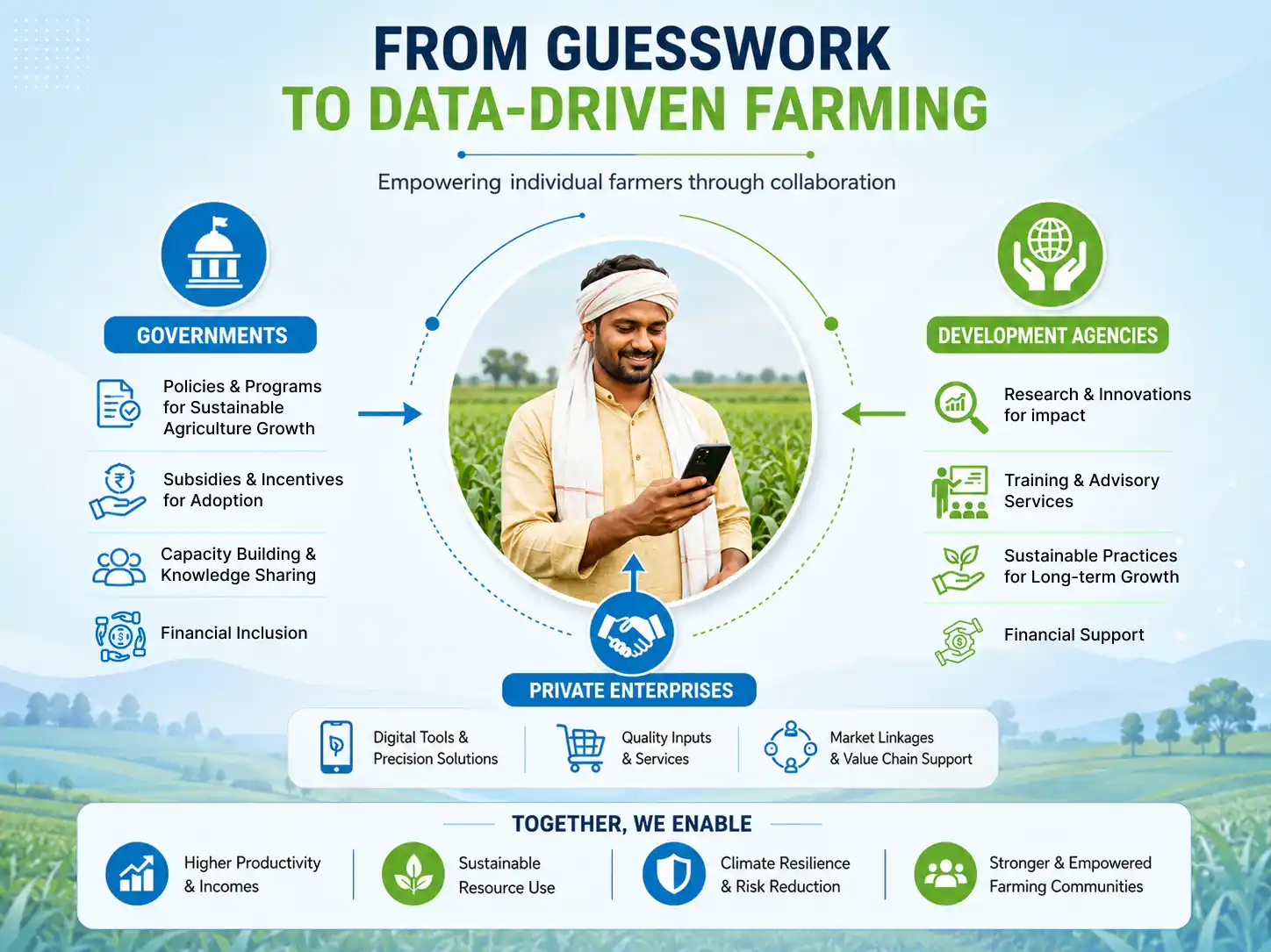
The shift from guesswork to data-driven farming must be spearheaded by governments, development agencies, and private enterprises, not left to individual farmers already juggling weather risks, input costs, and livelihood pressures. The initial investment by these partners will be surpassed by the social, economic, and agronomic returns within just a few seasons.
Step Two: Know What the Country Is Actually Growing
Before planning a fertilizer transition at a national scale, we need to know with certainty what crops are being grown, where, and on how many acres. That clarity does not yet fully exist.
How many farmers are cultivating paddy right now across India? How many acres are under wheat? Estimates exist, but estimates are not good enough when we are talking about food security for 1.4 billion people.
Using remote sensing and AI, Cropin can provide country-scale crop mapping. We have done this in Kenya, Nigeria, and Mexico, deploying AI and satellite imagery to detect production declines across vast regions, giving policymakers the intelligence to act. In Kenya, this approach revealed the wheat cultivation picture at a resolution traditional surveys could never achieve.
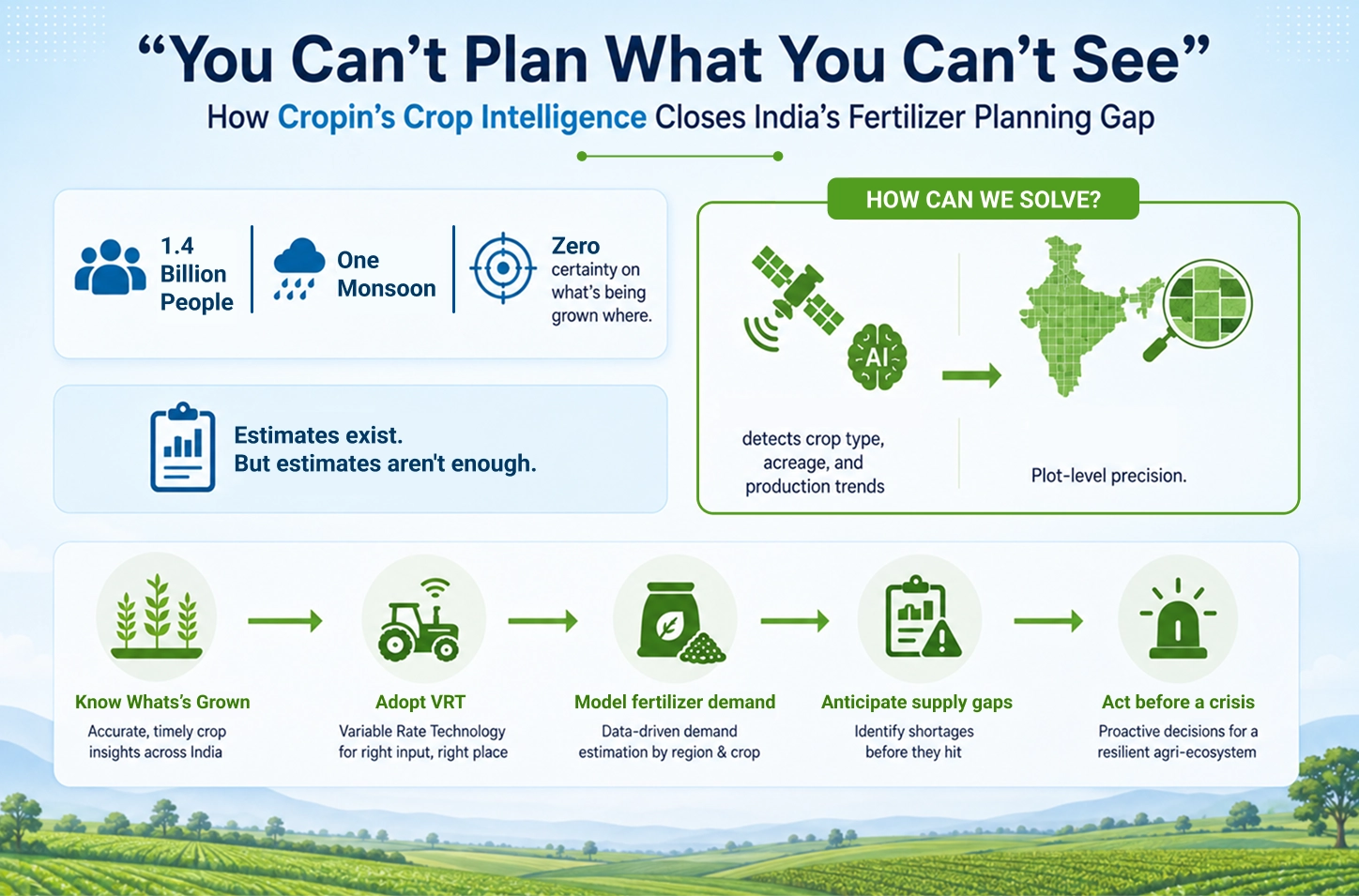
Once we know what is grown where, we can model fertilizer demand crop by crop, region by region, season by season and anticipate demand-supply gaps for urea, DAP, MOP, and NPK before they become crises. For context, 100% of India’s Muriate of Potash and 60% of its DAP is imported. Better crop visibility translates directly into better procurement strategy.
This intelligence matters even more as farming patterns shift. Media reports already suggest that farmers may shift away from paddy and maize toward soybean and pulses amid monsoon uncertainty ahead of the upcoming kharif season. Without a real-time view of what India is growing, import-export and policy decisions will always be reactive rather than strategic.
Step Three: Fertilizer, Water, and Energy Are One Problem
The fertilizer conversation cannot be separated from energy and water. India’s farm sector accounts for about two-fifths of the country’s annual diesel demand and nearly 20% of total electricity consumption. Every inefficiency in irrigation is also an energy cost and a fertilizer cost.
Most agricultural irrigation in India is not guided by soil moisture data or crop water stress models; it runs on habit. Diesel pumps run for hours because they always have. Water is applied because the season demands it. The consequence is over-irrigation that leaches nutrients from the soil, reduces fertilizer efficiency, and drives groundwater contamination. In Punjab, nitrate levels in groundwater have been rising since 1975, a direct result of nitrogen-heavy farming combined with flood irrigation.
Cropin’s irrigation advisory uses water balance models, satellite-detected soil moisture, and plant water stress indices to guide scheduling. Optimize water use, and you simultaneously reduce nutrient runoff, cut diesel consumption, and improve returns on every kilogram of fertilizer applied. These are not separate levers; they are one system.
Cropin’s work with the Asian Disaster Preparedness Center (ADPC) under the World Bank-financed CARE for South Asia project in Sri Lanka and Bangladesh demonstrates exactly what this looks like at scale. Across 8,000+ farmers, our AI-driven advisories guided precise fertilizer application by identifying nutrient-deficient zones and timing inputs to actual crop needs rather than habit or guesswork. The result: farmers cut inputs and fertilizer costs by over 50%.
The project also helped farmers conserve water and energy. For instance, weather advisories alerting them to upcoming rainfall meant spraying could be delayed or avoided entirely. Scaled up, this kind of precision gives local administrations the data to decide how much water to release into canals based on real demand, not historical trends, driving meaningful energy and water savings at the regional level.
Step Four: The Food Security Equation Cannot Be Ignored
If farmers in paddy-producing regions shift to lower-input crops in response to price signals or policy nudges, who is tracking the downstream impact on rice availability, procurement prices, and export commitments? If PM-PRANAM reduces chemical fertilizer use by 10% nationally, what is the modeled yield impact, and how does that affect buffer stocks?
India’s foodgrain output reached a record 357.73 million tonnes in 2024–25, up 8% from the previous year. Any policy-driven reduction in input intensity will have yield implications that must be modeled in advance, not after the fact.
In the era of AI, these questions are answerable, even though agriculture remains one of India’s least digitized sectors. But they must be asked and answered before the transition begins. Countries that skipped this step paid a steep price. With 1.4 billion people depending on India’s food system, we cannot afford to.
Country-scale crop intelligence gives governments and development agencies the visibility to model these scenarios and to make decisions grounded in data, not hope.
Step Five: Transition to Natural Farming - But Do It Right
I believe in natural farming. I believe in regenerative agriculture. At Cropin, we are actively helping potato farmers in Europe move from conventional to regenerative practices and we understand, better than most, how demanding that journey is.
The keyword is transition. Not overnight. Not in one season. Not even five.
Sri Lanka’s 2021 nationwide ban on chemical fertilizers caused food production to collapse by 40–50%. Prices skyrocketed. The economic and political fallout was severe. The lesson is not that natural farming is wrong; it is that transition without data, infrastructure, and supply chain readiness is catastrophic.
India is the world’s second-largest producer of both rice and wheat, with production reaching 150.18 million tonnes of rice and 117.94 million tonnes of wheat in the 2024–25 agricultural year. Each acre under natural farming will yield differently depending on soil health, variety, availability of organic inputs, and farmer training. Before committing any portion of India’s rice bowl to this transition, we need answers: What is the yield delta per acre? Do we have sufficient compost and biofertilizer supply to substitute even 10% of chemical inputs? How many seasons of income support does each farmer need?
These answers require a data layer that does not yet exist at the national scale. Building it is not a barrier to the transition; it is the transition. Scientifically grounded, digitally monitored, and regionally sequenced.
The Coalition India Needs
This problem is too large and too consequential for any single player. Encouraging farmers to use less fertilizer, without precision guidance, alternative supply chains, or income protection will do more harm than good.
What India needs is a coalition?
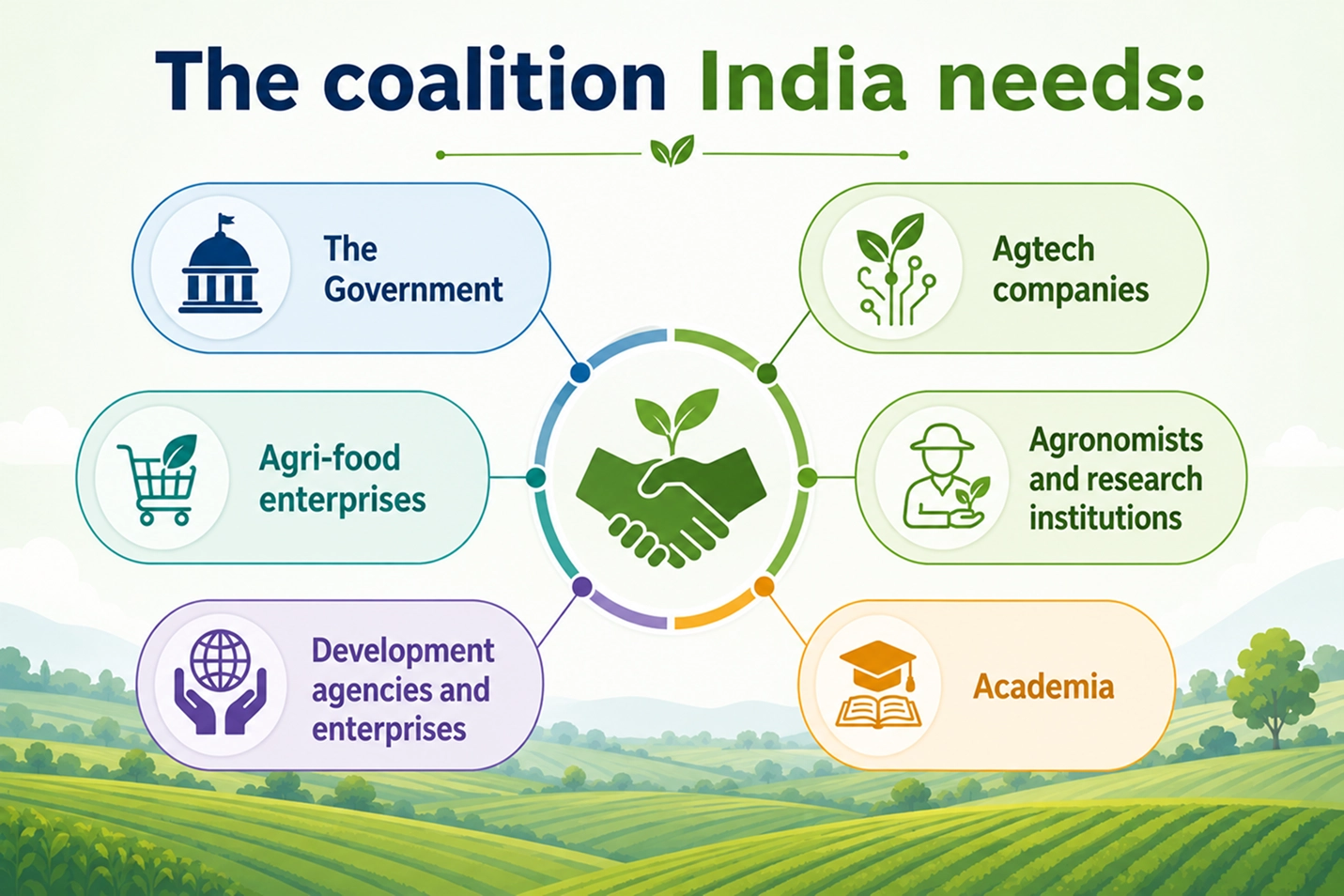
The Government: must realign incentive structures so that balanced nutrition is economically rational, not just agronomically advisable. PM-PRANAM is a step in the right direction; it needs proper planning, urgency, and supporting policy around it.
Agtech companies: must be embedded in policy, delivering crop mapping, precision advisories, demand forecasting, and transition planning at the scale and cost Indian agriculture requires.
Agri-food enterprises: seed companies, input providers, processors, and exporters must recognise that their long-term supply chains depend on soil health. They have both the incentive and the reach to drive change at the farm level.
Agronomists and research institutions: must convert science into field-ready protocols for climate-smart agriculture, soil restoration, and natural input management.
Development agencies and enterprises: must fund the transition, protect farmer incomes during yield adjustment periods, and help build organic input supply chains at scale.
Academia: must generate rigorous, region-specific data on yield impacts, soil carbon sequestration, and input substitution rates, the evidence base policymakers need to act with confidence.
Conclusion
India has a remarkable opportunity; to show the world how a country of its size, diversity, and food security complexity can transition from chemical dependency to intelligent, sustainable farming. Not by wish, but by design. Not by intuition, but by intelligence.
The PM has set the direction. Now it is time for the ecosystem; government, industry, technology, academia, and civil society to build the road.
Author Bio

Krishna Kumar
Krishna Kumar is the Founder and Chief Executive Officer of Cropin, the world's most advanced AI platform for Food and Agriculture. He established Cropin in 2010 and pioneered the use of digital technologies and predictive intelligence. Cropin is transforming humankind’s oldest industry – agriculture into a modern, digitally connected sector. Today, Cropin has digitized over 30 million acres and empowered nearly 7 million farmers across 103 countries. Under his leadership, Cropin has introduced cutting-edge innovations, including Cropin Cloud and the industry's first real-time Gen AI platform, Cropin Sage, with the goal of building intelligence around every acre of cultivable land. Passionate about transforming global food systems through tech and data, he has also been recognized as a UBS Global Visionary, World Economic Forum Steering Committee Member, Top 10 Emerging Technologies of 2025, and serves as a non-official member of the National Startup Advisory Council. His areas of interest include deforestation monitoring, soil and crop intelligence, and precision agriculture. Passionate about leveraging technology for sustainable agriculture, Deepak believes that the future of farming will be shaped by the convergence of geospatial intelligence, AI, and actionable field insights to create more resilient and efficient food systems worldwide.