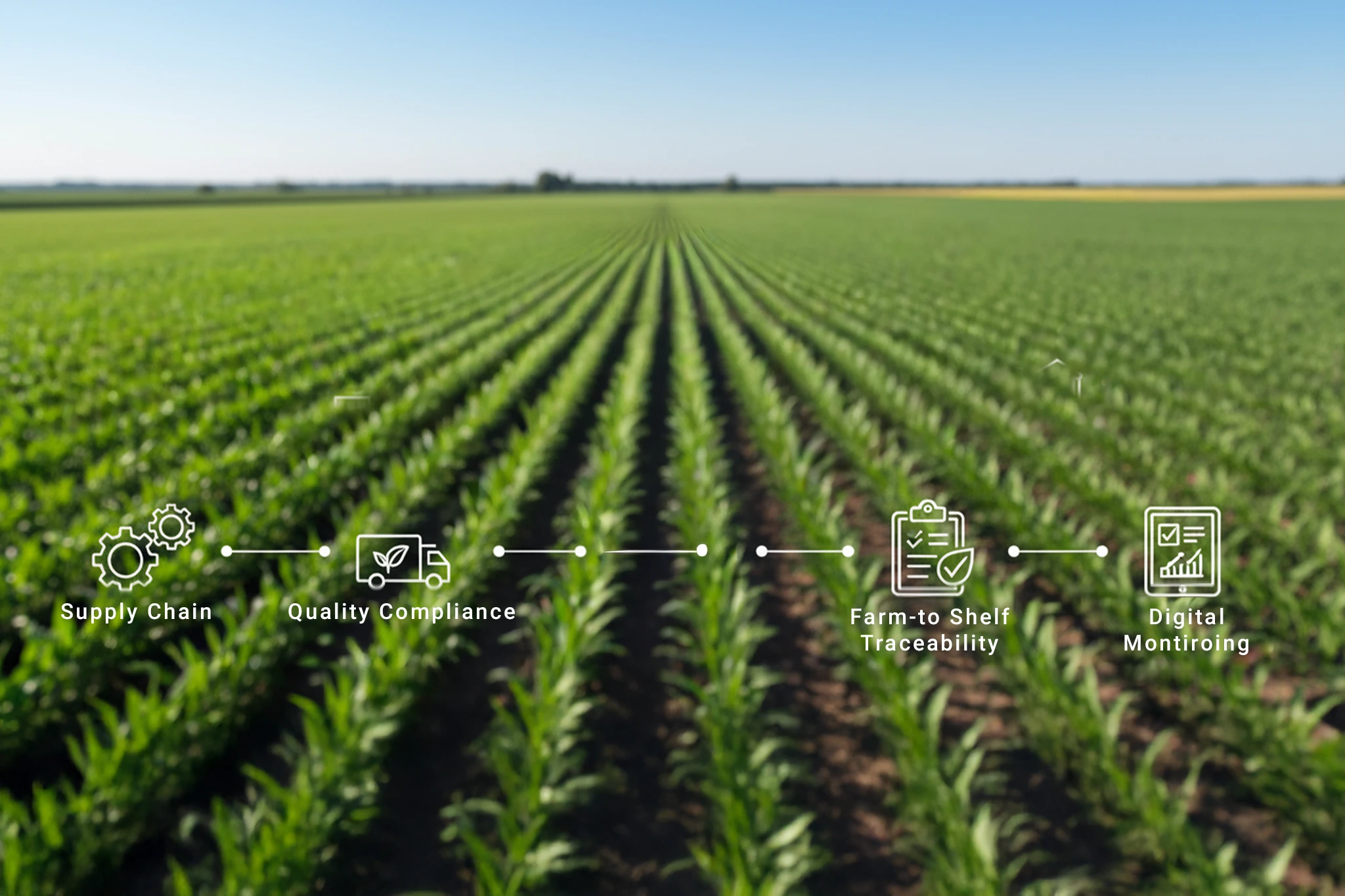
Our food systems are continually evolving, more now than ever, to feed a growing population. However, several challenges face the Agri ecosystem’s attempts to produce enough to meet the global demand for nutritious food, such as deficient crop yields, broken supply chains, and excessive food wastage, among many others.
Overcoming these hurdles requires the collaboration of all stakeholders, woven together with transformative technology solutions to ensure a sustainable, food-secure future. Against this background, traceability in agriculture is being recognized by agri-food producers as one such technology solution that provides the foundation to identify and address food system challenges.
Traceability in agriculture provides significant benefits to the various stakeholders in the supply chain. For producers, specifically, these benefits could be operational efficiencies, better risk mitigation, improved access to global markets, and even contributing to achieving the Sustainable Development Goals (SDGs).
Let us take a closer look at the top seven benefits for agri-food producers.
1. Optimized supply chains
An evident advantage of digitizing supply chains is that it makes them traceable by creating a digital record of all activities and improves the capability to internally track and document all activities from production and harvest to warehousing and distribution.
Traceability in agriculture, therefore, makes the supply chain more transparent and offers better control over operations to all the stakeholders. It facilitates them to address pain points, such as food loss or wastage, and identify opportunities to accelerate processes and make them cost-effective.
2. Food safety and quality compliance
One of the ways an effective food traceability system improves risk management is by enabling agribusinesses to implement a mechanism for safety and quality compliance. The visibility that such systems provide allows stakeholders in the supply chain to quickly identify vulnerabilities and reduce their response time to food crises, such as contamination or disease outbreaks.
3. Identification of deforestation risks in the supply chain
Global organizations that work towards ecosystem conservation can employ traceability and remote sensing to monitor issues such as deforestation. Gaurav Gupta, the Head of Conservation Landscape at WWF-Myanmar explains how the organization uses a digital platform to register natural rubber farmers in Myanmar along with information pertaining to their geospatial location, the crops they cultivate, and the farming practices they follow. All transactions starting from these farmers, all the way up to the international buyers, are then recorded in the system to map out the supply chain.
“This provides us [with an] incredible amount of data that is absolutely needed for us to monitor whether there is a system in place that incentivizes farmers to not do any further deforestation and well as to protect the no-go zones around their area. This gives us the power to also do geospatial monitoring.”
For instance, satellite monitoring and remote sensing technologies enable them to capture deforestation. “Once we register farmers in the system, we can overlay any new deforestation with the geospatial coordinates of the farmers. If there is any deforestation in the vicinity of the registered farmers, we can do further investigation. If farmers who have committed to sustainable production are responsible for the deforestation, they can be easily decoupled from the registered supply chain.”
4. Better price realization
Agriculture traceability systems that capture farm-level activities help producers to authenticate that they have met the standards set by certification bodies, particularly concerning the quality and safety of the product, fair labor practices, and the like. This helps them gain better access to local and international markets and negotiate higher prices for the quality assurance they provide. Several studies point to the fact that several consumers today are willing to pay extra for products with traceability information.
5. Strengthened brand equity
Considering that today’s consumers are highly aware and concerned about the safety of the products they buy, traceability plays an integral role in their purchasing decisions and, consequently, the trust they place in a brand or a product. Firstly, prompt and proactive actions on the part of the businesses during an emergency, as mentioned above, secures the consumers’ trust in the brand and their continued loyalty. Secondly, farm-to-shelf traceability systems also prevent illegal and fraudulent practices right from the source and contribute to accurate certification and product labeling. The certification will, in return, guarantee that the products are ethically sourced and fairly traded.
6. Improved market access
Be it for food processing companies committed to sourcing locally or for agribusinesses that strive to export domestically-produced commodities to international markets, producers can increase their marketability by employing traceability in agriculture. The information collected helps verify their product’s quality. This information is particularly beneficial when consumers opt for a product for its distinct qualities, such as its geographical indications (GI), sustainable/ethical production, its organic nature, or because it is a non-genetically modified food.
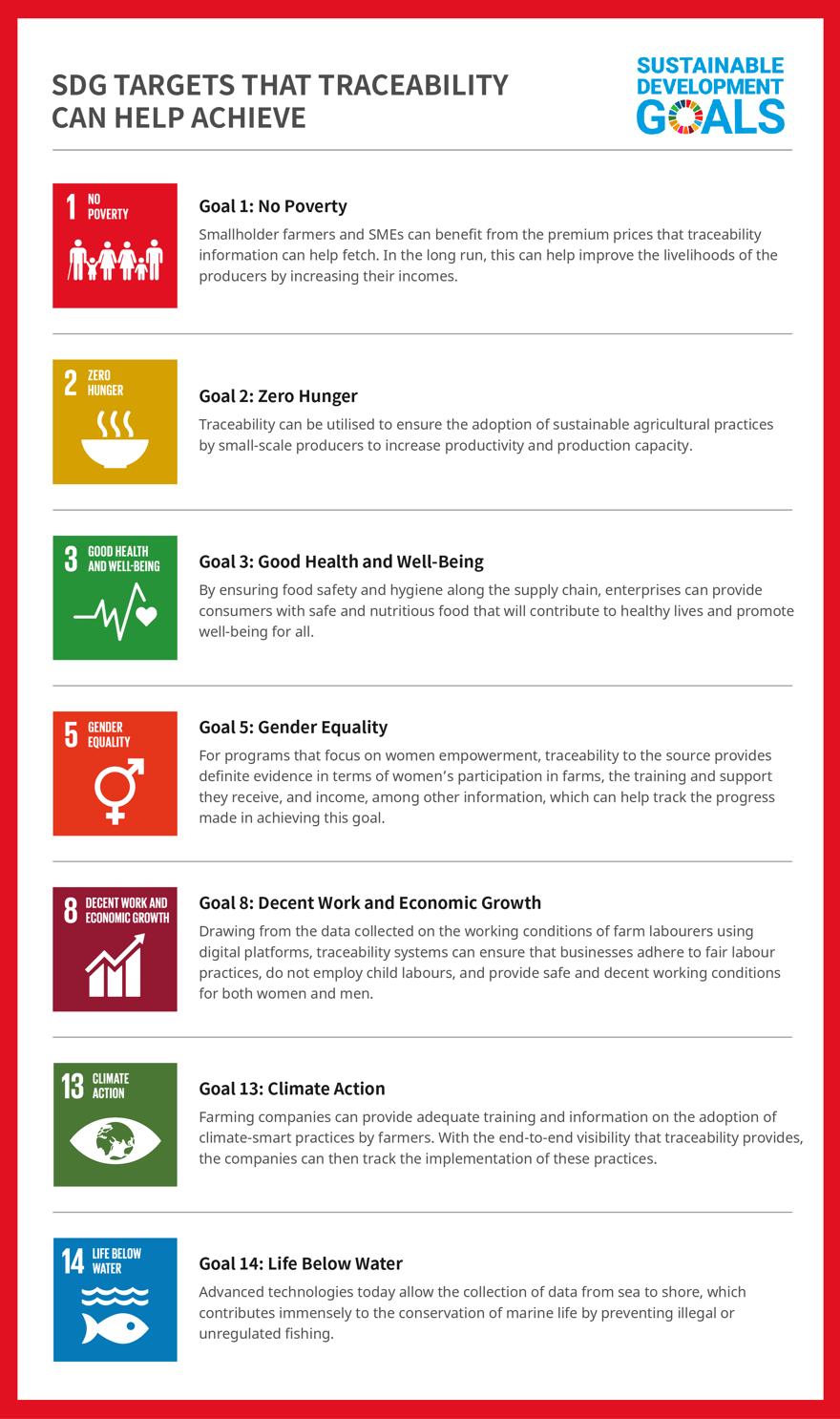
7. Contributing to the sustainable development goals
Several enterprises are identifying the role of traceability systems in supporting their mission to achieve sustainable development goals. At its core, the traceable information associated with each individually-labeled product can guarantee that the product was produced, packaged, and distributed sustainably.
Farm to fork– empowering agri-food supply chains to achieve their full traceability potential
Agri-food supply chains are complex networks that span geographies and impact a broad range of industries and their operations. Implementing end-to-end traceability in agriculture contributes to more than just regulatory compliance or ensuring food safety. It lowers operational costs for producers, improves profitability, regulates fraudulent activities or unethical practices, and unlocks new business opportunities.
When stakeholders actively collaborate to implement a tech-enabled end-to-end traceability system, supply chains can achieve their full potential.
Watch this webinar to discover more about the applications of traceability in agriculture and some of the challenges it helps overcome.
How Traceability Supports EUDR, FSMA 204, and GlobalGAPCompliance.
EUDR Compliance and Deforestation Monitoring
The European Union Deforestation Regulation (EUDR) enforcement confirmed for 31 Dec 2026, requires companies to prove that agricultural commodities such as cocoa, coffee, rubber, soy, palm oil, cattle, and wood are not sourced land deforested after 31 Dec 2020. Non-compliance carries penalties up to 4% annual turnover, and a ban on placing products in the EU market.
Cropin combines farm-level geospatial data with satellite deforestation monitoring to provide auditable proof of deforestation-free sourcing. The platform captures land-use land-change (LULC) history for each sourcing region, enabling EUDR compliance documentation
FSMA 204 Traceability Requirements
Food Safety Modernization Act (FSMA) 204, proposed by the United States Food and Drug Administration (USFDA) aims to mandate traceability records to fast-track recalls. While the original compliance date was set for January 20, 2026, the FDA has proposed an extension to July 20, 2028. The law requires companies to maintain detailed traceability records for high-risk foods.
Businesses must track Key Data Elements (KDEs) – such as product identity, location, and date – and Critical Tracking Events (CTEs) – such as harvest, processing, packaging, and shipment throughout the food supply chain. For food produce like potatoes, harvest date, location, and handler identity are critical KDEs.
GlobalGAP Certification and Farm Traceability
GlobalGAP certification focuses on food safety, sustainability, worker welfare, and responsible agricultural practices. Maintaining accurate farm-level records is essential for certification and audit readiness.
Traceability in agriculture enables producers to document farming practices, input usage, harvest records, and supply chain movements to support GlobalGAP certification requirements.
Traceability in agriculture enables producers to document farming practices, input usage, harvest records, and supply chain movements to support GlobalGAP certification requirements. Cropin’s digital Monitoring, Reporting, and Verification (dMRV) provides time-stamped, geo-referenced immutable record of every observation (land and satellite), reducing audit preparation time.
Why Agricultural Traceability Matters More from 2026
1. The Regulatory Convergence
In 2026, agricultural traceability has shifted from a competitive advantage to a business necessity. Three major regulatory deadlines are converging simultaneously: the European Union Deforestation Regulation (EUDR) enforcement (December 2024 onwards), FSMA 204 compliance requirements (January 2026), and GlobalGAP certification demands from major retailers. Companies without traceability systems in place are facing a critical window to implement solutions before losing market access and incurring regulatory penalties. For agribusinesses sourcing from or selling to Europe and North America, traceability is no longer optional.
2. Market Access and Retailer Requirements
Major global retailers – Walmart, Carrefour, Nestlé, PepsiCo, and Unilever – now require farm-level traceability data from all suppliers. These companies have made public commitments to deforestation-free sourcing and sustainable procurement, and they are enforcing these commitments through supply chain audits. Producers and exporters without documented traceability records are being delisted from supplier lists or facing price penalties. In 2026, traceability is directly tied to market access and profitability. A farmer or exporter without traceability data cannot sell to these buyers, regardless of product quality
3. Technology Enablement
Modern agricultural traceability platforms combine multiple technologies to deliver scalable, auditable visibility across global supply chains. Geospatial intelligence (satellite imagery) verifies land use and detects deforestation risks. Remote sensing monitors crop health and growth stages. IoT-enabled farm monitoring captures real-time data and handler information. AI-powered analytics automate compliance reporting and flag supply chain anomalies. In 2026, these technologies have matured to the point where traceability is no longer a manual, paper-based process – it is a digital, real-time, immutable, automated system. This technological shift makes traceability affordable and scalable for agribusinesses of all sizes
Supply Chain Resilience
Beyond compliance, traceability has become essential for supply chain resilience. Climate disruptions, geopolitical conflicts, and disease outbreaks are creating unpredictable sourcing challenges. Companies with traceability systems can quickly identify alternative suppliers, verify their compliance status, and pivot sourcing decisions in real-time. Companies without traceability data face weeks or months of uncertainty during supply chain disruptions. In 2026, traceability is a strategic tool for business continuity and risk mitigation, not just regulatory compliance.
Ready to unlock the future of agriculture?
Explore Cropin Sage and witness the power of real-time agri-intelligence.
Frequently Asked Questions About Agricultural Traceability
What is EUDR and how does traceability help?
EUDR (European Union Deforestation Regulation) requires businesses to prove that agricultural commodities are not linked to deforestation. Agricultural traceability systems help companies collect geospatial farm data, monitor sourcing regions, and maintain auditable compliance records.
What is FSMA 204 and what traceability data does it require?
FSMA 204 is a food traceability regulation under the U.S. Food Safety Modernization Act. It requires businesses to maintain records for Critical Tracking Events (CTEs) and Key Data Elements (KDEs) throughout the food supply chain to improve food recall readiness and safety monitoring.
How does GlobalGAP certification connect to farm traceability?
GlobalGAP certification requires producers to maintain accurate records related to farming practices, inputs, worker safety, and product handling. Farm traceability systems simplify documentation and improve audit readiness for certification programs.
What is the difference between traceability and supply chain transparency?
Traceability focuses on tracking products across the supply chain, while supply chain transparency involves sharing sourcing, sustainability, and operational information with stakeholders and consumers. Traceability systems provide the foundational data needed for transparency initiatives.
Author Bio

Haripriya Muralidharan
Haripriya Muralidharan leads content marketing at Cropin Technology Solutions, bringing a unique scientific rigor to brand storytelling. With a Master's in Chemistry from Pune University and research experience in cancer immunology, she discovered her passion in storytelling. For two decades, she has operated at the intersection of content, communication, and brand strategy, specializing in turning complex ideas into impactful narratives. Prior to Cropin, Haripriya leveraged her creative skills at Elsevier’s Chemical Business News Base and shaped multi-format content strategies for B2B marketing at Scatter.