The global potato processing industry is under increasing pressure as climate change disrupts traditional farming patterns and raw material availability. Potatoes, once considered a stable agricultural commodity, are now highly exposed to unpredictable rainfall, rising temperatures, and soil variability. This environmental shift has transformed potato procurement from a routine logistical task (which has its set of uncertainties and is tough) into a more complex high stakes strategic challenge.
According to the FAO, while the global potato production exceeds 370 million tonnes annually, yield stability is increasingly compromised by environmental stressors. To navigate this volatility, industry leaders are leveraging AI and farm-level intelligence to move from reactive procurement to predictive supply chain management. By building data-driven resilience, food processors are securing the long-term “Surety of Supply” required to feed a global market.
The Potato's Outsized Role in Global Food Processing (potato supply chain, food processor potato supply)
Potatoes are a core raw material for global snack foods, frozen products, and packaged meals. The potato supply chain is uniquely sensitive; even minor variations in tuber quality can significantly degrade processing efficiency and product consistency. Unlike grains, which are relatively hardy, potatoes require precise temperature-controlled handling from farm to factory. Managing this complexity at a global scale is one of the most significant hurdles for modern food processors. Agtech platforms like Cropin enable food processors secure a reliable potato supply, which is critical to maintain production continuity.
From Stable Staple to Volatile Raw Material: What Changed
Historically, potatoes were viewed as a predictable staple crop. However, climate variability, soil degradation, and shifting rainfall cycles have turned them into a volatile crop. This shift has shortened procurement cycles and forced a radical rethink of sourcing strategies. Potato processors are now investing heavily in advanced forecasting to stay ahead of the next climate-induced shortage.
Why Potato Is the Hardest Crop for Food Processors to Forecast
Dry Matter Variability
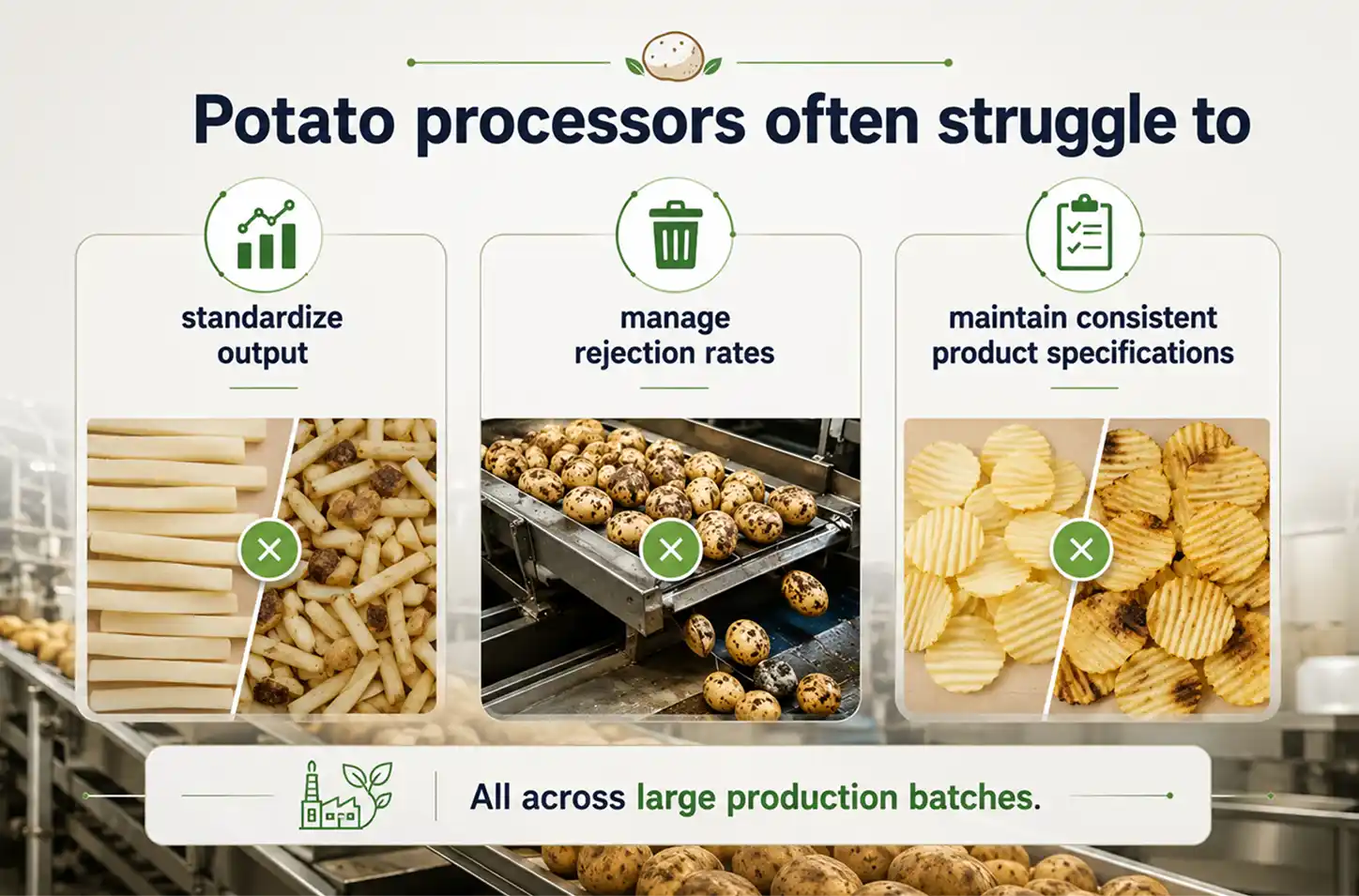
Processing outcomes such as texture, taste, and frying performance are dictated by dry matter content. However, this dry matter level is highly sensitive to changing soil conditions, irrigation practices, and weather patterns throughout the growing season.
Even within the same field, variations in nutrient availability or moisture stress can lead to uneven tuber development. Results? Inconsistent oil absorption and “crispness” in the final product. For food processors,it translates to higher rejection rates and the constant struggle to maintain a standardized output.
Underground Risk
Because potatoes develop entirely beneath the soil, they are “hidden” from traditional scouting. This lack of visibility makes early detection of fungal infections, pests, or nutrient deficiencies nearly impossible. By the time symptoms appear on the foliage, the damage to the tubers is often irreversible. This “information gap” creates massive uncertainty for procurement teams who need accurate yield forecasts months in advance.
In many cases, traditional field visits are not sufficient, which is why digital monitoring tools and satellite-based crop intelligence systems are becoming increasingly important for improving visibility and reducing risk.
Storage Complexity
Post-harvest, the potato remains a living, breathing organism. Storage is not just a holding phase; it is an extension of the supply chain. Precise management of temperature, humidity, and ventilation is required to prevent sprouting or sugar buildup, which turns fries brown and bitter. For food processors, poor storage management can lead to significant losses even when field yields are strong. In a warming world, traditional storage is no longer enough; it must be integrated with real-time monitoring to prevent catastrophic spoilage.
Plot-Level Yield Forecasting: How AI Is Changing Procurement Planning for Potato Processors
“Surety of supply” has become a critical focus for global food processors as climate uncertainty continues to disrupt agricultural output. In potatoes, where both yield and quality can vary widely even within nearby fields, traditional forecasting methods are often not precise enough to support procurement decisions.
With AI-powered platforms like Cropin, processors can now provide plot-level yield forecasting, where every farm plot is analyzed individually using real-time and historical data. These models consider soil health, weather patterns, irrigation practices, and crop growth stages to generate more accurate yield predictions.
To further strengthen procurement decisions, Cropin accounts for unforeseen events, such as mid-season weather anomalies or pest infestations, in its yield re-estimation model. It adjusts the initial crop yield estimate using new in-season data. Cropin’s deep-learning models overlay accurate ground data, zone sampling to account for sample heterogeneity, remote sensing data, and historical and current observations to improve yield re-estimation accuracy.
This predictive sourcing allows processors early visibility to avoid last-minute shortages and align factory demand with actual field output. This strengthens long-term supply stability and ensures more consistent raw material availability for processing operations.
How Climate Change Is Breaking the Potato Supply Chain
Extreme weather events are now significantly contributing to climate change-induced potato supply disruptions. Studies show that extreme weather events can reduce yields by 20-30% in vulnerable regions, directly inflating procurement costs and affecting availability.
Yield Shocks, Price Spikes, and Quality Loss: The Hard Numbers(climate change potato supply, potato yield loss climate)
Climate change is causing measurable disruptions in the potato sector. Climate and potato yield loss are directly linked, as climate anomalies during the critical tuber-bulking stage lead to immediate declines in both quality and quantity.
These shocks often trigger sharp price spikes in the open market, as processors scramble to secure processing-grade supply. Higher rejection rates due to heat stress further squeeze margins and disrupt manufacturing schedules. Overall, climate change-induced potato supply disruptions are increasing volatility across procurement, pricing, and processing efficiency.
Cold Chain Under Pressure: When Storage Fails in a Warming World (potato supply chain resilience)
As ambient temperatures rise, the energy and infrastructure required to maintain “dormancy” in storage increase. When storage conditions fail, the resulting sprouting and decay create a “bottleneck” in the supply chain, highlighting the urgent need for IoT-enabled monitoring and improved potato supply chain resilience. It is today a critical priority for food processors.
Downstream Impact: What Supply Disruptions Cost Food Processors and CPG Brands (CPG supply chain)
Disruptions in potato supply directly impact the CPG supply chain, affecting production schedules, increasing procurement costs, and reducing product availability in the market.
For CPG brands, an unstable potato supply means inconsistent shelf availability and a potential loss of consumer trust. When raw materials are scarce, operational costs soar, and production schedules fracture, making upstream stability a key business priority for the entire value chain.
Securing Surety of Supply: Core Strategies Food Processors Are Using
Contract Farming: Locking In Volume and Quality Before the Season Starts (surety of supply, contract farming potatoes)
Contract farming ensures Surety of Supply and secures you from the oldest inevitability, namely, competition (amidst limited arable land). It creates structured agreements between processors and farmers. Through contract farming potatoes, companies secure predefined volumes, quality standards, and pricing before planting begins, reducing exposure to market fluctuations and ensuring more predictable procurement outcomes across seasons.
Agtech platforms like Cropin enable
- Remote site selection
- Universal contract with common template and editable fields
- Global standardized regardless of location
- Improved transparency, agility, and scalability
Geographic Sourcing Diversification: Not Relying on One Region or One Crop Cycle (surety of supply, potato supply chain resilience)
Diversifying sourcing regions strengthens the Surety of Supply by reducing dependency on a single geography. This improves potato supply chain resilience by balancing risks from localized climate events, crop failures, and seasonal disruptions, ensuring more stable and continuous raw material availability for processors.
Cropin empowers your expansion plans with:
- Dynamic agri-mask generation
- Crop suitability and yield estimation
- Crop acreage estimation
- Long term weather and sisease pressure forecasts
- Insights on high-stress and high-yield areas
Regenerative Agriculture Partnerships: How Leading Processors Are Stabilizing the Farm Base (regenerative agriculture potato)
Investing in regenerative agriculture potato programs helps improve long-term soil health and water retention. These practices enhance biodiversity and reduce input dependency, leading to more stable yields and healthier farming ecosystems that support consistent supply for processors over time.
Cropin’s Decision Support System (DSS) enables adoption of regenerative agriculture. We help track and validate:
- Reduced tillage
- Cover croppin
- Crop rotation
- Input usage
- Traceability
Climate-Resilient Potato Varieties: Investing to Protect Downstream Supply
Developing climate-resilient seed varieties enables potato farmers to adapt to rising temperatures, irregular rainfall, and pest pressures. These improved varieties support stable production cycles, helping processors protect downstream supply chains and maintain consistent quality even under changing environmental conditions.
Digital Solutions Powering a More Resilient CPG Potato Supply Chain
AI-Driven Climate Risk Forecasting for Raw Material Procurement (CPG supply chain digital solutions, potato supply chain)
CPG supply chain digital solutions powered by AI are helping food processors move from reactive procurement to predictive planning. In the potato supply chain, climate variability directly impacts yield timing and quality, making early risk detection essential.
AI models analyze weather trends, soil moisture patterns, and historical crop behavior to forecast potential disruptions. This allows processors to adjust sourcing strategies in advance, reduce procurement uncertainty, and secure more stable raw material availability across seasons.
Precision Agriculture and IoT: Bringing Field-Level Data Into Processor Decision-Making (CPG supply chain digital solutions, precision agriculture potato)
CPG supply chain digital solutions, combined with precision agriculture potato technologies, are transforming how potato processors interact with farms. Through IoT sensors, satellite imagery, and AI-driven field analytics, Cropin enables continuous monitoring of crop health, soil conditions, and growth stages.
This real-time visibility helps processors identify stress early, improve yield prediction accuracy, and make more informed procurement decisions, reducing risk and improving overall supply planning efficiency.
End-to-End Traceability: From Farm to Factory to Retailer Shelf (CPG supply chain)
End-to-end digital traceability strengthens the CPG supply chain by creating full visibility across every stage of production. From farm input usage to processing and distribution, each step is digitally recorded and monitored.
This improves quality assurance, supports regulatory compliance, and enhances accountability across the value chain. For potato processors, traceability also helps quickly identify the source of quality issues, reducing waste and improving operational responsiveness.
How Global Food Processors Are Responding: Real-World Examples
Global food processors are increasingly adopting digital agriculture and sustainability-led sourcing models to stabilize the potato processor supply chain. By combining farm-level intelligence with data-driven procurement, they are improving yield predictability and profitability, while reducing the impact of climate-related risks. These approaches help ensure more consistent quality and volume, while strengthening long-term supply resilience across sourcing regions and farming networks.
PepsiCo
PepsiCo has been strengthening its potato sourcing ecosystem by using digital agriculture platforms and working closely with farmers to improve yield predictability. By combining data-driven insights with sustainable farming practices, the company has reduced supply volatility and improved procurement planning for the food processor’s potato supply chain.
These efforts help PepsiCo gain better visibility into crop conditions and expected output, enabling more consistent quality and volume alignment across seasons. Cropin’s intelligence solutions further support such initiatives by providing real-time field insights and improving decision-making across sourcing regions.
Conclusion
The global potato processing industry is entering a new era where climate variability and supply uncertainty are the norm rather than the exception. To survive, food processors must move beyond traditional procurement and embrace AI, regenerative practices, and digital intelligence.
Digital intelligence platforms like Cropin are essential in this transition enabling predictive procurement and improving visibility across the entire supply chain. As climate pressures intensify, data-led decision-making will become essential for global food security and ensuring consistent potato availability for processing industries.
Transform your potato supply chain with Cropin’s AI-powered farm intelligence platform. Gain real-time visibility, reduce procurement risks, and ensure consistent supply with data-driven precision.
Frequently asked questions (FAQs)
How is climate change affecting potato supply for food processors?
Climate change is increasing temperature extremes, irregular rainfall, and pest pressure, which directly impacts potato yield and quality. These disruptions make procurement less predictable and increase volatility in the food processor potato supply chain, affecting both availability and processing consistency.
What does surety of supply mean in potato procurement?
Surety of supply refers to the ability of food processors to secure the right quantity and quality of potatoes at the right time. It focuses on reducing uncertainty in procurement through better forecasting, planning, and farmer coordination.
What are the biggest risks to the global potato supply chain right now?
Key risks include climate variability, soil degradation, storage losses, and price volatility. These factors affect both yield stability and quality consistency, making supply planning more complex for processors globally.
How are CPG companies using digital tools to protect potato raw material supply?
CPG companies are deploying platforms like Cropin to leverage AI, satellite monitoring, and IoT sensors to track crop health, forecast yields, and monitor storage conditions. These CPG supply chain digital solutions improve visibility and reduce procurement risk.
What strategies are leading food processors using to secure potato supply?
Leading processors are using contract farming, geographic diversification, regenerative agriculture, and climate-resilient seed varieties to stabilize supply and reduce dependence on single-region sourcing.
How does contract farming help food processors manage potato supply risk?
Contract farming helps processors secure predefined volumes, quality standards, and pricing before the season begins. This reduces exposure to market fluctuations and ensures more predictable procurement outcomes.
What is regenerative agriculture, and why do potato processors invest in it?
Regenerative agriculture focuses on improving soil health, biodiversity, and water retention. Potato processors invest in it because healthier soil leads to more stable yields, improved crop quality, and long-term supply sustainability.
Author Bio

Haripriya Muralidharan
Haripriya Muralidharan leads content marketing at Cropin Technology Solutions, bringing a unique scientific rigor to brand storytelling. With a Master's in Chemistry from Pune University and research experience in cancer immunology, she discovered her passion in storytelling. For two decades, she has operated at the intersection of content, communication, and brand strategy, specializing in turning complex ideas into impactful narratives. Prior to Cropin, Haripriya leveraged her creative skills at Elsevier’s Chemical Business News Base and shaped multi-format content strategies for B2B marketing at Scatter.