
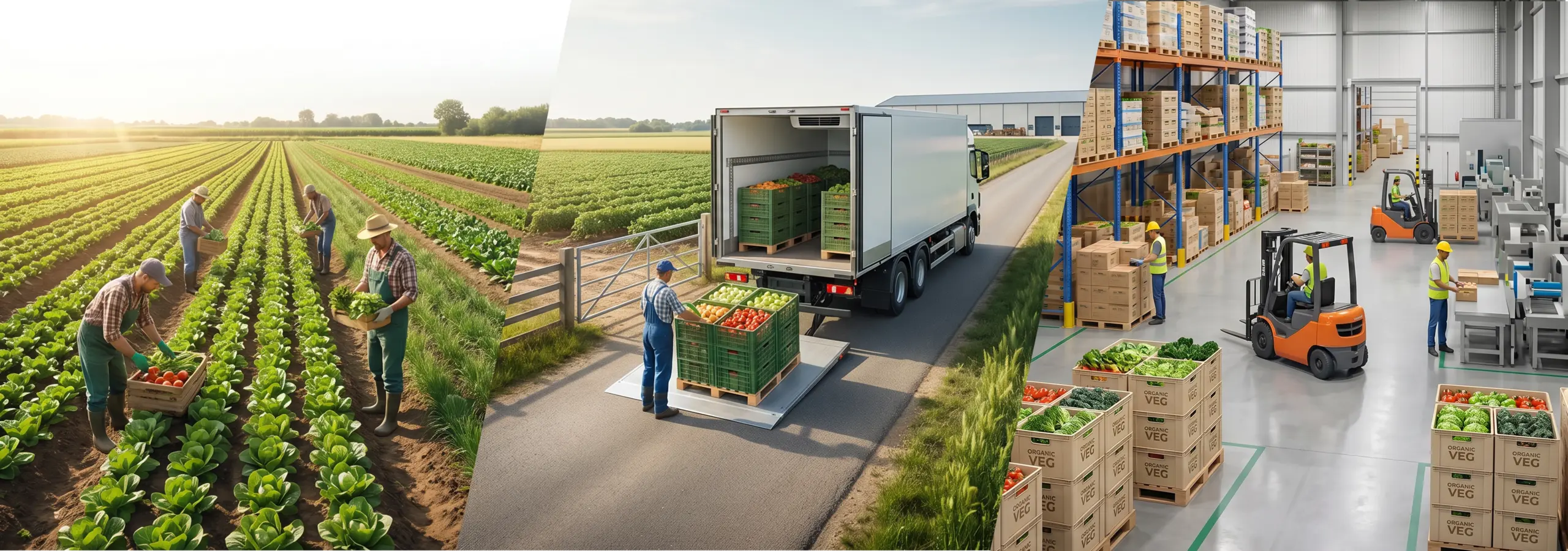
Synopsis:
This blog explores how FSMA 204 is transforming food supply chains from the ground up, turning compliance from a regulatory burden into a catalyst for digital innovation. It outlines the essential compliance steps, highlights the real-world digitization challenges faced by global agriculture, and explains the critical roles of CTEs and KDEs. The narrative then demonstrates how progressive regulations are driving the adoption of agri-tech.
Food safety in CPG and retail has been mostly reactive, with analysis after recalls. Food Safety Modernization Act (FSMA) 204, the USFDA’s (United States Food and Drug Administration) Food Traceability Rule, changes this dynamic. Any business handling foods on the Food Traceability List (FTL), ranging from leafy greens to seafood, must uphold strict traceability records under this rule. This mandatory shift aims to enable faster, more accurate tracking by requiring detailed, readily accessible records.
The mandate is clear: If you cannot provide traceability records tracing a food product back to its origin within hours, your business faces compliance risks as well as food safety concerns.
What Is FSMA 204 and Why Does It Matter for Food Traceability?
FSMA 204 formally known as the FDA Food Traceability Rule is Section 204 of the Food Safety Modernization Act (FSMA), enacted by the United States Food and Drug Administration (USFDA). It is the most significant expansion of food traceability recordkeeping requirements in US regulatory history.
The rule was built on a clear premise: when a foodborne illness outbreak strikes, the FDA must be able to trace the contaminated product back to its source within hours, not weeks. Traditional traceability methods, relying on paper logs, fragmented spreadsheets, and siloed ERP data, proved dangerously inadequate during major outbreaks. The FDA food traceability rule responds by mandating standardized, digital, and readily accessible records for high-risk foods at every step of the supply chain.
Any business that manufactures, processes, packs, or holds foods on the Food Traceability List (FTL) is subject to FSMA 204. This includes farms, processors, distributors, and retailers both domestic and foreign suppliers exporting to the US market.
What are the Foods on the Food Traceability List (FTL)
The FTL identifies high-risk categories that the US FDA has determined pose a higher threat of foodborne illness. It covers both the listed foods themselves and any multi-ingredient food that contains a listed item as an ingredient, provided the ingredient remains in the same form (e.g., fresh) as it appears on the list. The list includes:
- Nut Butters: All types of tree nut and butters, including almond, cashew, and peanut butter.
- Produce (Fresh): Vegetables (cucumbers, herbs, leafy greens, peppers, sprouts, tomatoes, etc.); Fruits (melons, some tropical tree fruits).
- Produce (Fresh-Cut): All types of fresh-cut fruits and vegetables.
- Cheeses: Fresh soft, soft-ripened, and semi-soft cheeses; cheeses made with unpasteurized milk (excludes hard cheeses)
- Shell Eggs: Eggs from domesticated chickens.
- Seafood: Finfish, Crustaceans, Molluscan Shellfish
- Ready-to-Eat Deli Salads
Who Is Exempt from FSMA 204?
With a clear understanding of which foods fall under the FTL, the next step is to recognize that not all entities are required to comply. Let’s look at the main exemptions provided by the rule.
The rule provides some exemptions based on business size, processing methods, and sales models:
- Small Businesses: Retail food establishments with $250,000 or less in annual food sales
- Direct Sales: Food sold or donated directly to consumers (like farmers’ markets)
- Processing: Produce that receives commercial processing that adequately reduces pathogens
- Rarely Consumed Raw: Produce listed as rarely consumed raw
The FSMA 204 Compliance Timeline : A 30-Month "Recovery Window"
While the original compliance date was set for January 20, 2026, the FDA has proposed an extension to July 20, 2028. This is not a reason to pause; it is a critical window for industry preparation. Transitioning from paper to a digital “Record of Traceability” takes time, especially when your supply chain spans thousands of smallholder farms.
FSMA 204 Requirements : What Compliance Really Requires
FSMA 204 focuses on tracking the physical movement of food through Critical Tracking Events (CTEs) to enable rapid recall in an emergency. Retailers and processors are now encouraging suppliers to be compliance-ready. For produce, traceability must begin at the earliest point in the supply chain.
- Growing: Farmers are required to maintain a Traceability Plan, including a detailed, geo-tagged map of every field or growing area where FTL foods are cultivated.
- Harvesting: Detailed records must be kept for each harvest, including the specific variety of the commodity, quantity, and the precise field or area harvested.
These requirements form the backbone of compliance, but implementation is not without challenges. The next section explores why many organizations struggle to bridge the gap between policy and practice.
The First-Mile Crisis: Why the Biggest FSMA 204 Traceability Gap Starts at the Farm
While the law sets a progressive standard, the realities of global agriculture present a sobering challenge. A significant infrastructure gap threatens to undermine the very goals of FSMA 204.
- The Paper-Based Peril: Nearly 70% of the world’s farms still rely on manual logs and physical ledgers. In an era of digital mandates, where speed and accuracy are non-negotiable, paper receipts are a systemic vulnerability.
- The “First Mile” Blind Spot: While most CPGs have excellent visibility into direct suppliers, FSMA 204 requires complete transparency into the “First Mile”, including geo-tagging the exact point of cultivation. This is where data often goes dark.
- The Data Silo Crisis: In a food safety crisis, speed is everything. Data trapped in isolated spreadsheets or “data silos” can’t be retrieved fast enough to satisfy an FDA inquiry, turning a local issue into a brand-wide crisis.
The Anatomy of Compliance: Understanding CTEs and KDEs
For CPG enterprises, compliance isn’t just about “knowing your farmer.” It is about the rigorous digital record of Critical Tracking Events (CTEs) and Key Data Elements (KDEs).
The law demands a continuous, digital record at every stage, including details like:
- Harvesting: Log the type of commodity, quantity, harvest date, and geo-tag each field.
- Cooling/Initial Packing: Record the Traceability Lot Code (TLC), temperature logs, packing date and quantity, and the packing location.
- Shipping & Receiving: Document transit data (TLC, shipping and receiving dates), any transformation events (processing or slicing), and sender/receiver details.
- Transformation: Assign a new TLC if products are repacked or further processed and record the quantity and date of transformation.
This level of granularity is pushing agri-tech from a “nice-to-have” innovation project to a strategic imperative. You cannot meet these requirements manually; you need a digital layer that captures data at the source, plugs the loss, and ensures it is readily retrievable.
Why FSMA 204 Is Making Agri-Tech a Strategic Imperative for the Food Industry
Regulatory pressure is no longer just a compliance hurdle; it’s a catalyst accelerating digital maturity across the industry. Forward-thinking CPG leaders now recognize that the very tools needed for FSMA 204 compliance can unlock new levels of operational excellence.
- From Burden to Benefit: Digital traceability systems don’t just satisfy the FDA, they cut waste, enable “First-Expired, First-Out” (FEFO) logistics, and safeguard your brand’s reputation.
- The End of Opaque Sourcing: Regulations are moving the industry beyond “opaque” bulk sourcing to transparent, plot-level intelligence, turning compliance into a strategic asset.
This shift in mindset turns compliance from an obligation into an opportunity for transformation. The question is no longer whether to digitize, but how and with which technology partner.
Let us now explore how technology platforms like Cropin Cloud help enterprises bridge the gap between regulatory requirements and real-world digitization.
How Cropin Agri-Intelligence Solves FSMA 204 Traceability at the Source
Cropin bridges the gap between the “manual farm” and the fully compliant enterprise. We are more than a compliance tool. We digitize ground-level realities, empowering you to build a truly resilient and future-ready business.
1. Precision Geo-Tagging & Farm Mapping
FSMA 204 requires a Traceability Plan with a detailed, geo-tagged farm map. Cropin automates this process by geo-tagging every plot in the Cropin Grow app and recording the exact crop, variety, and unique field conditions for each harvest.
2. Digitizing the Farmer & the Harvest
Moving beyond anonymous sourcing, Cropin digitizes farmer profiles and captures harvest dates directly at the source. This “born digital” approach prevents data loss between field and warehouse, ensuring complete, compliant records.
3. A Unified "Single Source of Truth"
Cropin standardizes data globally, whether your supply comes from massive plantations in Brazil or smallholder clusters in India. All Key Data Elements (KDEs) flow into a single, searchable dashboard. The platform’s multi-lingual, user-friendly interface records adoption rates above 90%.
4. Data-driven Intelligence for Agility
Agri-intelligence provides insights on real-time crop readiness for harvest, remote field monitoring at near real-time, yield estimation, and more to triangulate quality, cost, and shelf-life.
5. Risk Mitigation
Alerts on dynamic weather risks and the probability of disease outbreaks help with definitive mitigative efforts to protect harvests.
6. From Traceability to Operational Excellence
With Cropin, tracing a batch from retail shelf to specific plot takes minutes, not days. Digitizing for compliance also unlocks broader business gains:
- FEFO Logistics: Use real-time harvest data to implement “First-Expired, First-Out” inventory.
- Brand Trust: Provide consumers and regulators with a verifiable “Seed-to-Shelf” story.
- Risk Mitigation: Perform “Trace-Backs” in minutes, protecting your brand from over-reaching recalls.
Conclusion : Compliance, Connection, and a New Way Forward
The complexities of FSMA 204 should not be viewed as a regulatory burden, but as a catalyst for a long-overdue digital transformation. The era of opaque supply chains is ending. By embracing Agri-Intelligence today, CPG leaders can move beyond the “post-mortem” of food safety and build a transparent, data-driven future where time is no longer a threat, but a competitive advantage.
For every agri-enterprise, the path forward is about more than technology. It is about connection.
Digitize the first mile. Master your data. And most importantly, build supply chains that put people and trust at the center.
Author Bio

Krishna Kumar
Krishna Kumar is the Founder and Chief Executive Officer of Cropin, the world's most advanced AI platform for Food and Agriculture. He established Cropin in 2010 and pioneered the use of digital technologies and predictive intelligence. Cropin is transforming humankind’s oldest industry – agriculture into a modern, digitally connected sector. Today, Cropin has digitized over 30 million acres and empowered nearly 7 million farmers across 103 countries. Under his leadership, Cropin has introduced cutting-edge innovations, including Cropin Cloud and the industry's first real-time Gen AI platform, Cropin Sage, with the goal of building intelligence around every acre of cultivable land. Passionate about transforming global food systems through tech and data, he has also been recognized as a UBS Global Visionary, World Economic Forum Steering Committee Member, Top 10 Emerging Technologies of 2025, and serves as a non-official member of the National Startup Advisory Council.