
Synopsis:
Faced with simultaneous, climate-induced crop failures in Brazil and Vietnam, global commodity traders are abandoning reactive trading in favor of data-driven coffee supply chain risk management. This comprehensive deep-dive explores how deploying platforms like Cropin for advanced farm-level digitization, offers AI-powered yield forecasting, Disease Early Warning Systems (DEWS), and pin code-level weather updates to erase upstream blind spots well in advance. Ultimately, it demonstrates how integrating real-time environmental data allows trade houses to secure volume, mitigate price volatility, and achieve truly sustainable coffee sourcing.
Introduction
The global coffee trade is running on caffeine and anxiety. Here is a number worth sitting with: one pound of arabica coffee crossed $4 on commodity markets in early 2025. That is not a blip. It is the outcome of years of compounding supply shocks. For decades, commodity traders relied on predictable weather cycles and reliable seasonal flows to keep global mugs filled. Then came climate events, geopolitical disruption, and gone is predictability. The coffee supply chain was never built for the volatility it is now absorbing.
Today, the coffee supply chain is facing a structural shift with extreme climate shocks hitting major production hubs simultaneously. When a frost hits Brazil or a drought parches Vietnam, the shockwaves travel instantly through the Intercontinental Exchange (ICE). The result is extreme price volatility, supply anxiety, and structural disruption. To survive, commodity traders are overhauling their playbooks. They are moving away from reactive hedging. Instead, they are turning to advanced coffee supply chain risk management strategies driven by real-time data, predictive modeling, and global network diversification.
Why Global Coffee Supply Chains Are Under Severe Climate Stress
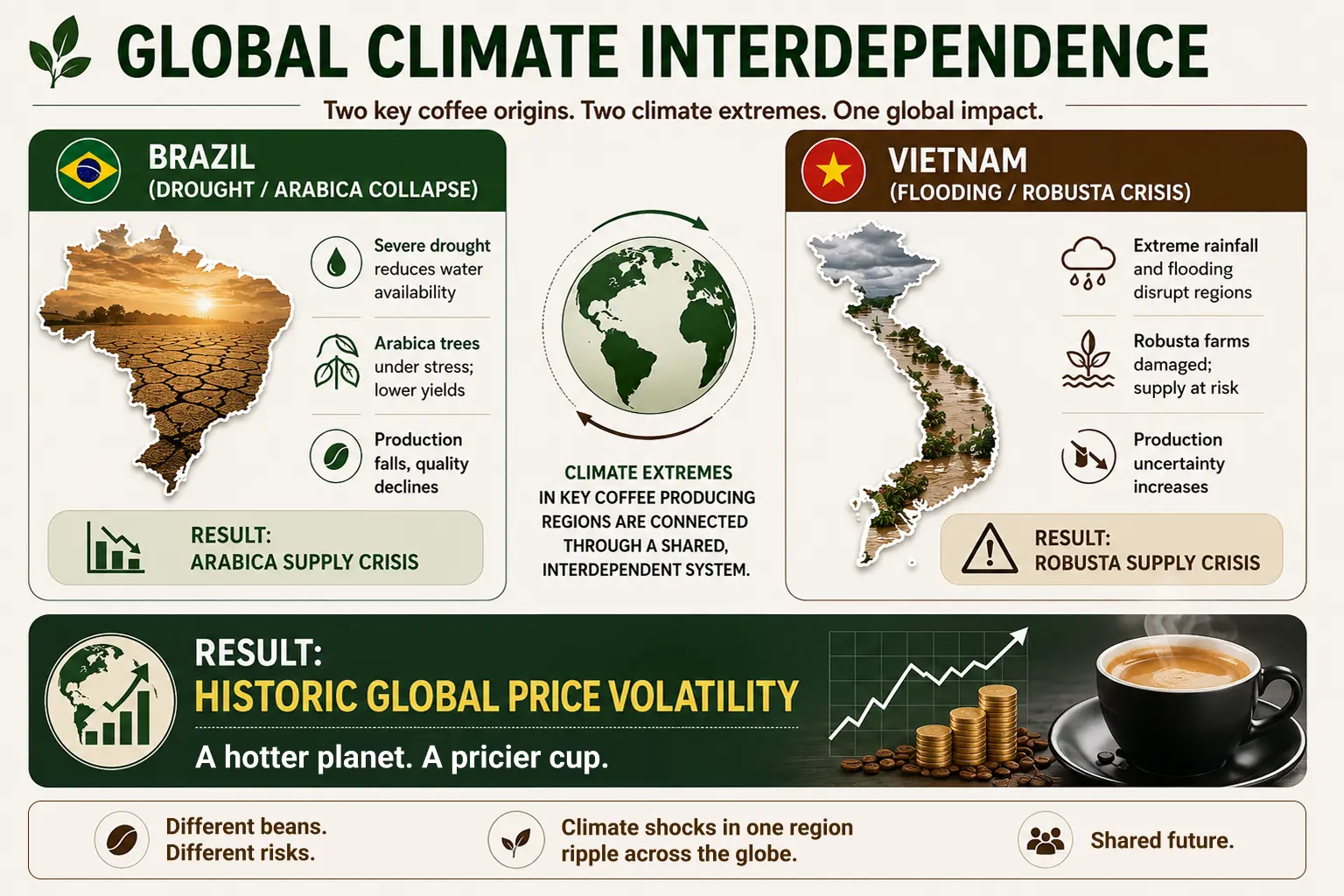
Coffee is a highly sensitive crop. It thrives within narrow temperature, altitude, and rainfall bands. When those bands shift, production numbers crater, quality degrades, and global markets panic. Arabica is delicate, while Robusta is hardier, but not immune. And the two countries that together supply more than half the world’s coffee, Brazil and Vietnam, have spent the past two years dealing with climate conditions that no historical model fully anticipated.
Brazil's Arabica Crisis: How the World's Worst Drought in 70 Years Triggered a Global Price Spike
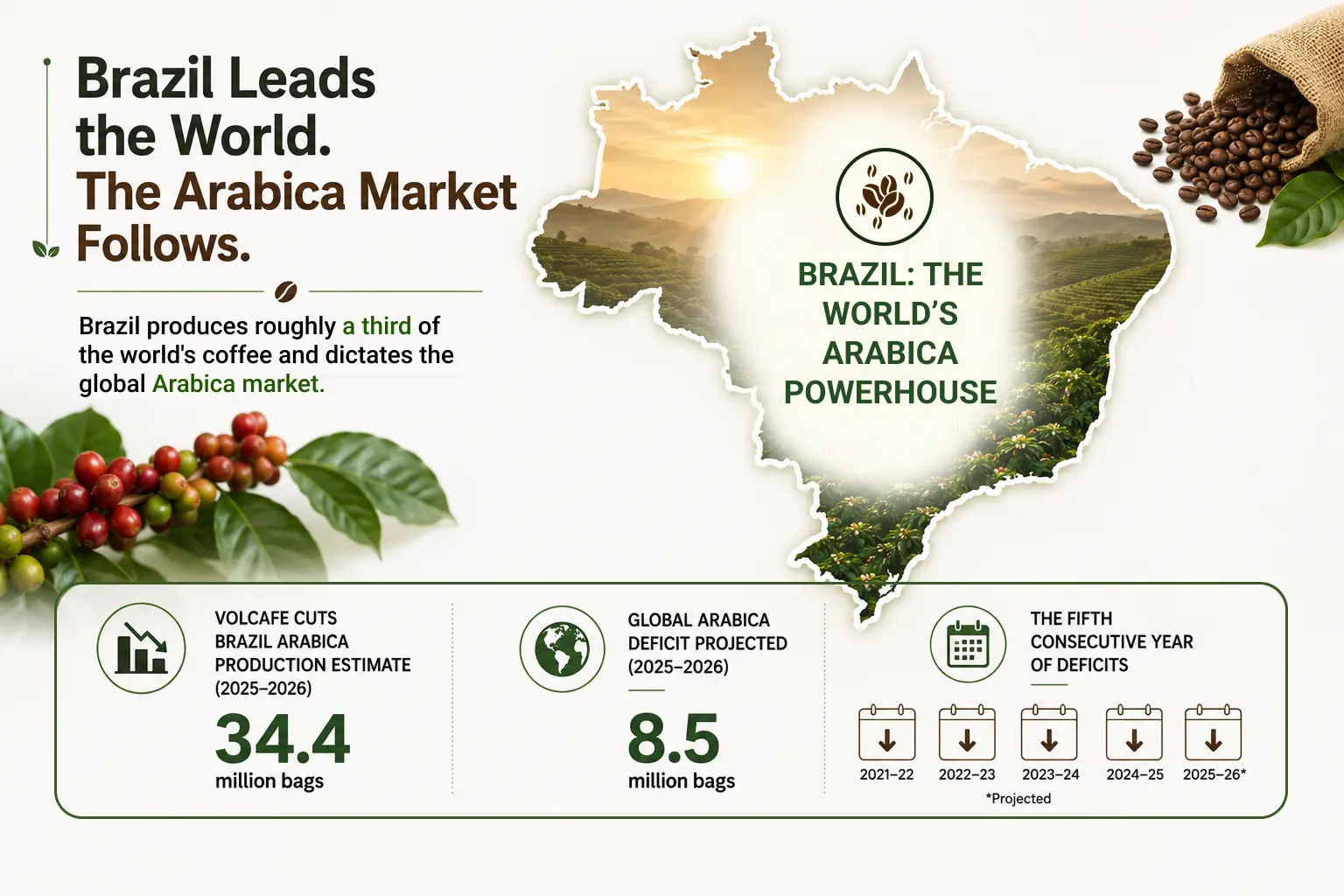
Recently, Brazil faced its most severe drought in seven decades. Prolonged moisture deficits, coupled with record-breaking heat, severely compromised the reproductive cycle of coffee trees. So, when Minas Gerais, the heart of Brazil’s arabica belt started recording rainfall at a fraction of historical averages, the market paid attention fast.
Result?
Yields in early 2025 reduced by as much as 12%. That may sound modest, but at Brazil’s scale, a 12% yield reduction means millions of bags removed from global supply. Arabica coffee futures reached a 47-year high of $3.35 per pound on the ICE in 2024, with prices rising around 71% across the year. By early 2025, they had pushed past $4. The drought did not just tighten current supply; it damaged flowering. Trees dropped their cherries prematurely, setting back the crop before it even started. This environmental crisis triggered a sharp contraction in global export volumes, driving Arabica futures to multi-year highs and squeezing roaster margins worldwide.
Vietnam's Robusta Collapse: Why a Flooding Crisis 8,000 Miles Away Raised Your Espresso Cost
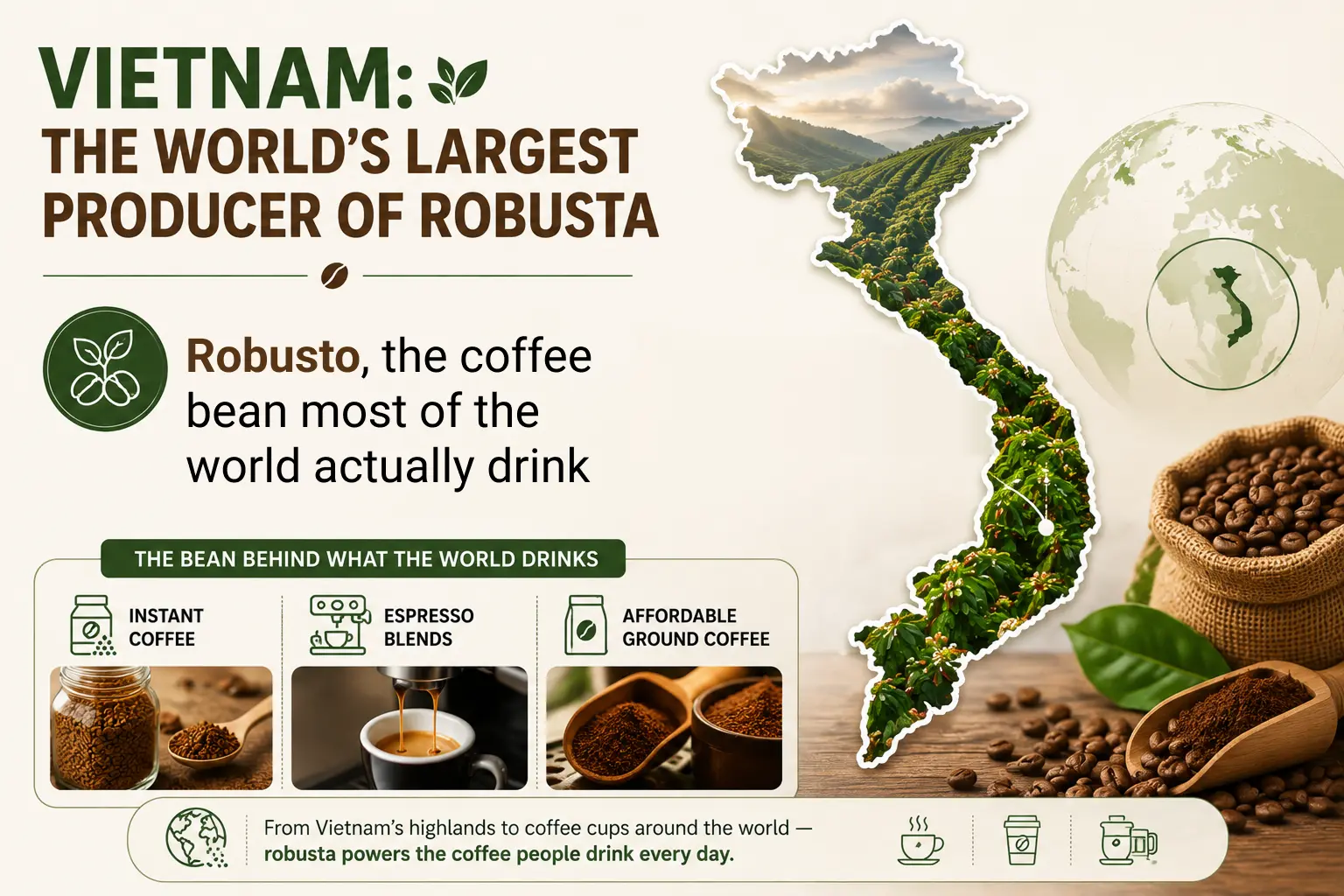
While Brazil withered under a drought, Vietnam, the world’s undisputed Robusta powerhouse, was hit by the opposite extreme. Unprecedented, off-season rainfall and severe flooding swamped primary growing regions like Dak Lak and Lam Dong. The excessive moisture triggered widespread root rot, disrupted drying operations, and degraded bean quality. Because Robusta is the primary component of instant coffee and espresso blends, this collapse 8,000 miles away caused a historic spike in Robusta prices, narrowing the traditional premium gap between Arabica and Robusta.
The ripple effect was immediate. With robusta in short supply, buyers were increasingly forced to turn to arabica to fill the gap, putting simultaneous pressure on both markets. Robusta, once a cheap commodity, has surged to near-arabica price levels. Your espresso cup got more expensive because of an unprecedented typhoon in Southeast Asia. That is what an integrated, fragile global supply chain looks like under stress.
How U.S. Tariffs, Currency Volatility, and Speculative Futures Positioning Compounded the Supply Shock
Climate stress does not happen in a vacuum. Macroeconomic pressures (read trade policy and financial markets) quickly compound physical supply shocks.
The U.S. tariffs on Brazilian coffee pushed exchange inventories to their lowest since 2024. Importers rerouted cargoes to Canada, paid $20–25 per bag cancellation fees, or warehoused beans under bond in Florida to delay tax payments. Retail coffee prices in US stores rose 41% year-on-year.
A weakening Brazilian Real and Vietnamese Dong made dollar-denominated exports more attractive, encouraging sell-offs that further drew down warehouse stocks. Futures traders positioned for continued tightness, speculative buying amplified the price signal well beyond what physical supply fundamentals alone would have justified. This influx created an environment of extreme price volatility. By the time procurement teams reacted, the window for cost-effective forward purchasing had already closed.
7 Ways Commodity Traders Are Protecting Against Coffee Price Volatility
To defend their margins against this permanent volatility, global trade houses are deploying sophisticated, multifaceted risk management frameworks.
- Geographic Diversification: Traders are reducing dependency on any single origin. They are building flexible supply networks across alternative producing nations like Colombia, Ethiopia, and Honduras. Origins with climate risk profiles different from those of Brazil and Vietnam.
- Upstream Direct -Sourcing Integration: By bypassing secondary brokers, traders establish direct relationships with local cooperatives to guarantee physical volume access. They are locking in volumes 12–18 months ahead, rather than 3–6, to reduce exposure to spot market spikes driven by weather events.
- On-the-Ground Agronomic Networks: Trade houses deploy private agronomy teams to manually monitor crop health weeks before official government numbers drop.
- Climate-adjusted Demand Forecasting: Integrating weather data into demand models, rather than relying on historical volume patterns that climate volatility is rapidly making obsolete.
- Traceability Infrastructure: Building farm-level data visibility to understand exactly where volumes come from, because in a tight market, the traders with the clearest picture of supply reality make better decisions faster.
- Predictive Analytics Ingestion: Integrating advanced digital intelligence platforms allows risk desks to model yield anomalies weeks before they manifest on the trading floor. Traders are moving from seasonal crop reports to continuous, satellite-driven intelligence that surfaces yield risks weeks or months before they hit the market, a critical step toward surety of supply.
- Dynamic Hedging and Options Structures: Moving beyond basic futures contracts, trade desks use complex options strategies to cap downside risk while preserving purchasing flexibility.
In almost all the above, technology is bringing in rapid and significant transformation.
Supply Chain Digitization: How Technology Is Closing the Visibility Gap in Coffee Procurement
The ultimate enemy of a commodity risk desk is blind spots. If you only know a crop failed after the harvest report is published, you have already lost the trade.
Why Most Coffee Supply Chains Still Have a Serious Visibility Problem
Here is the uncomfortable truth about most coffee supply chains: visibility effectively ends at the exporter. Origin data! What is actually being grown, where, in what condition, is estimated, surveyed, and reported with months of lag. By the time a crop failure in Minas Gerais shows up in a USDA report, the futures market has already moved.
This is not a data problem in the abstract. It is a structural gap that costs traders money every time a climate event hits or regional pest pressures arrive, leaving the entire coffee supply chain exposed to sudden, unannounced volume drops. The traders paying the least for this information gap are the ones who have already closed it with satellite imagery, AI-powered crop monitoring, and digital supply chain platforms. They connect farm-level intelligence to procurement decisions in near real time with complete supply chain digitization.
This is the shift that supply chain digitization is enabling. And in coffee, it is arriving just in time.
AgTech Platforms Transforming Coffee Supply Chain Risk Intelligence
Modern trade houses are closing the first-mile visibility gap by deploying advanced agtech platforms that turn raw field data into actionable risk intelligence.
How Cropin's AI-Powered Yield Forecasting Gives Coffee Traders Early Warning
Cropin’s intelligence platform approaches coffee supply chains the way Bloomberg approaches capital markets. By decoding the biological balance sheet of a crop, Cropin provides intelligence across yield potential, stress signals, and production trajectory to procurement and trading teams before events become crises.
Cropin’s AI models ingest multi-source satellite data from Planet Labs, Sentinel-2, Landsat, and MODIS, combine it with on-the-ground field observations, localized meteorological data, and proprietary crop knowledge graph. The models analyze over 40 distinct vegetation and moisture indices to derive crop health at the plot level across large geographies and compute yield estimations 30 to 45 days before harvest. For a commodity trader sourcing from Brazil’s Minas Gerais or Vietnam’s Central Highlands, this means access to an early read on yield trajectory weeks before official crop estimates are published.
Cropin's Disease Early Warning System (DEWS)
Coffee leaf rust, berry borer, and other diseases can devastate production, and they move faster than conventional scouting can detect. To put this into perspective, fungal outbreaks like Coffee Leaf Rust (Hemileia vastatrix) can destroy entire microclimates in weeks. Cropin’s Disease Early Warning System (DEWS) uses predictive models to identify when environmental conditions, such as specific temperature baselines and humidity levels, are favorable for a disease outbreak at a specific crop growth stage.
DEWS is Cropin’s weather-driven probabilistic model that predicts the likelihood of disease occurrence at the plot level before symptoms appear. This allows field agents to implement targeted, preventive crop protection applications, preventing localized infections from appearing in yield data or market reports. It is the difference between a preventive response and a reactive one, measured in both crop loss and procurement cost.
From Reactive to Predictive: How Cropin's Regional Intelligence Replaces Pattern Sourcing with Real-Time Climate Risk Data
Traditional trading relies on “pattern sourcing”, buying from specific regions because they historically delivered reliable volume. Climate change has broken that paradigm.
Cropin’s regional intelligence shifts the trade from reliance on historical patterns to real-time risk mitigation. By monitoring soil moisture depletion, canopy temperature, and microclimate stress anomalies across entire countries, traders can proactively spot when a reliable sourcing zone is entering an environmental crisis, allowing them to shift procurement strategies.
The model also helps identify new procurement zones with ideal climate, soil and other features to enable intelligent diversification decisions.
Cropin Ecosystem Partners: How Google Cloud, BCG and The Weather Company Are Building the Intelligent Coffee Supply Chain
No single technology solves global volatility alone. Cropin builds systemic resilience by integrating with world-class technology leaders, data, and expertise required to address climate-driven supply chain risk at scale. The ecosystem unites
- Google Cloud, which provides AI infrastructure, including generative and agentic AI for forecasting
- Boston Consulting Group (BCG), which handles strategy and links technology investment to business outcomes such as supply certainty
- Climate intelligence providers, including The Weather Company, Meteomatics, Google Weather, and ERA5, to deliver hyper-local climate data for risk modeling
- Satellite and ground-truth data come from Planet Labs, Sentinel-2, Landsat/NASA, and MODIS, combined with field-level intelligence, to deliver precise crop monitoring and predictive insights.
For a commodity trader sourcing coffee across multiple origins, this ecosystem delivers a single, integrated intelligence layer that connects climate forecasts, satellite crop monitoring, disease risk signals, and yield projections into a decision-support system that operates continuously, not seasonally. Enterprises can deploy and see impact in less than six months, drastically faster than building all components from scratch. The coffee supply chain has never had access to this level of integrated, forward-looking intelligence before.
Conclusion: The Era of Informed Trade
The conditions driving coffee price volatility, namely climate instability, concentrated production geographies, thin global inventories, and speculative futures markets, are not going away. La Niña probability of 71% points to further dryness through early 2026, which has historically trimmed global supply by 3–5%. The next supply shock is not a question of if. It is a question of who sees it coming.
Commodity traders and procurement teams that invest in supply chain digitization, AI-powered yield forecasting, and real-time climate risk intelligence will make better sourcing decisions, hedge more accurately, and build supply chains that absorb disruption rather than amplify it.
The tools exist. The data is available. The question is whether the industry will use them before the next crisis or after.
Frequently asked questions (FAQs)
What is coffee supply chain risk management?
It is the strategic practice of identifying, analyzing, and mitigating physical, financial, and regulatory risks within the coffee value chain. This involves using financial hedging, sourcing diversification, and digital monitoring tools to protect against price volatility, crop failures, and delivery delays.
Why is the coffee supply chain uniquely vulnerable to climate change?
Coffee requires precise temperature, humidity, and rainfall conditions to develop high-quality beans. Climate change causes erratic rainfall, droughts, and heat stress that disrupt flowering, increase pest pressures, and significantly reduce both yield quality and overall volumes.
How does supply chain digitization improve coffee traceability?
Digitization replaces paper records with automated digital tools like GPS polygon mapping, mobile KYC records, and satellite tracking. This creates an immutable digital record for every bag of coffee, allowing companies to trace beans back to the exact plot of land where they were grown, satisfying both corporate ESG goals and strict regulatory audits like the EUDR.
How can AI platforms forecast coffee yields before harvest?
AI platforms like Cropin ingest real-time and historical datasets, including multi-spectral satellite indices, soil moisture levels, and advanced weather forecasts. Deep-learning algorithms analyze these data points against specific crop growth stages to generate precise yield forecasts weeks before harvesting operations begin.
What is a Disease Early Warning System (DEWS) in coffee farming?
DEWS is a predictive model that analyzes localized micro-climate variables such as rainfall, temperature and relative humidity along with historical data to determine the probability of a pathogen outbreak, such as Coffee Leaf Rust. It alerts field teams to favorable disease conditions before visible symptoms manifest on the plant, enabling effective prevention.
Author Bio

Haripriya Muralidharan
Haripriya Muralidharan leads content marketing at Cropin Technology Solutions, bringing a unique scientific rigor to brand storytelling. With a Master's in Chemistry from Pune University and research experience in cancer immunology, she discovered her passion in storytelling. For two decades, she has operated at the intersection of content, communication, and brand strategy, specializing in turning complex ideas into impactful narratives. Prior to Cropin, Haripriya leveraged her creative skills at Elsevier’s Chemical Business News Base and shaped multi-format content strategies for B2B marketing at Scatter.