
For decades, the global food supply chain operated on the assumption of stability with steady climates, predictable logistics, and reliable demand. Today, that stability is history. We are navigating an era of “permanent volatility,” dominated by unseasonal climate events, geopolitical shocks, and rapid shifts in consumer behaviour.
The result?
Traditional systems are rendered obsolete.
According to the Food and Agriculture Organization (FAO), nearly 14% of the world’s food is lost even before it reaches retail markets. This isn’t just a logistical failure; it is a data failure. The agri-food sector is now at a tipping point, shifting from reactive “post-mortem” management to Predictive Agriculture
By fusing artificial intelligence (AI), machine learning, and real-time ground-truth data, we are no longer just guessing the harvest. Today, we are orchestrating the entire journey of food with surgical precision. This is the transformation of the supply chain into an intelligent, self-healing ecosystem.
Why Global Food Supply Chains Are Failing at Scale (And Why Traditional Forecasting No Longer Works)
Structural Weaknesses in Modern Food Supply Networks
Modern food supply chains are highly fragmented, involving multiple stakeholders, from farmers and aggregators to distributors and retailers. This fragmentation creates data silos where a delay at the farm level doesn’t trigger a response at the retail level until it’s too late. Traditional forecasting, which relies on historical data and static models, fails to account for real-time variability. As a result, businesses often face overproduction, understocking, and increased waste.
A report by McKinsey notes that supply chain disruptions can erase up to 45% of a company’s revenue over a decade. This is a risk that static models simply cannot mitigate, mandating the need for more adaptive systems.
Climate Volatility, Geopolitical Shocks, and Demand Instability
Climate change has retired the concept of a “typical” growing season. The increased frequency of droughts, unseasonal floods, and rains directly impacts crop yields and the consistency of supply. As a result, historical data has become secondary compared to real-time predictive intelligence. Simultaneously, geopolitical tensions, such as export bans or trade restrictions, the recent Iran-US-Israel war, and the Ukraine war, have abruptly throttled global breadbaskets and critical trade routes. Regional conflicts have turned into global food security crises overnight. Add to this the rapidly changing consumer demand patterns, and traditional forecasting models simply cannot keep pace.
To survive this “perma-multi-pronged crisis,” enterprises must shift from “best-guess” to dynamic, AI-led risk monitoring that can pivot supply strategies with real-time insights and predictive intelligence.
What Is Predictive Agriculture? From Farm-Level Data to End-to-End Supply Chain Intelligence
Effective data integration that unifies satellite imagery, IoT sensor feeds, and weather models into a single intelligence layer is crucial to Predictive agriculture. It eliminates siloed decision-making across the supply chain.
Predictive agriculture refers to the use of advanced analytics, AI, and IoT-enabled data collection to forecast agricultural outcomes and optimize decision-making across the value chain.
It connects farm-level data, such as soil health, weather patterns, and crop conditions, with downstream supply chain operations, creating a unified and intelligent ecosystem.
This approach is at the core of enterprise agritech supply chain management, enabling organizations to move from reactive to proactive strategies.
The Technology Stack Behind Predictive Supply Chains
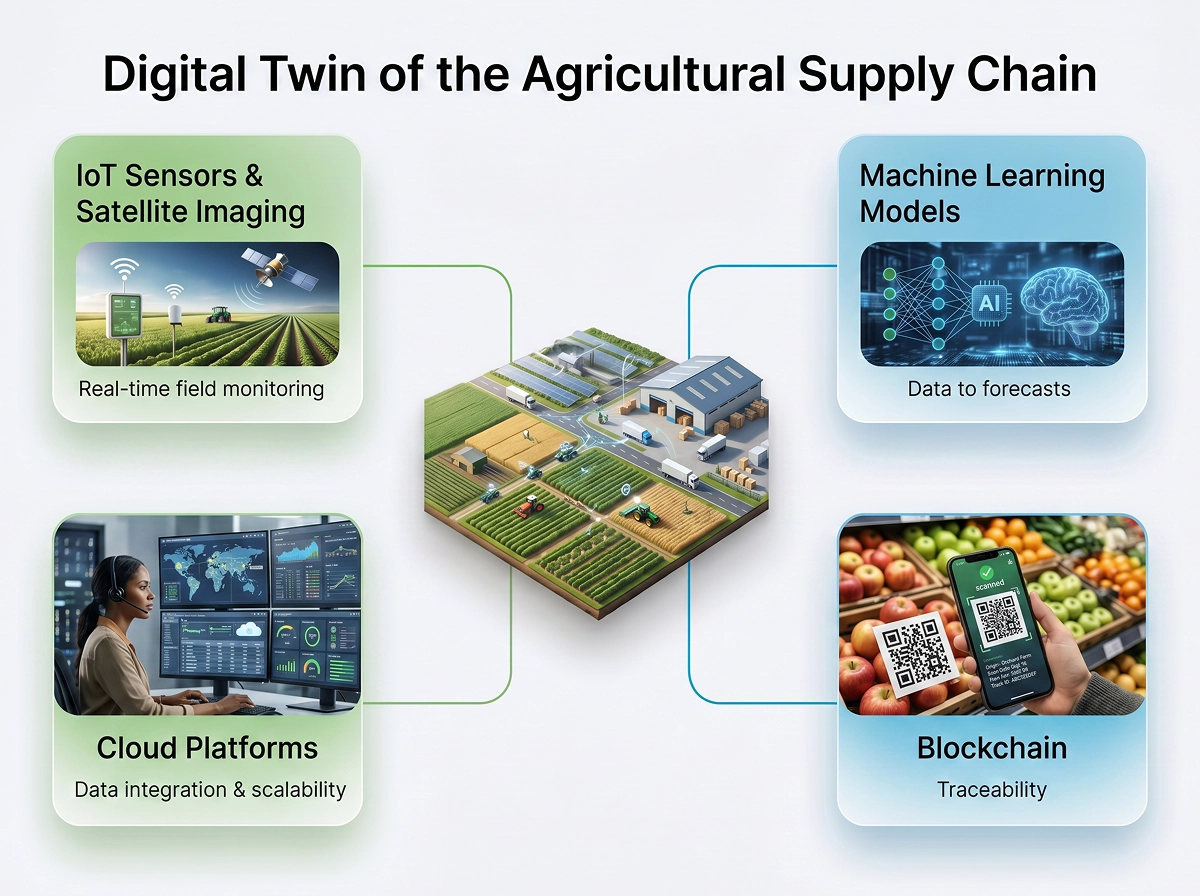
Predictive agriculture leverages this robust technology stack to create a Digital Twin of the entire supply chain:
- IoT Sensors & Satellite Imaging – Real-time eyes on the field
- Machine Learning Models – The brain that converts data into forecasts
- Cloud Platforms – Enable data integration and scalability. APIs serve as the connective tissue, enabling real-time data exchange between farm-level systems, ERP platforms, and downstream procurement tools seamlessly
- Blockchain – Immutable record of traceability
Together, these technologies power predictive analytics agrifood enterprise solutions that provide end-to-end visibility and actionable insights.
How Predictive Analytics Transforms Global Food Supply Chain Performance
Yield Forecasting Models and Production Optimization
Predictive models analyze weather and crop health to estimate yields weeks before harvest. This allows farmers and agribusinesses to:
- Optimize planting schedules
- Allocate resources efficiently
- Reduce input costs
- Plan sourcing
According to the World Economic Forum, AI-driven agriculture could increase global crop yields by up to 15%, significantly improving food availability.
AI-Driven Demand Forecasting and Inventory Optimization
On the demand side, predictive analytics aligns inventory with actual consumption patterns (based on factors like seasonality, market trends, and consumer behaviour), reducing spoilage and maximizing customer satisfaction. This enables:
- Better inventor planning
- Reduced food waste
- Improved customer satisfaction
Retailers and distributors can align supply with demand more precisely, minimizing excess stock and shortages.
Real-Time Supply Chain Risk Monitoring and Scenario Planning
Predictive systems continuously monitor risks across the supply chain, from weather disruptions to logistics delays. By simulating “what-if” scenarios, businesses can develop contingency strategies before global events impact shelves. This is a critical component of agri supply chain risk management, helping organizations stay resilient in the face of uncertainty.
Real-time crop monitoring tracks field-level health indicators continuously, giving procurement teams early visibility into shortfalls weeks before they impact contracted supply volumes.
Economic Impact: ROI, Cost Reduction, and Efficiency Gains in Predictive Food Supply Systems
Financial Benefits of Predictive Agriculture Adoption
The adoption of predictive agriculture delivers measurable financial benefits across the value chain. Key advantages include:
- Reduced operational costs through optimized resource use
- Lower wastage and spoilage
- Improved yield quality and consistency
A report by Deloitte suggests that digital transformation in agriculture can reduce supply chain costs by up to 20%. For enterprises, this translates into a strong B2B agritech ROI, driven by efficiency gains and improved decision-making.
Supply Chain Performance Metrics Before vs After AI Adoption
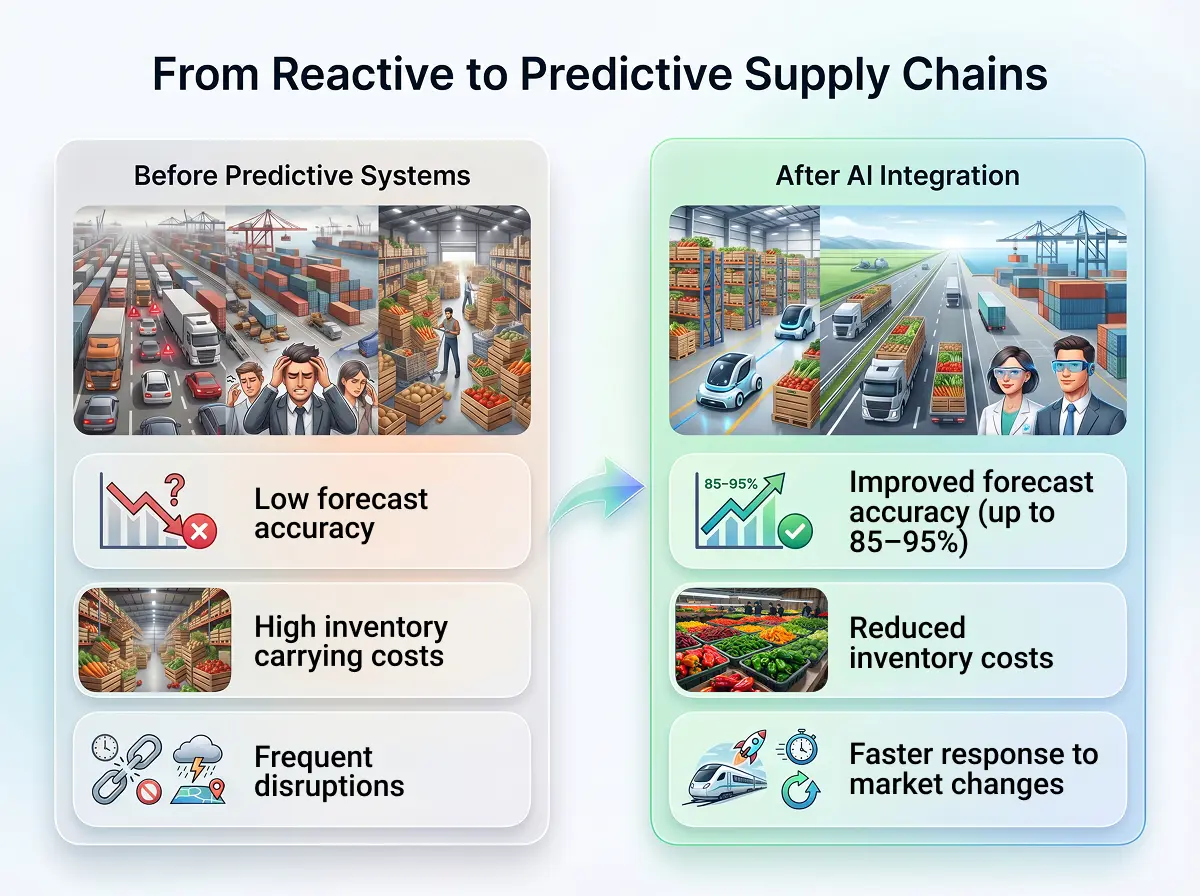
This shift is a key driver of food supply chain digital transformation, enabling smarter, data-driven operations.
Climate-Smart Agriculture and the Future of Food Security
Predictive Agriculture for Drought and Extreme Weather Adaptation
Predictive agriculture plays a crucial role in climate resilience. By analyzing weather data and climate models, it helps farmers prepare for adverse conditions such as droughts or floods.
For example:
- Early warnings enable timely irrigation planning
- Crop recommendations reduce climate risk exposure
- Resource optimization minimizes environmental impact
The Intergovernmental Panel on Climate Change (IPCC) emphasizes that climate-smart practices are essential to sustaining global food systems.
Aligning with Global Food Security and Sustainability Goals
Predictive agriculture aligns closely with global sustainability initiatives, including the United Nations Sustainable Development Goals (SDGs).
It supports:
- Reduced food loss and waste
- Efficient use of water and fertilizers
- Improved access to food in vulnerable regions
By integrating sustainability with technology, predictive systems help build a more secure and equitable food future.
Industry Use Cases of Predictive Agriculture in Global Markets
The transition to predictive systems is already being led by global giants who recognize that data is the new “safety stock.” Here are some proof points showing how the Cropin Cloud platform leverages multiple data moats, including satellite imagery, weather data, farm data, and open-source datasets. Cropin’s AI models monitor millions of hectares of farmland and derive data-driven insights for its partners.
- Agribusiness Enterprises (Surety of Supply): A major US Food Processing major leveraged Cropin Inteliigence to digitize their “first mile.” The company ensured surety of supply by gaining insights fofr geographic expansion and orchestrated procurement with real-time visibility into farmer activities and harvest windows across vast geographies.
- Food Processing Companies (Precision Sourcing): PepsiCo utilizes predictive insights offered by Cropin to manage potato sourcing. This ensures raw materials meet strict quality standards regardless of local weather fluctuations and maximizes yield.
- Retail Chains (Inventory Optimization): Walmart partnered with Cropin for an AI-powered sourcing framework for grapes and strawberries. Cropin provided Walmart’s fresh produce procurement team with advanced AI-driven real-time insights on supply to cut down on perishable waste.
- Exporters & Traders (Fair Trade and Organic Certification): Gebana deployed Cropin platform to ensure visibility and transparency. The farm management solution helped monitor entire field operations to manage complex cross-border risks. Gebana ensured smallholder-sourced products meet international standards and traceability requirements for global markets.
- Commodity traders : Commodity traders rely on predictive agriculture to benchmark yield estimates across sourcing regions, enabling smarter contract positioning and reduced exposure to volatile spot markets.
- Development Agencies (Climate Resilience & Risk Mitigation): Asian Disaster Preparedness Center (ADPC), supported by the World Bank, deployed the Cropin Cloud platform to drive climate resilience in farmers across Bangladesh and Sri Lanka. Cropin digitized farmers and offered predictive intelligence. The timely, personalized advisories helped farmers mitigate climate and disease risks.
These use cases demonstrate how predictive agriculture is transforming the entire food ecosystem, from farm to fork.
Conclusion
The future of global food supply chains lies in their ability to adapt, predict, and respond to an increasingly complex world. As global food supply chains grow more complex and the environment more volatile, the ability to predict is the only true form of protection.
Predictive agriculture is not a futuristic concept; it is the current standard for any organization that intends to be relevant in the next decade. By integrating ground-truth data with advanced AI, we are doing more than improving margins. We are building a food system that is resilient enough to withstand the unknown and efficient enough to feed a growing planet.
In the race for food security, certainty is the ultimate competitive advantage. Organizations that embrace agri-intelligence today will be the architects of a more secure, sustainable, and profitable tomorrow.
Frequently asked questions (FAQs)
What is predictive agriculture, and how does it improve supply chain efficiency?
Predictive agriculture uses AI and data analytics to forecast crop yields, demand, and risks. It improves efficiency by enabling better planning, reducing waste, and optimizing resource use across the supply chain.
How does predictive analytics reduce risks in global food supply chains?
It identifies potential disruptions, such as weather events or logistics delays, in advance, allowing businesses to take proactive measures and minimize impact.
What are the economic benefits of implementing predictive agriculture?
Businesses benefit from cost reduction, improved yield quality, reduced waste, and higher profitability, resulting in strong ROI.
How does predictive agriculture support climate-smart and sustainable farming?
It helps farmers adapt to climate variability, optimize resource usage, and reduce environmental impact, supporting sustainable agriculture practices.
Which industries and businesses benefit most from predictive agriculture?
Agribusinesses, food processors, retailers, exporters, and supply chain operators benefit significantly from improved forecasting, efficiency, and risk management.
Author Bio

Prateek Srivastva
Prateek Srivastva is a Chief Business Officer at Cropin, a global Agtech leader, bringing over two decades of experience spanning technology, consulting, entrepreneurship, and investment. A seasoned serial entrepreneur, he has successfully established and exited three ventures, including a precision agriculture startup focused on perennial crops across three continents. At Cropin, Prateek is responsible for expanding the company’s presence in the critical EMEA region, managing revenue, investments, and academic partnerships. His extensive expertise in the field has earned him global recognition, with features in esteemed media platforms including Fortune, Forbes, and The Economist.