
Synopsis:
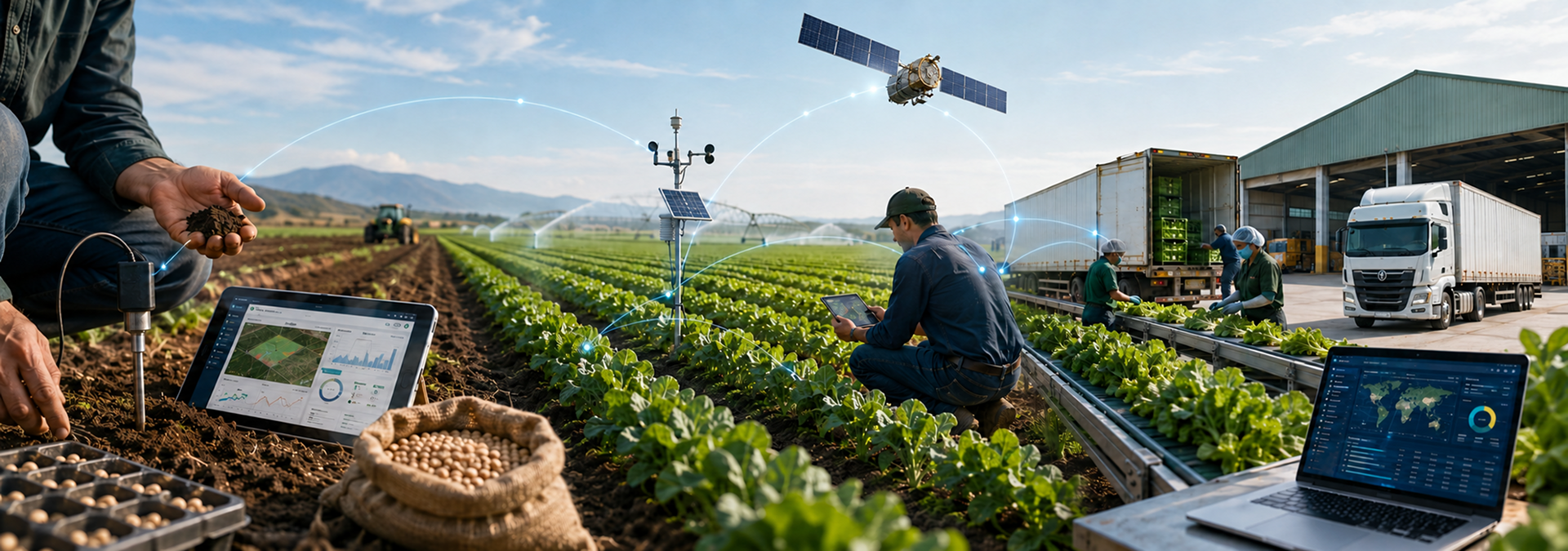
Agentic AI is redefining agtech as a decision-making discipline rather than a data-reporting one. This guide breaks down what agentic AI actually is, how it differs from generative AI and traditional automation. It explores how networks of specialized AI agents operate across the entire crop lifecycle, from soil intelligence before sowing and crop planning, through in-season monitoring, to sustainability tracking and farm-to-fork supply chain visibility. We further explore what this shift means for farmers, agribusinesses and stakeholders, positioning AI agents as the connective intelligence layer behind the next era of farming.
Agentic AI in agriculture is the shift from software that manages farm data to AI agents that bring autonomous decision-making intelligence to global food systems using collated data points. By 2030, agriculture is projected to be one of the largest adopters of autonomous AI systems outside manufacturing. This is attributed to the growing non-negotiable pressure to cultivate more food on less land with fewer resources. AI Agents in agriculture aren’t a single tool bolted onto an existing farm workflow. It’s a new operating layer that runs across the entire crop lifecycle, from the choosing the seed variety to the harvest that leaves the field to the warehouse, where it is either further processed or reaches a retailer’s shelf. Understanding how it works, stage by stage, is the first step to understanding why it’s being called the biggest structural shift in farming since precision agriculture itself.
What Is Agentic AI in Agriculture?
Agentic AI in agriculture refers to AI systems called agents that can perceive farm conditions, reason over data, and drive decision-making. Unlike a chatbot that answers a question or a dashboard that displays a chart, an agentic system for agriculture brings together models trained with real-world scenarios across farms, crop varieties, climate change, weather, soil, geography, agronomic practices, and global supply chains. It is not a generic platform that answers queries using data available on the internet. The intelligence isn’t static; it’s continuously learning from soil, weather, satellite, and market data to refine every decision it makes.
In practice, this means a sourcing manager in Europe or a farmer in Latin America can use the same region-specific, actionable recommendations, provided in natural language and grounded in verified agricultural intelligence and real-world conditions.
What Does Agentic AI Need?
Agentic AI runs on models trained on real-world, complex scenarios, using varied datasets on crops, weather, climate, geography, open-source data, soil types, regional agronomic practices, global supply chains, and more. This contrasts with Generative AI that uses generic data available on the internet. Agentic AI must integrate a range of specialized AI models trained to support decisions across the agricultural value chain.
Agentic AI vs Generative AI vs Traditional Farm Automation
These three categories are often used interchangeably, but they solve fundamentally different problems on the farm.
Dimension
Traditional Farm Automation
Generative AI
Agentic AI
How it works
Fixed rules and timers (e.g., irrigate every 3 days using x liters of water)
Generates text, images, or recommendations from prompts
Perceives, reasons, decides, and acts in a continuous loop
Autonomy level
None, follows pre-set schedules
Low, provides output from generic data available on the internet
High, drives decision-making using conceptualized deep learning models trained on ground-verified agri-data.
Farm example
A timer-based drip irrigation controller
An AI chatbot providing suggestions for a query raised
A network of models integrated to provide actionable recommendations, in natural language
Traditional automation is reactive and rigid. Generative AI is an advisor that uses generic data. Agentic AI for agriculture, on the other hand, can help farm level decision-making grounded in verified agricultural intelligence and real-world conditions.
How Agentic AI Works on the Farm
The data backbone: soil sensors, drones, satellite, weather APIs
Every agentic system is only as good as the reality it can perceive. On the farm, that reality is assembled from IoT soil sensors tracking moisture and nutrient levels, drone and satellite imagery monitoring crop health at the pixel level, and weather APIs feeding hyperlocal forecasts. This is the sensory layer (read the eyes and ears) that lets agents understand what’s actually happening in a field, not just what a static plan assumed would happen.
Multi-model collaboration for agents across the agri-value chain
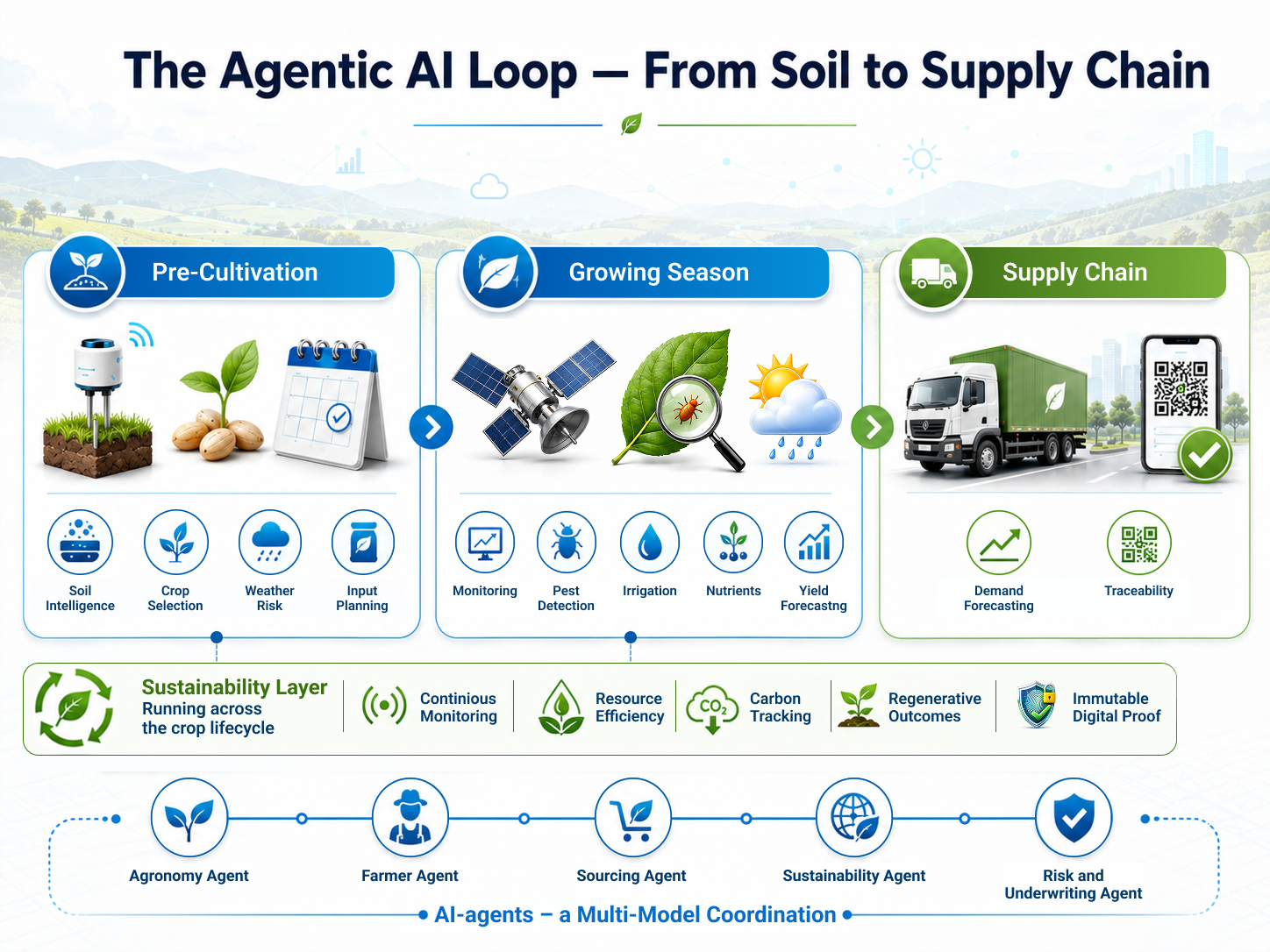
Agentic AI in agriculture rarely means a single all-knowing system. It typically means a coordinated network of conceptualized models, each an expert in its own deep domain. A soil model tracks nutrient and moisture profiles. Weather models assess short- and long-range risk. A crop model interprets growth stage and health signals. A yield model derives production estimates. An agent translates all of that into an executable task, adjusting and triggering an alert, or scheduling a task. These models communicate and negotiate with each other in real time, the way a team of specialists would huddle before making a joint call. The beauty is this huddle happens continuously, at machine speed, generating farmer agents, agronomy agents, underwriting agents, sourcing agents, sustainability agents, and more for every operation across the agri-value chain.
The human-in-the-loop
Autonomy does not mean the absence of the farmer. It means the farmer’s judgment is elevated, not replaced. Every credible agentic system is built with human-in-the-loop guardrails. They come with thresholds and approval points where the farmer or agronomist stays firmly in control of high-stakes decisions. The system handles the repetitive, time-sensitive, mundane, and data-heavy work that no human can monitor every hour of every day.
Agentic AI Before You Plant: The Pre-Cultivation Stage
The most overlooked opportunity to leverage AI in farming isn’t during the growing season; it’s before a single seed goes into the ground. Decisions made at this stage compound across the entire season, which is exactly why agentic systems are being deployed earliest here.
Land and soil intelligence: autonomous soil health, nutrient and moisture profiling
Agents continuously build a living profile of soil health, nutrient composition, moisture retention, organic matter and more. They do not rely on a single lab test taken once a season. This turns soil management from a static snapshot into a dynamic, ever-updating picture.
Crop and variety selection: matching crop to soil, climate, and market signals
Choosing what to plant is no longer a matter of habit or last year’s price. Agentic systems cross-reference soil profiles, climate projections, and market demand signals to recommend the crop and seed variety most likely to succeed agronomically and commercially.
Climate and weather risk forecasting: sowing-window prediction, season-ahead planning
Human decisions are often based on limited historic experiences and a single seasonal forecast. On the other hand, agents access historical data spanning multiple decades to update risk windows, identify the optimal sowing window, and flag season-ahead threats, such as the probability of drought or excess rainfall, well before they materialize. This intelligence is also employed to choose the best suited seed variety.
Input and resource pre-planning: seed, water, and fertilizer demand modeled before day one
Before day one of the season, agentic systems can model exact seed variety, water, and fertilizer requirements. This reduces both waste and the guesswork that has historically driven over-application and related leaching, resulting in pollution.
Field mapping and plot-level planning
Technology uses granular, plot-level maps that account for micro-variations within a single field, enabling decisions to be made at the zone level rather than treating an entire farm as a single uniform unit.
Now that we have explored the use of AI agents in pre-cultivation, let’s move on to the growing season.
Agentic AI During the Growing Season
The growing season is the time the crop requires maximum attention. It is also the period when multiple factors can determine the final yield. Let’s now explore how AI Agents integrate various factors to enable decision-making.
Autonomous crop and growth-stage monitoring
AI Agents continuously use AI models to track crop development using satellite imagery and sensor data, identifying growth-stage transitions in real time rather than relying on manual field visits.
Disease and pest detection with self-triggered intervention
Early anomaly signals a subtle shift in leaf color or canopy density. Models use this, weather data, and historical data to derive the probability of disease. The agents can trigger/alert an intervention before an outbreak spreads, compressing the response window from days to hours.
Smart irrigation and water management
Agents use live soil moisture and crop-stage data to determine when to irrigate the field, rather than relying on a fixed calendar. This meaningfully reduces water waste, and cuts yield risk from under- or over-irrigation.
Precision nutrient and fertilizer management
Fertigation and nutrient application are dynamically adjusted zone by zone, ensuring inputs go where the crop actually needs them, rather than being applied uniformly across a field.
Yield forecasting and harvest-readiness signals
Continuously updated yield models give growers, cooperatives, and buyers a live, evolving forecast replacing the single end-of-season estimate. Sourcing agents thus continuously monitor and make decisions that improve procurement and logistics planning well ahead of harvest.
Agentic AI for Sustainable & Regenerative Agriculture
Sustainability in agriculture has long been constrained by a visibility problem. It’s hard to adjust what you can’t measure in real time. Agentic AI closes that gap. By continuously optimizing water, fertilizer, and pesticide use at the zone level rather than the field level, these systems inherently reduce over-application and runoff. Sustainability agents can track soil organic carbon trends across multiple seasons and guide regenerative practices, such as cover cropping and reduced tillage, based on real soil responses rather than generic playbooks. These agents can quantify environmental impact with the kind of granularity that makes sustainability reporting verifiable rather than aspirational. This is what turns sustainability from a compliance checkbox into a continuously improving, data-backed discipline.
Agentic AI Across the Agricultural Supply Chain
Demand forecasting and procurement
Sourcing agents connect farm-level yield signals directly to downstream demand data, allowing procurement teams and cooperatives to plan purchasing, storage, and logistics with far greater precision than historical averages ever allowed. Sourcing agents offer procurement teams of CPG companies, food processors, and retailers unprecedented decision-making power with deep insights into
- Production expectations
- Acreage variation
- Advanced yield estimates
- Commodity supply outlooks
- Harvest readiness assessments
- Supply risk identification
- Alternative sourcing recommendations
- Procurement opportunity alerts
Traceability and quality assurance farm-to-fork
Every input, intervention, and yield data point captured in the field becomes part of a verifiable digital trail, giving buyers, regulators, and consumers end-to-end visibility that was previously impossible to assemble at scale. Sourcing agents enable regulatory compliance with an immutable digital record as proof.
What Agentic AI Means for Different Players
For farmers & field agents
Time and expertise are freed from repetitive monitoring and reactive firefighting, redirected instead toward the decisions that genuinely require human judgment, while yield consistency and input efficiency improve season over season.
Sourcing for procurement teams
Consolidated intelligence across production forecasts, acreage, yield estimates, supply risk and outlook, harvest readiness, alternative procurement opportunity alerts and more provides sourcing intelligence to procurement teams across agri-food enterprises.
For agribusinesses & cooperatives
Aggregated, real-time field intelligence across thousands of acres enables far more accurate demand planning, resource allocation, and risk management than fragmented, manually reported data ever could.
For developmental agencies and policy stakeholders
Verifiable, granular agricultural data becomes the foundation for smarter subsidy design, climate policy, and resource allocation, replacing broad assumptions with ground-truth evidence. Programs and investments can be validated by immutable digital proof by AI agents.
For Insurance and agri-finance stakeholders
Crop risk assessment, real-time portfolio monitoring, and underwriting intelligence enable banks, insurers, and reinsurers to make informed decisions on lending, risk reduction, swift claim settlements, policy pricing, and more.
Conclusion
Agentic AI is not another point solution layered onto the farm. It is the connective intelligence that links every stage of the agricultural value chain, from the soil test before planting to the pallet that reaches a retailer’s shelf. It reflects a fundamental shift by bringing autonomous intelligence to the farm and bridging the gap between data and decision-making. As the pressure on global food systems intensifies, with an increase in population, less predictable climate, and tighter margins, agriculture is not just adopting AI. It is being redesigned around it, field by field, season by season. The agri-businesses leading this shift today are the ones defining what modern agriculture will look like tomorrow.
Cropin is ready to help you close the gap. Explore how at
Frequently asked questions (FAQs)
How is agentic AI used in precision agriculture?
Agentic AI powers precision agriculture by continuously sensing zone-level field conditions soil, crop health, moisture and autonomously adjusting irrigation, nutrient application, and interventions at that same granular level, rather than applying uniform treatment across an entire field.
What data does agentic AI need to work on a farm?
It typically draws on soil sensor data, drone and satellite imagery, weather API feeds, historical climate and yield records, and market signals, combining them into a continuously updated picture of farm conditions.
How is agentic AI different from traditional AI in agriculture?
Traditional AI in agriculture typically generates recommendations or predictions using historical data and online information. Agentic AI integrates multiple deep learning models to perceive conditions and derive autonomous, actionable intelligence. It continuously monitors the outcomes of actions and provides insights.
How do multiple AI agents coordinate on a single farm?
Conceptualized models for weather, crop health, yield, and more share data and communicate in real time, negotiating a combined response as a team of domain experts would. AI agents, however, do this continuously and at machine speed.
Is agentic AI the same as autonomous tractors or farm robots?
No. Autonomous tractors and robots are physical execution tools. Agentic AI is the decision-making intelligence layer that can be used to derive insights that direct those tools and many other systems. It is based on continuous data and reasoning, and is not the physical hardware itself.
Author Bio

Haripriya Muralidharan
Haripriya Muralidharan leads content marketing at Cropin Technology Solutions, bringing a unique scientific rigor to brand storytelling. With a Master's in Chemistry from Pune University and research experience in cancer immunology, she discovered her passion in storytelling. For two decades, she has operated at the intersection of content, communication, and brand strategy, specializing in turning complex ideas into impactful narratives. Prior to Cropin, Haripriya leveraged her creative skills at Elsevier’s Chemical Business News Base and shaped multi-format content strategies for B2B marketing at Scatter.