Synopsis:
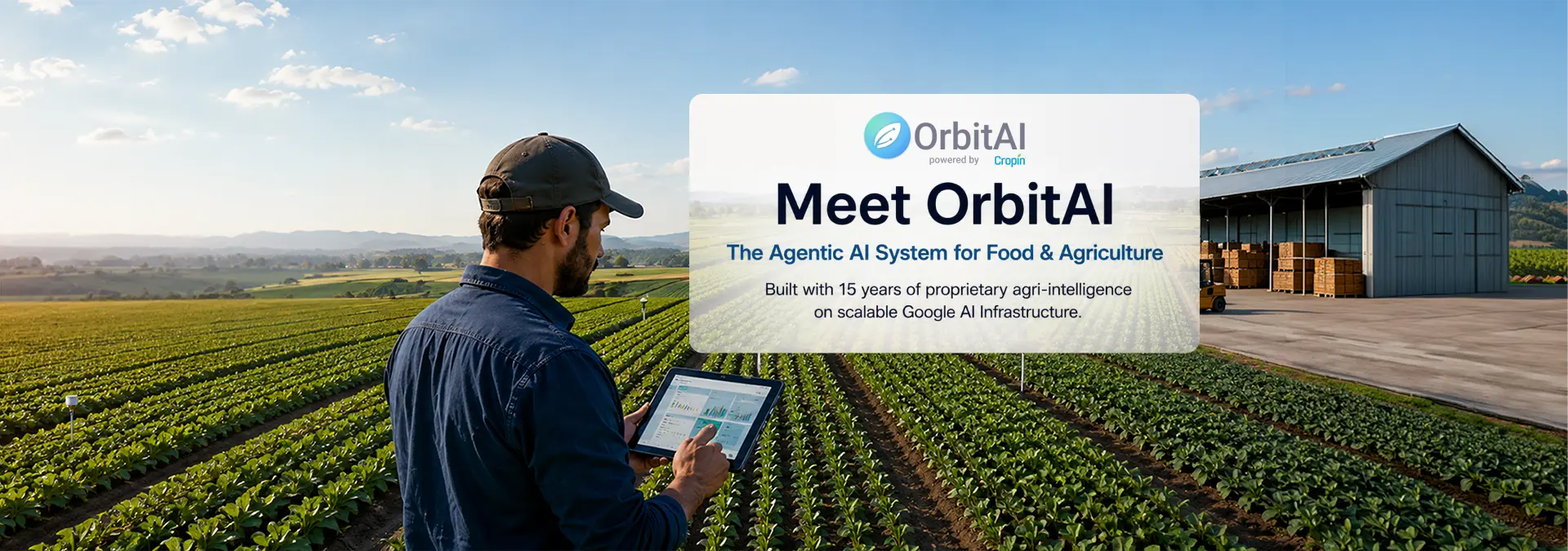
Cropin has launched OrbitAI, domain-first AI agents for the food and agriculture industry. It is built on Google’s AI infrastructure and trained on 15 years of real agricultural field-verified data, records, and outcomes worldwide. OrbitAI moves beyond generic AI chatbots to deliver autonomous, region-specific decision support intelligence across the entire food value chain, from farmers to global sourcing desks. This blog unpacks why agriculture needs agentic AI now, what makes OrbitAI’s architecture fundamentally different from open-source General AI models, and how it’s designed to democratize expert-grade agricultural intelligence for everyone in the system.
Food and agriculture is one of the world’s most essential industries. It is also the hardest to make timely, high-confidence decisions amid the moving web of signals of crop stage, weather shifts, climate variability, soil conditions, disease pressure, acreage changes, logistics, market demand, and on-the-ground operations. A delayed decision can affect supply continuity, margin, and food security. The stakes are enormous; decisions require data.
That said, agriculture has never lacked data. What it has lacked is a way to turn that data into a decision in a timely manner. A farmer watching unseasonal rain doesn’t need another dashboard; they need to know, right now, whether their crop is at risk and what to do about it. A sourcing lead 2,000 miles away doesn’t need a satellite image; they need to know if their harvest is coming in on time and how much is at stake.
This is the gap to be closed; not by generating more information, but by deploying models to reason through it and offer autonomous intelligence, the way a trusted expert would. That gap is exactly why Cropin built OrbitAI, breakthrough AI agents on Google’s AI infrastructure, engineered to bring autonomous decision-making intelligence to global food systems. Instead of forcing people to manually interpret disconnected dashboards, reports, and data streams, OrbitAI enables them to ask a question in plain language and receive grounded, actionable answers that reflect real agricultural context.
What is OrbitAI
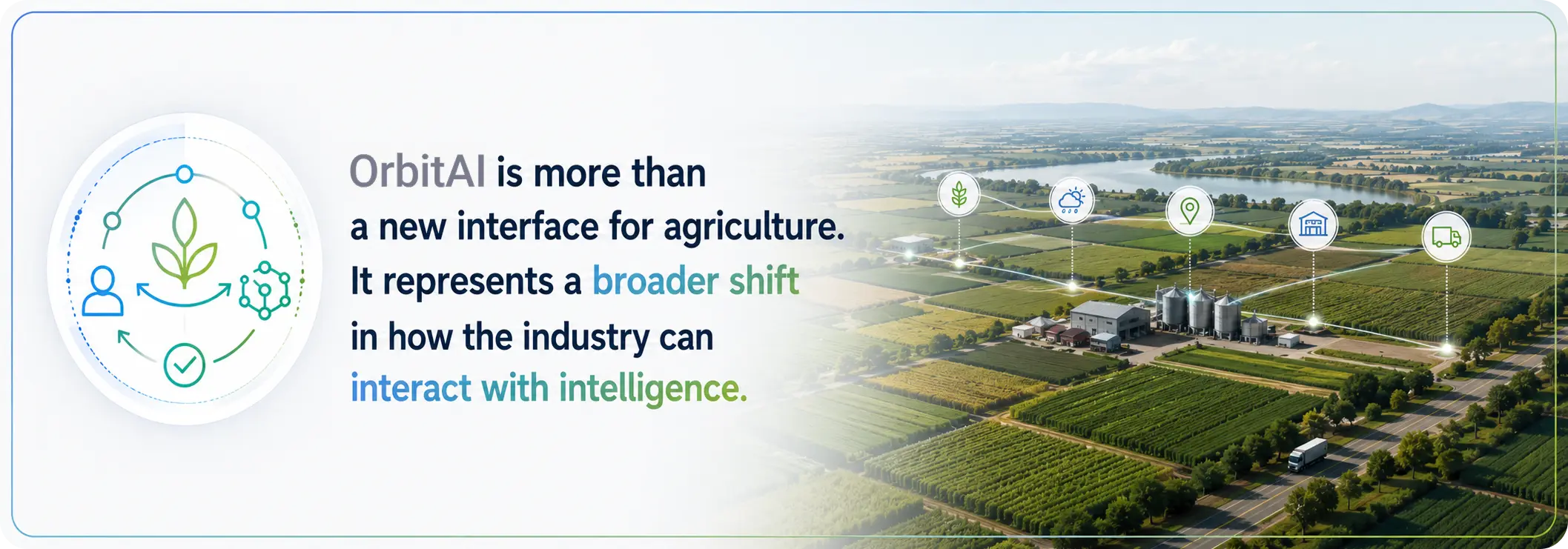
OrbitAI is a hierarchical multi-agent system. User-facing role agents (e.g., Farmer Agent, Agronomist Agent) orchestrate specialized domain agents such as Yield, Crop Health, Weather, Analytics, and Data Agents to complete complex agricultural workflows. OrbitAI is trained on the complex, real-world data around crops, climate, weather, soil, geography, agronomic practices, and global supply chains, rather than generic internet data. This intelligence layer purpose-built for agriculture and food systems, combines Cropin’s structured agricultural intelligence accumulated over 15 years across 103+ countries, 400+ crops, 10,000+ varieties, more than 1 billion acres of agri-intelligence, and 22+ AgriAI models.
This matters because agriculture is a living, dynamic domain. Whether it’s a sourcing manager in London assessing supply risk, or a farmer in India deciding when to irrigate, OrbitAI delivers region-specific, actionable recommendations in natural language, grounded in verified agricultural truth, not guesswork. A question like “Is my crop healthy this week?” cannot be answered meaningfully from generic text alone. It requires awareness of local weather, crop stage, disease conditions, vegetation signals, and historical context. OrbitAI is designed to bring that context together and return insights that people can actually use.
This is what makes OrbitAI agents for agriculture in the truest sense: it doesn’t just answer questions! It leverages data moats and models; it reasons across seasons, geographies, and outcomes to arrive at a decision a human can act on immediately. It is secure and scalable.
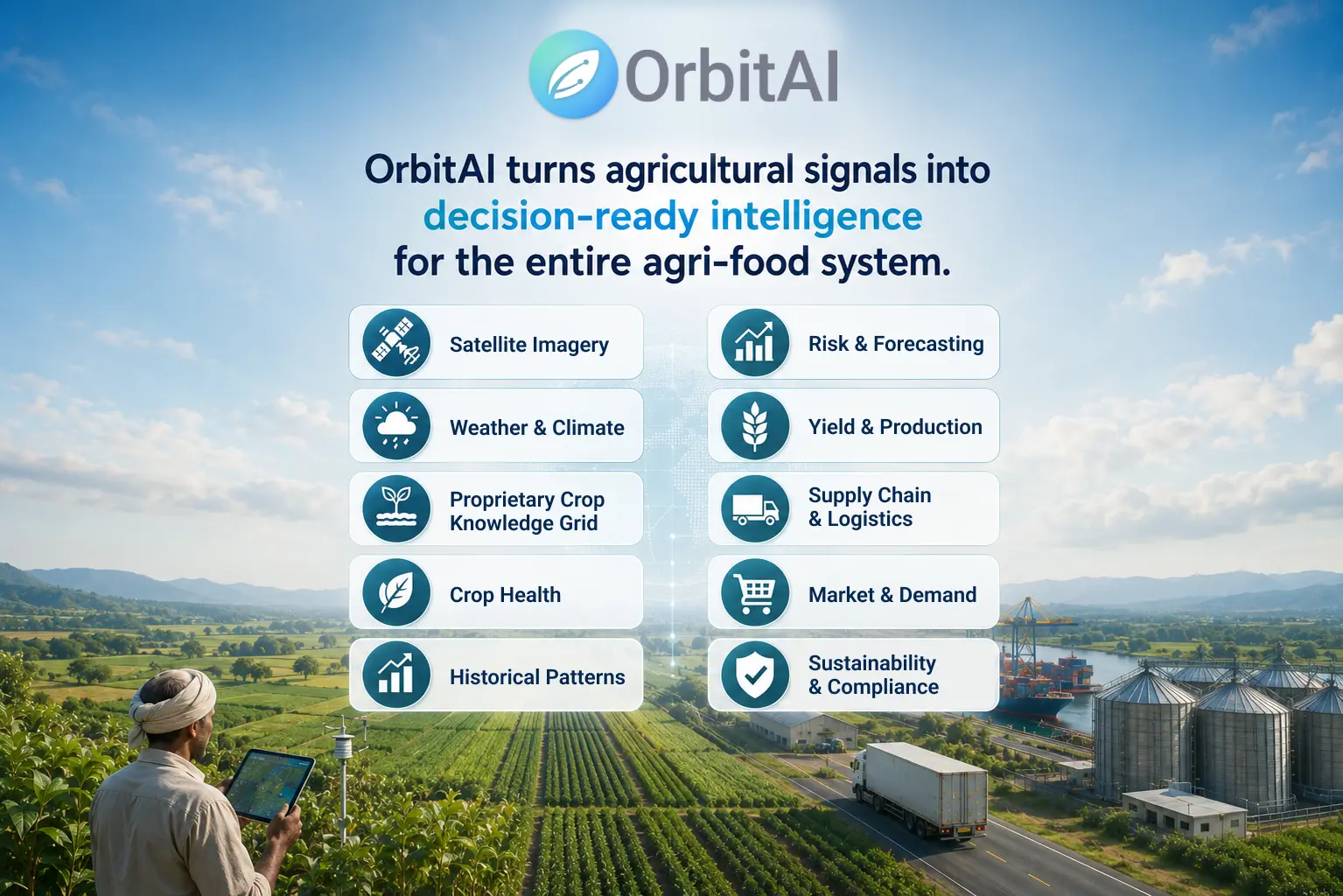
Some Datamoats Used by OrbitAI
Why OrbitAI Now for Agriculture
Agriculture is entering a period where decision quality matters more than ever. Climate volatility is increasing the frequency of stress events. Input costs are under pressure. Supply chains are becoming more fragile. Sustainability and compliance expectations are rising. And every participant in the food system from farmers and agronomists to sourcing leaders, financial institutions, and governments must make faster decisions with better precision.
Yet teams still work across disconnected spreadsheets, dashboards, and field updates. Valuable intelligence exists but is hard to discover and even harder to act on consistently. As a result,
- Decisions are delayed
- Sourcing is blind
- Opportunities are missed
- Sustainability has no proof
- Price risk insights are absent for underwriters
- Response quality varies from person to person
OrbitAI makes agricultural intelligence conversational, accessible, and action-oriented. It reduces the time between question and decision. It helps users see what matters, understand why it matters, and know what to do next. In an industry where timing can change outcomes, that shift is powerful.
What Powers OrbitAI
OrbitAI sits at the intersection of two strengths. Cropin’s agricultural intelligence foundation: proprietary crop knowledge grid, and deep-domain models, near-real-time satellite data, weather and climate intelligence, geospatial data layers, and supply- and production context. The second is Google’s AI infrastructure, including Gemini, Vertex AI, BigQuery, Google Cloud, WeatherNext, and the Agent Development Kit.
Together, these elements create more than a simple question-answering layer that can handle complexity without losing usability.
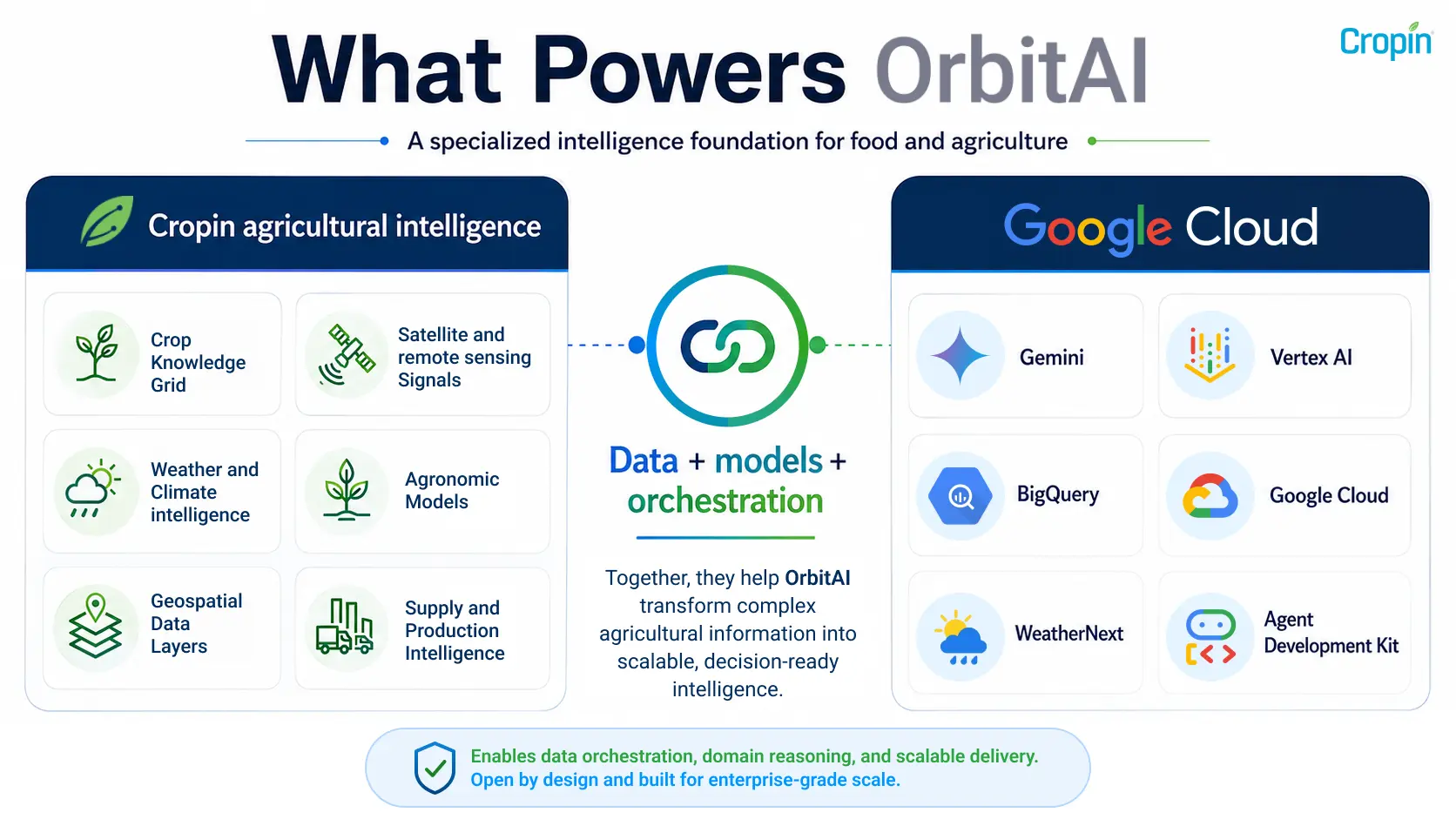
OrbitAI: A Cropin-Google Collaboration Product
Why generic LLMs are not Enough for Agriculture
Large language models are excellent at generating fluent responses. But agriculture’s most valuable data has never lived on the public internet. It requires high-context reasoning across signals that are local, seasonal, scientific, and time-sensitive. A general-purpose AI model can explain what late blight is, or define greenness (NDVI). That is not the same as helping a user decide whether a specific crop in a specific geography is at risk this week.
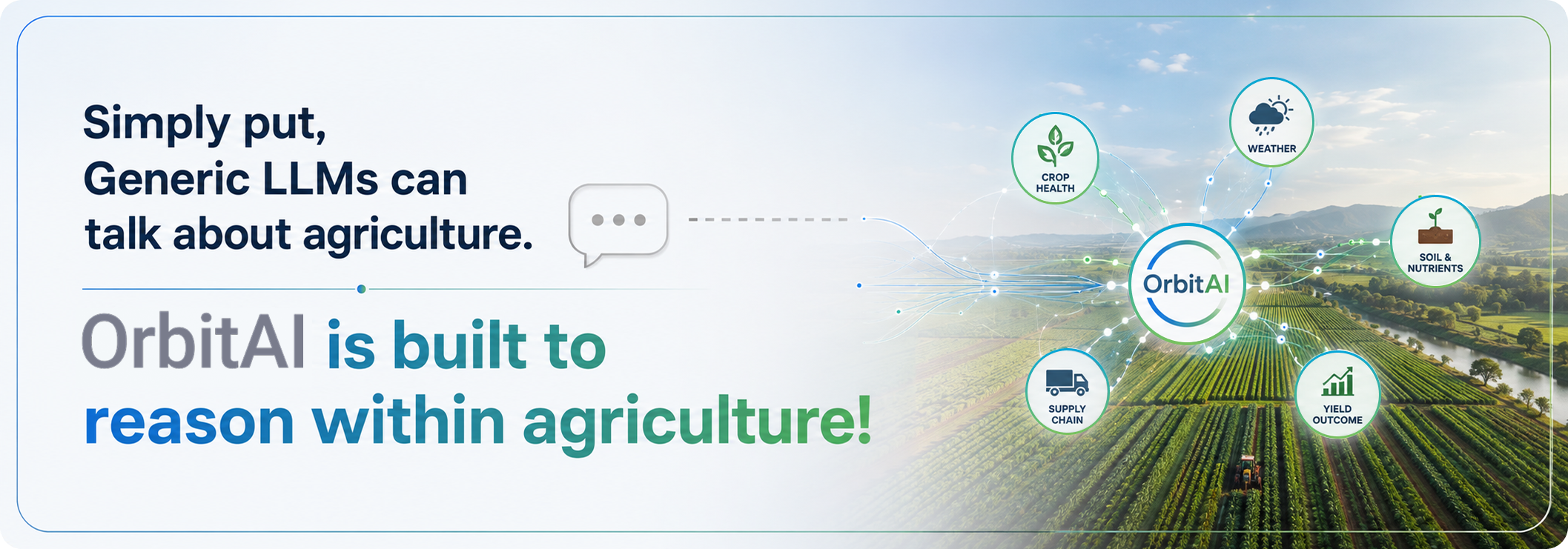
This distinction matters more than it might first appear. In OrbitAI, Cropin’s 22+ proprietary AgriAI models trained on its Crop knowledge grid and the Cropin Data Hub carry all agronomic intelligence; the LLM layer never generates agricultural knowledge on its own. It interprets the question and communicates the answer. Nothing more!
Open-source Gen AI models Vs Cropin’s OrbitAI
Dimension
Open-Source Gen AI Models
Cropin’s OrbitAI
Data foundation
Trained on public internet text, past data. Absence of ground-truth agricultural data
15 years of proprietary agri-data from 400+ crops, ~0.7 B verified records & outcomes, 1B+ acres of computed intelligence, 103+ countries, 9 M+ farmers
Reasoning approach
Statistical language prediction (RAG or generic chat)
Domain-first reasoning via 22+ proprietary AgriAI models + a bounded LLM layer
Knowledge source
General-purpose, not crop- or region-specific
Plot-linked imagery, observations, and outcomes validated over multiple seasons continuously
Validation
Rarely tested against real agronomic outcomes
Labeled, season-over-season ground truth tested against actual yield and disease outcomes
Role of the LLM
Generates the knowledge itself
Handles only query interpretation and narrative output. Never invents agricultural facts
Open by Design: Any Frontier Models on Top of Cropin’s Agronomic Reasoning
OrbitAI isn’t a walled garden. Beyond its native interface, it’s available as a Model Context Protocol (MCP) server. This means its agricultural intelligence layer can be accessed directly by frontier AI models and open-source systems alike. Whether an enterprise is building on Anthropic Claude, Google Gemini, Llama, Mistral, or a proprietary system, OrbitAI’s crop intelligence, climate signals, geospatial data, agronomic expertise, and proprietary crop knowledge grid can be called as a native tool. The intelligence is fine-tuned on your data, integrates with your own copilots, ERPs, and workflows, and lets your systems flow back in. Deployed exclusively for you, it remains yours.
How OrbitAI Works
OrbitAI turns a simple question into a structured decision workflow:
- Ask in natural language: Query about crop health, yield outlook, risk, sourcing, acreage, or broader regional conditions.
- Assemble context: OrbitAI translates the question into an agricultural context by identifying the verified grid of the crop, geography, season, weather, and other relevant signal layers.
- Reason across signals: specialized agents connect multiple grid datasets rather than treating them in isolation with the 22+ crop science and transformer models.
- Generate actionable intelligence: the response can include summaries, risk alerts, comparisons, opportunity flags, and recommendations.
- Enable action: the goal is not just understanding, but helping people act faster and more confidently.
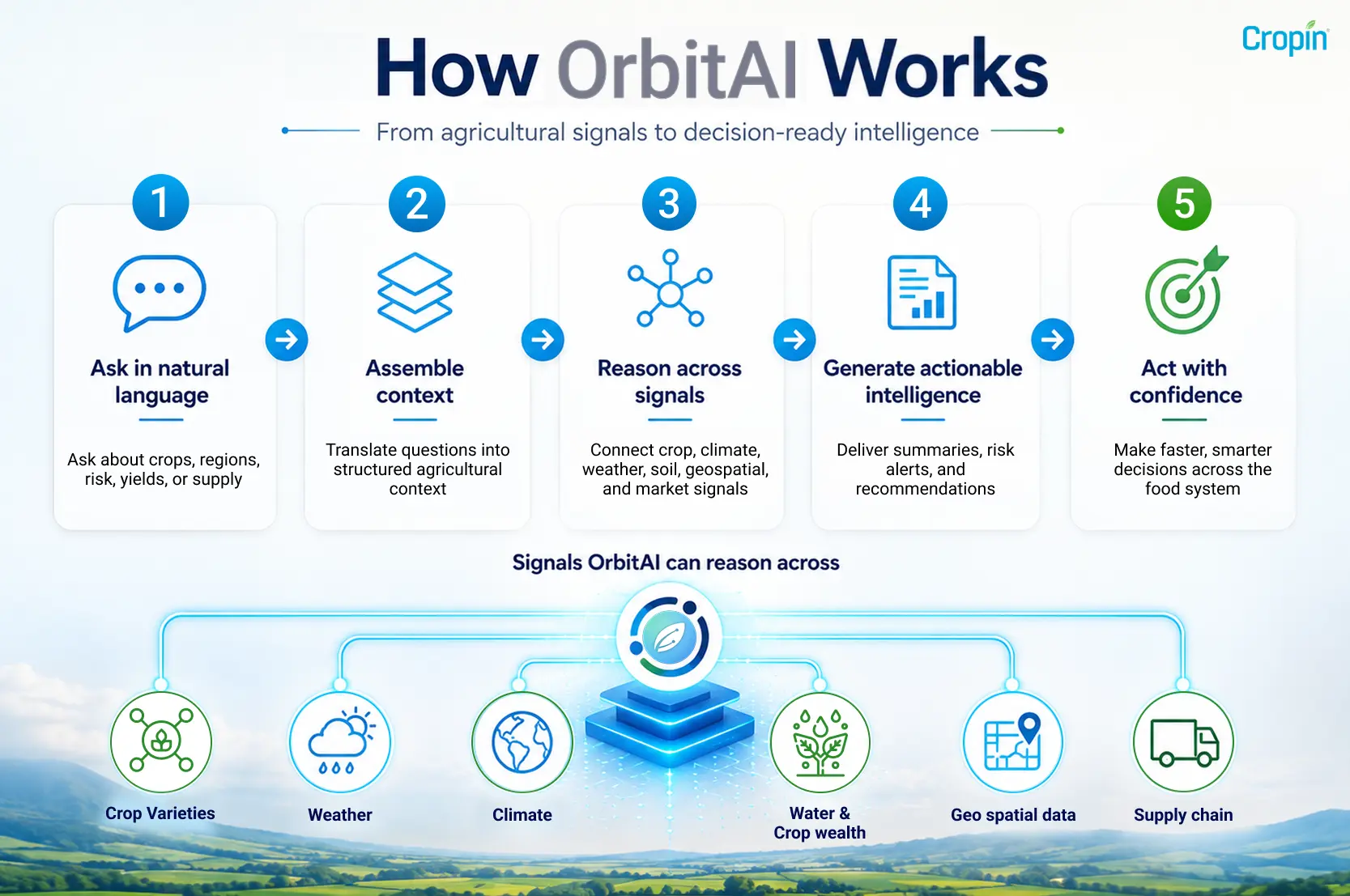
Workflow of OrbitAI
This workflow is important because it mirrors how good agricultural decisions are made in the real world. Experts rarely rely on a single datapoint. They combine context, pattern recognition, and domain understanding. OrbitAI is built to do the same at speed and at scale.
The Foundation That Makes It Work
How Cropin Gridified the World’s Agricultural Data
Behind every answer OrbitAI delivers is a data architecture most AI platforms in agriculture have never attempted and none have built at this scale.
Agriculture generates an enormous volume of data. But it is not structured data. Satellite images arrive at different resolutions. Weather stations report at different intervals. Soil sensors, tractor telemetry, drones, field observations, and remote sensing outputs all come in different formats, from different machines, covering different geographies, at different timestamps. Raw, this data is almost impossible to analyze systematically.
Cropin solved this problem through gridification.
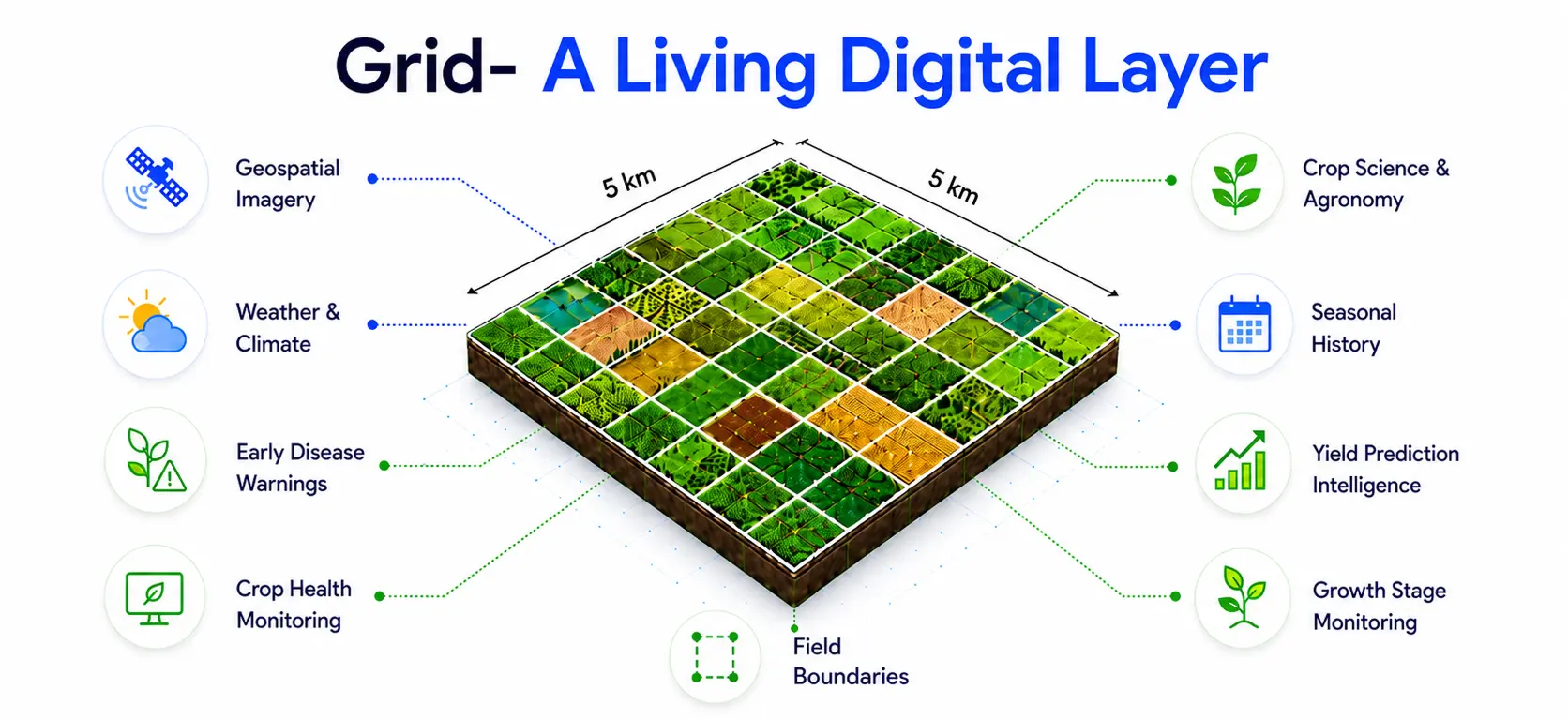
Every piece of agricultural data Cropin ingests is normalized, labeled, and organized into a verified grid system of 5×5 km, or 10×10 km cells. Models use it based on the use case and the required resolution. Multiple data layers for a specific region crop type, NDVI, precipitation, temperature, soil moisture, disease risk scores, yield forecasts, and more are processed and stored in the Cropin Data Hub and aggregated into a unified, grid-level view. This is then ingested as structured data into Cloud SQL, giving the system a clean, queryable representation of what is otherwise an unstructured, fragmented dataset.
Agricultural land spans 4.8 billion hectares globally. Gridification is what makes that scale computable.
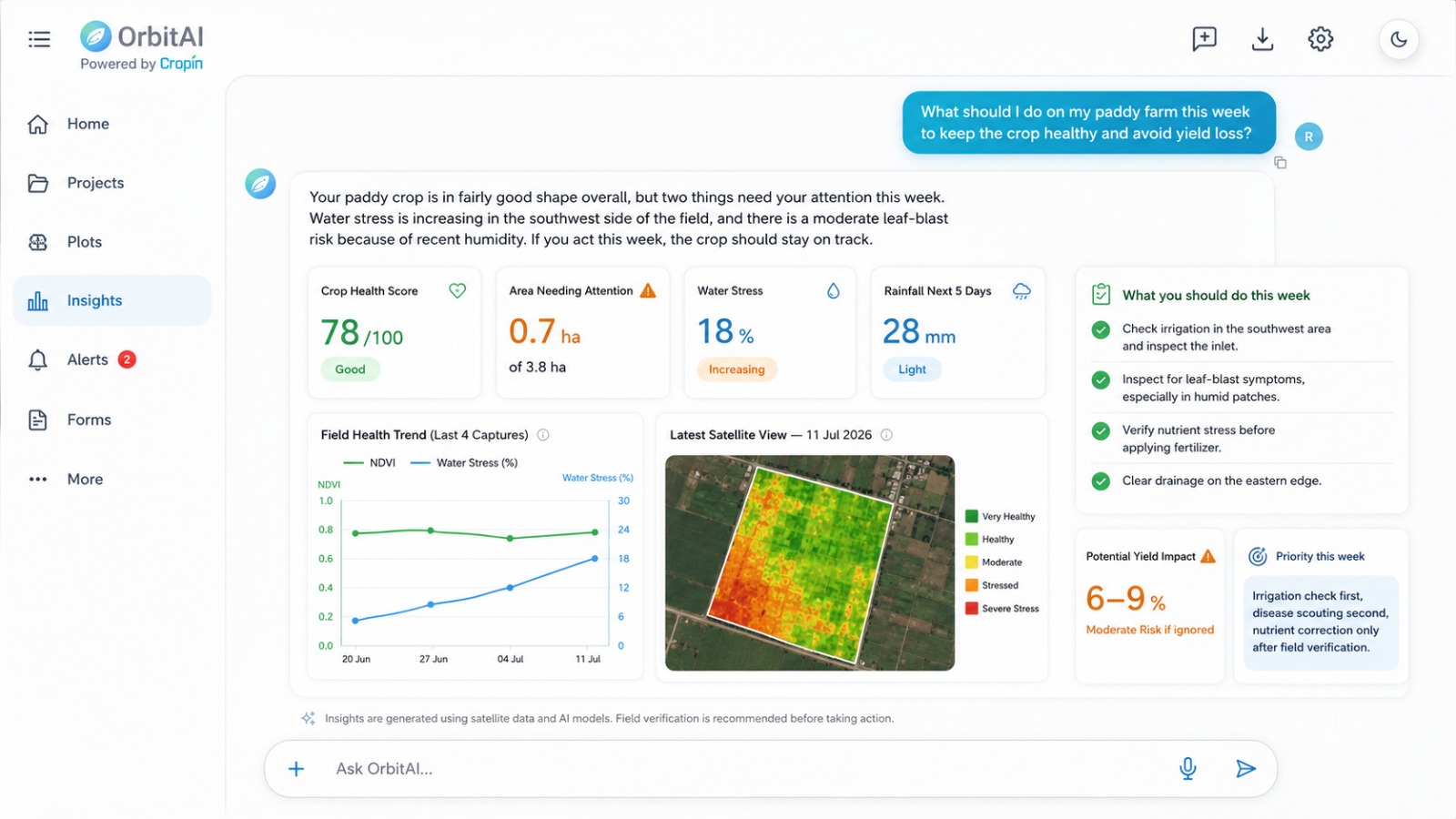
When a user asks OrbitAI a question in plain language, the platform extracts user intent from the query, retrieves data from the relevant grids, overlays multiple intelligence layers on those grids, and dynamically visualizes the results on geospatial maps. The response is not a static report. It is an interactive, spatially anchored view of the answer. Bar charts show statistical comparisons across grids. Time series graphs reveal how a variable has evolved across seasons. Geospatial maps let users interrogate any grid directly for the full picture across all data layers.
This is what turns a complex, multi-source question like, “What should I do with my paddy farm this week to keep crop healthy and avoid yield loss?” into a visual, actionable answer in seconds. Without the grid foundation, that question would take a team of analysts days to answer. OrbitAI answers it on demand.
OrbitAI in Action
Why Domain-Native Intelligence Makes the Answers Actually Useful
Most AI systems can retrieve data. What they cannot do is reason within a domain, understanding not just what a data point says, but what it means in context, and what it implies for a specific decision. This is the gap that Cropin’s domain-native intelligence layer closes. And it is what makes OrbitAI’s outputs actionable rather than merely informative.
Over 15 years, Cropin has built a proprietary crop knowledge grid that goes far deeper than any public dataset. This is agri-data covering 400+ crops and 10,000+ varieties, 400M+ acres across 103+ countries, encoding agronomic insights that link crop stage, weather conditions, soil characteristics, disease risk, and yield outcomes. These are datasets that have been validated against real ground truth – season-over-season, not inferred from internet text. This domain-native data powers 22+ proprietary AgriAI models purpose-built for specific tasks: crop phenology, NDVI health assessment, disease probability (DEWS), yield forecasting, irrigation stress, LULC classification, and regional production risk scoring.
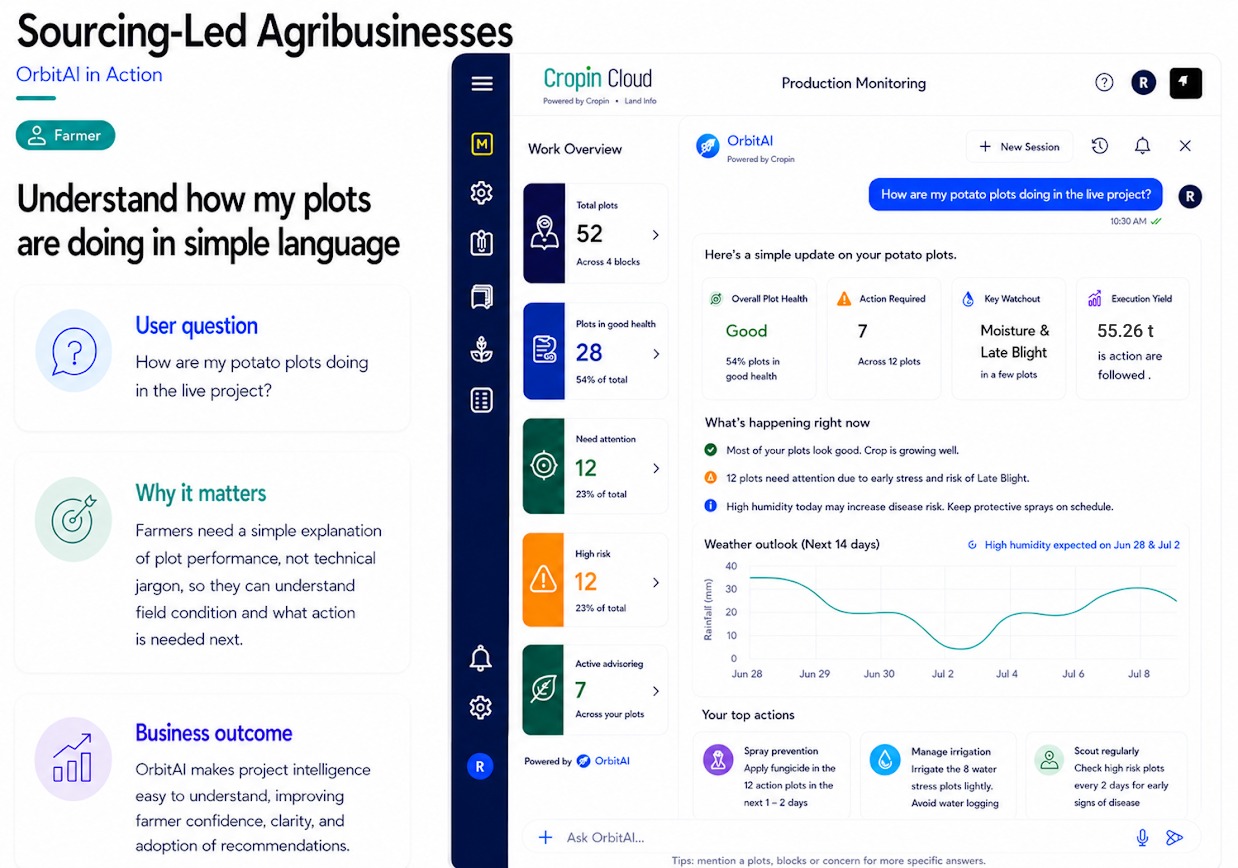
When OrbitAI responds to “Is there yield risk for cocoa in Côte d’Ivoire this quarter?”, the answer doesn’t come from the LLM. It comes from domain-native models that have already processed satellite signals, weather anomalies, and historical production patterns for that geography. A general-purpose AI can tell you late blight spreads in humid conditions. OrbitAI can tell you that based on the past 10 days in a specific grid, the probability of late blight in a potato crop is elevated and recommend the intervention window before symptoms appear.
One answers a question. The other changes a decision. The same logic applies across every persona OrbitAI serves. A sourcing manager gets supply-risk intelligence grounded in real-yield models, not statistical averages. A government planner gets acreage and production estimates built from satellite-verified crop mapping, not survey extrapolations. A farmer gets a personal agronomist with advisory calibrated to their specific plot, crop stage, and local weather, not generic best-practice guidance. The agricultural reasoning stays where it belongs in models trained on verified, crop-specific, plot-linked data.
OrbitAI in Action
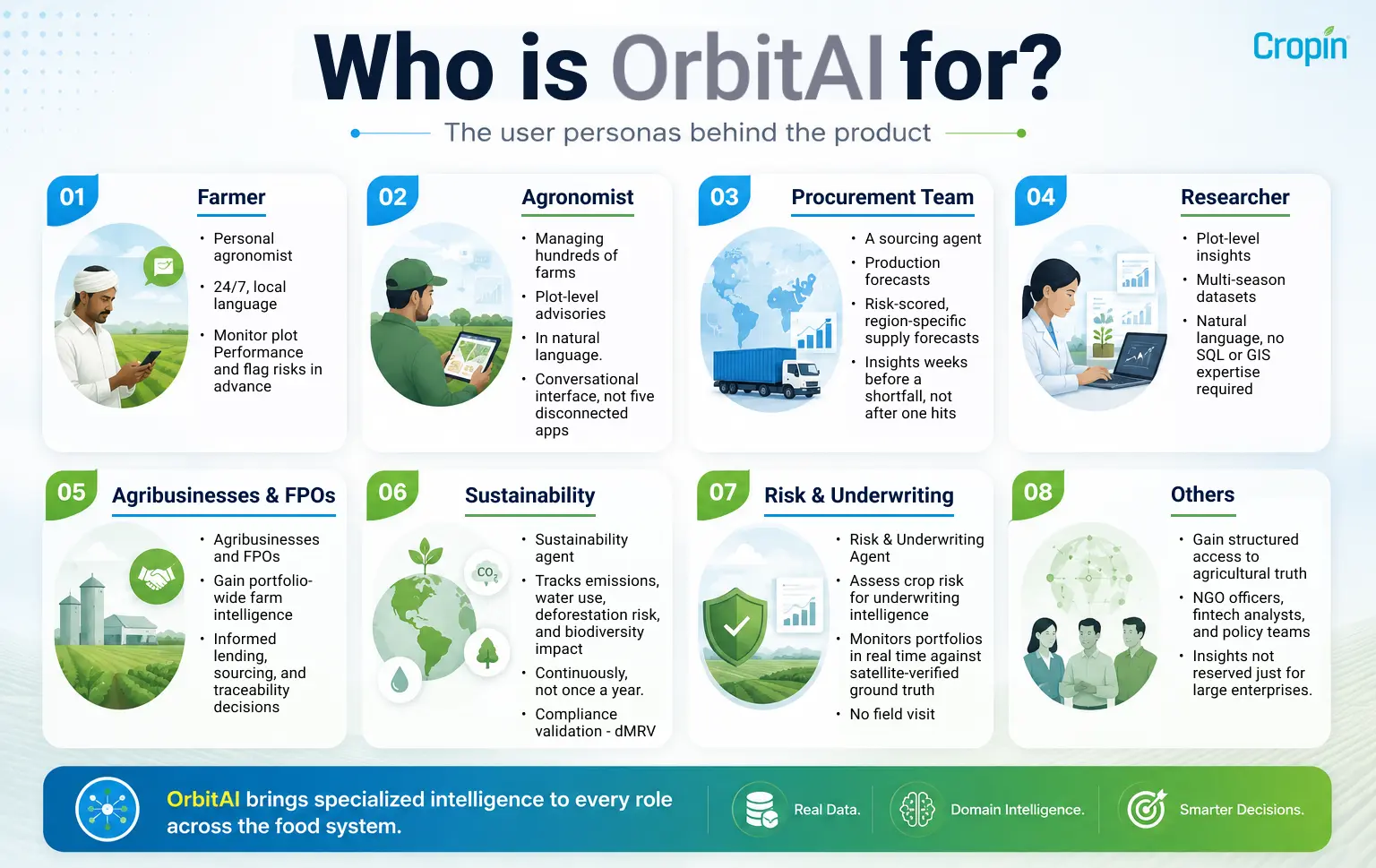
Who is OrbitAI for? The user personas behind the product
OrbitAI is designed around real personas, not a single generic user, but an agentic architecture. Rather than relying on a monolithic intelligence layer to solve every problem in the same way, OrbitAI brings together specialized agents designed around real decision domains in agriculture.
Benefits of OrbitAI
- It connects field risk to business risk. OrbitAI doesn’t stop at flagging crop stress – it shows how that stress translates into volume, quality, and procurement confidence downstream.
- It moves teams from insight to action. Every workflow ends somewhere useful: a decision, a priority list, a field check, or a management follow-up – never just a data point.
- It supports every role from one intelligence layer. The same underlying data helps an agronomist diagnose, a procurement lead plan, a field officer execute, and a farmer act. No translation layer required.
- It speaks in the format each user needs. Ranked tables, charts, plot maps, satellite imagery, or a plain-language explanation – OrbitAI adapts its output to the decision at hand, not the other way around.
The Bigger Vision Behind OrbitAI: Democratizing Agricultural Intelligence
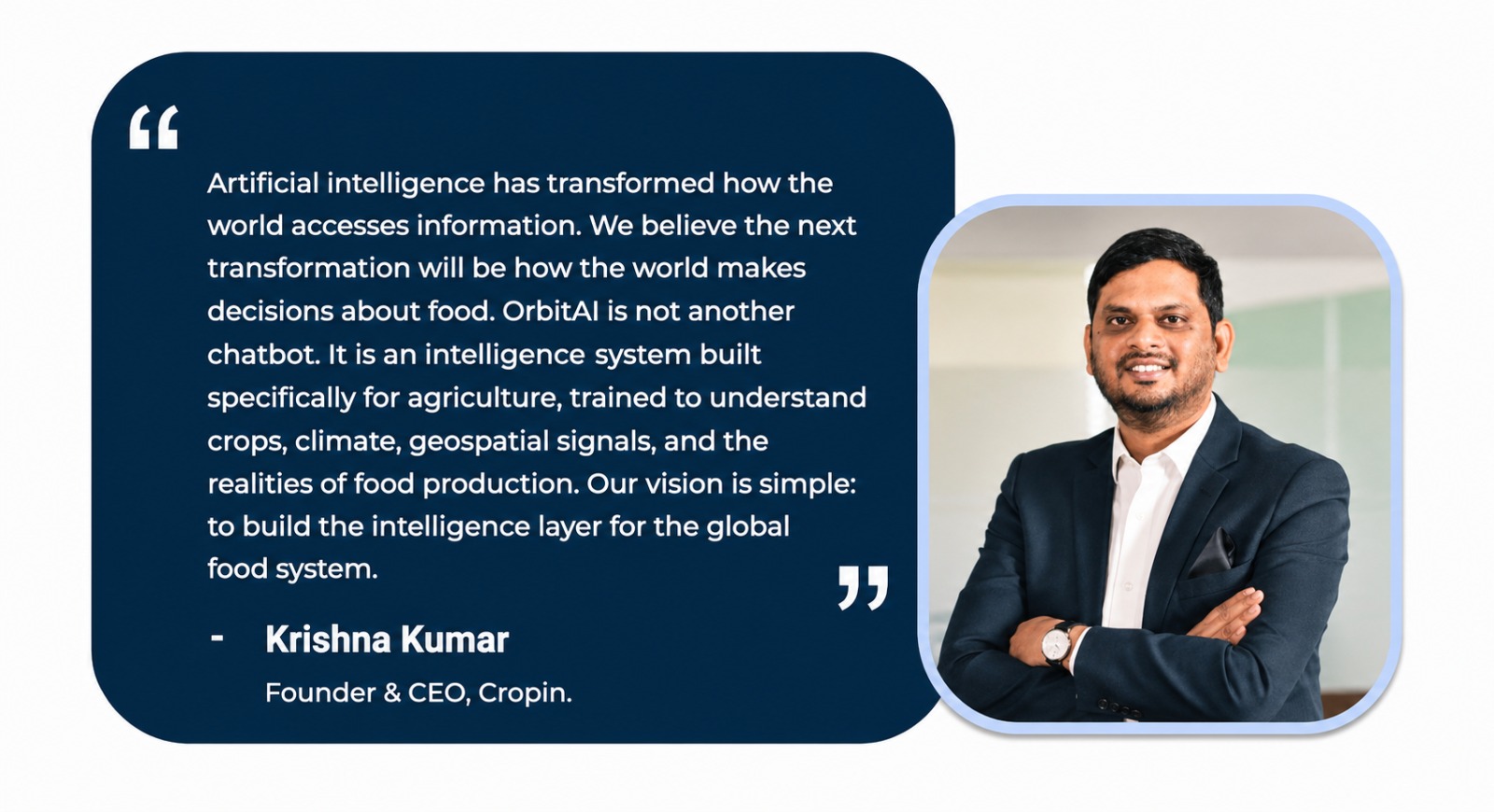
Food and agriculture support the livelihoods of more than a billion people, yet the decisions shaping those livelihoods are still made on fragmented, delayed information. Cropin built OrbitAI on a simple conviction: expert-grade agricultural intelligence shouldn’t be reserved for those with the biggest budgets or the most technical teams. Whether it’s a smallholder farmer in Africa or a banker underwriting agri-credit in New York, ask a question in plain language, get an answer grounded in real, verified agricultural truth.
This vision is especially powerful because food systems are deeply interconnected. A farmer’s risk today can become a procurement issue tomorrow and food insecurity the next day. A weather anomaly can affect yield, quality, logistics, and pricing. A compliance signal can influence market access. OrbitAI is designed to help people reason across those connections rather than manage each problem in isolation.
Why OrbitAI Matters
As the global food system becomes more complex, the gap between available data and usable intelligence will define who moves faster. The organizations and individuals who can interpret change sooner, act earlier, and respond with confidence will be better positioned to reduce risk, protect yields, secure supply, and improve outcomes across the value chain.
OrbitAI is built for that moment. For some users, OrbitAI will help answer a simple weekly question about crop health. For others, it will help guide sourcing strategy, risk monitoring, or sustainability decisions. Across all of those contexts, its value is the same: helping people access better intelligence and make better decisions.
Conclusion
OrbitAI represents a structural shift in what AI can do for food and agriculture as an autonomous, domain-first intelligence built on real agronomic ground truth and engineered for scale on Google’s AI infrastructure. The industry doesn’t need more data. It needs intelligence that acts. That’s precisely what OrbitAI was built to deliver, for everyone in the system, everywhere the system operates.
See OrbitAI in action, No demo call, No sales gate!
Request early access today, Ask your first question, and get an answer in minutes or even seconds!
How is agentic AI used in precision agriculture?
Agentic AI powers precision agriculture by continuously sensing zone-level field conditions soil, crop health, moisture and autonomously adjusting irrigation, nutrient application, and interventions at that same granular level, rather than applying uniform treatment across an entire field.
What data does agentic AI need to work on a farm?
It typically draws on soil sensor data, drone and satellite imagery, weather API feeds, historical climate and yield records, and market signals, combining them into a continuously updated picture of farm conditions.
How is agentic AI different from traditional AI in agriculture?
Traditional AI in agriculture typically generates recommendations or predictions using historical data and online information. Agentic AI integrates multiple deep learning models to perceive conditions and derive autonomous, actionable intelligence. It continuously monitors the outcomes of actions and provides insights.
How do multiple AI agents coordinate on a single farm?
Conceptualized models for weather, crop health, yield, and more share data and communicate in real time, negotiating a combined response as a team of domain experts would. AI agents, however, do this continuously and at machine speed.
Is agentic AI the same as autonomous tractors or farm robots?
No. Autonomous tractors and robots are physical execution tools. Agentic AI is the decision-making intelligence layer that can be used to derive insights that direct those tools and many other systems. It is based on continuous data and reasoning, and is not the physical hardware itself.
Author Bio

Prakhyath Hegde
Prakhyath Hegde is the Chief Technology Officer at Cropin, the world's largest deployed AI platform for food and agriculture, bringing over two decades of experience in building hyper-scale software and AI-powered products. At Cropin, he is instrumental in leading the engineering for all platforms, including developing its multi-tenant, micro-services based Cloud & SaaS digitization platform. His work focuses on converging farm digitization data with advanced intelligence outputs from AI, ML, data science, satellite imagery, and remote sensing. A passionate problem-solver, Prakhyath previously held leadership roles at Samsung Research Institute and Viacom18, and has authored multiple scholarly articles and holds international patents.