Synopsis:
The growing complexity of sugarcane production makes accurate yield forecasting increasingly important for sugar producers. Traditional methods often struggle to capture changing weather conditions, crop health, pest pressure, and field-level variability, creating uncertainty in harvest and supply planning. This blog explores how AI, satellite intelligence, weather data, and predictive analytics are changing sugarcane yield forecasting. It also looks at how Cropin uses crop intelligence and AI-driven insights to help sugar enterprises monitor crop performance, identify risks early, estimate yields, and make more informed harvest and supply chain decisions.
Sugarcane plays a critical role in the global agri-economy, supporting sugar production, ethanol blending, and bio-based industrial supply chains. According to FAO estimates, global sugarcane production exceeds 1.9 billion tonnes annually, with major producers including Brazil, India, China, and Thailand. However, despite its economic importance, sugarcane yield forecasting remains one of agriculture’s most complex challenges.
Yield fluctuations caused by weather, soil conditions, pest outbreaks, and harvesting inefficiencies often lead to significant uncertainty in planning. To reduce this uncertainty, agribusinesses are transitioning from traditional estimation methods to AI-driven predictive systems powered by satellite intelligence, machine learning, and digital agronomy platforms like Cropin.
Why Sugarcane Yield Forecasting Is a Strategic Priority for Sugar Producers
Yield forecasting has long shifted from an agronomic exercise to a business-critical function.
Accurate forecasts directly influence:
- Sugar mill crushing capacity planning
- Ethanol production alignment with government blending mandates
- Export commitments and trade planning
- Farmer procurement and pricing decisions
- Logistics and storage optimization
Even a 5–10% forecasting error can lead to severe inefficiencies in mill operations, resulting in either overcapacity wastage or supply shortages. This makes it essential for sugar enterprises to increase investments in data-driven forecasting ecosystems instead of traditional manual estimation systems.
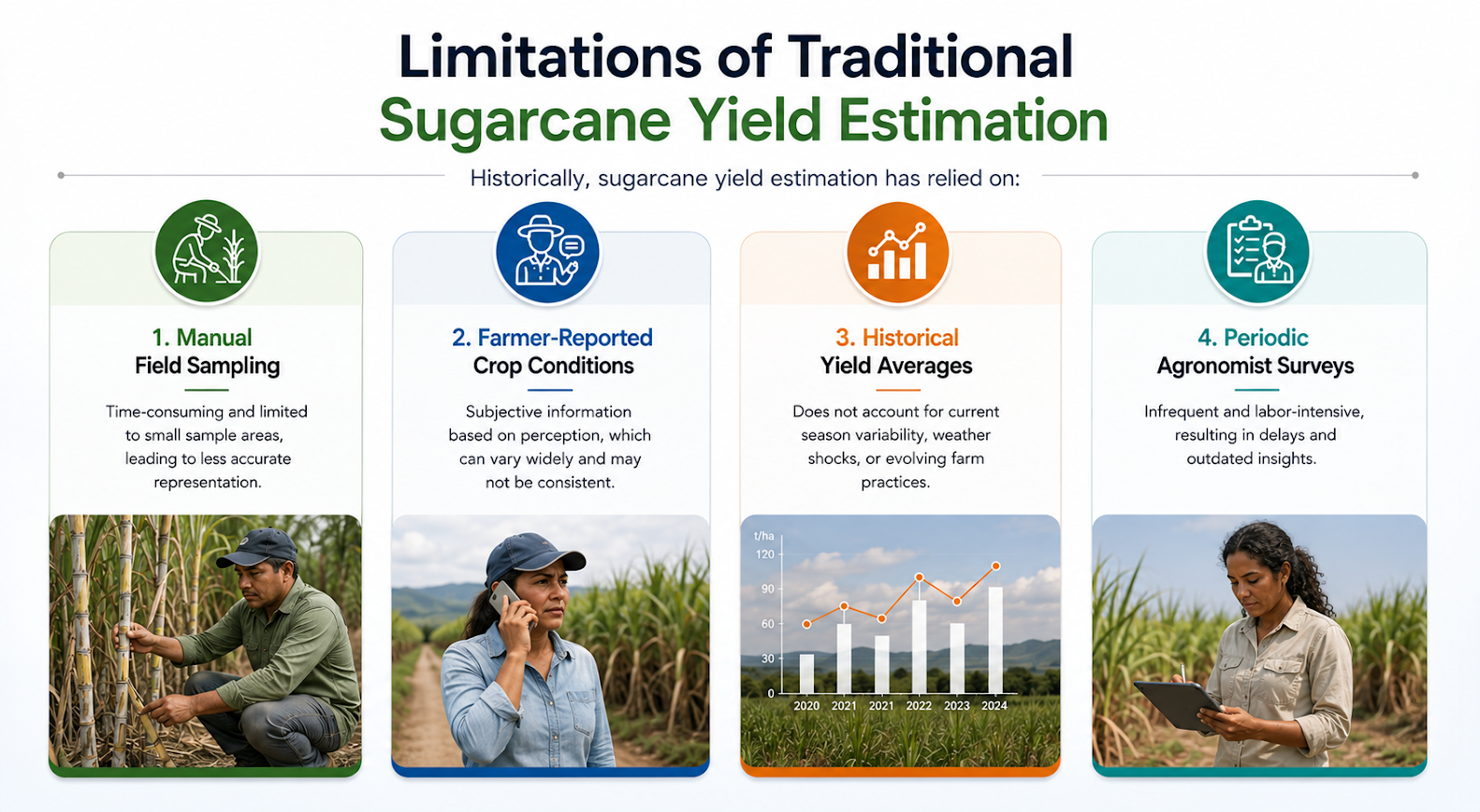
Limitations of Traditional Sugarcane Yield Estimation
Historically, sugarcane yield estimation has relied on:
- Manual field sampling
- Farmer-reported crop conditions
- Historical yield averages
- Periodic agronomist surveys
While these methods provided basic visibility, they suffer from key limitations:
Delayed Data Collection
Manual survey methods rely on periodic field visits, which means data is collected only at fixed intervals such as weekly, monthly, or during specific crop stages. In fast-changing agricultural environments, this creates a major blind spot. Sugarcane crop conditions can shift quickly due to rainfall, temperature spikes, irrigation delays, or pest activity.
By the time survey data is compiled and analyzed, the actual field conditions may have already changed. Result? Reduced accuracy of forecasting and limited ability of sugar producers to respond proactively to emerging risks.
Limited Geographic Coverage
Sugarcane plantations are often spread across vast and fragmented agricultural landscapes, sometimes covering thousands or even tens of thousands of acres. Conducting physical inspections across such large areas is operationally difficult and time-consuming.
As a result, only sample fields are typically assessed, and conclusions are extrapolated to represent entire regions. This creates visibility gaps, where localized issues such as irrigation failure or pest infestation in specific zones remain undetected until they escalate, impacting overall yield accuracy.
Subjective Interpretation
Traditional field assessment depends heavily on human judgment, which naturally introduces variability. Different inspectors may evaluate the same field differently based on experience, observation style, or how they interpret crop conditions.
One agronomist may classify crop health as “good,” while another may rate it as “average” under identical conditions. This lack of standardization leads to inconsistencies in reporting, making it difficult to build reliable, uniform datasets for forecasting models and long-term planning.
No Real-Time Visibility
Conventional forecasting methods do not provide continuous visibility into crop health. Issues such as pest attacks, nutrient deficiencies, water stress, or disease outbreaks often develop rapidly between inspection cycles.
Without real-time monitoring, these problems are detected only after visible damage has already occurred. This reactive approach limits early intervention, resulting in avoidable yield losses and reduced operational efficiency across the supply chain.
These limitations make traditional forecasting systems reactive rather than predictive. They focus on recording what has already happened instead of continuously understanding what is happening in the field. This gap is exactly what platforms like Cropin are designed to solve by leveraging satellite imagery and AI/ML models.
What Drives Sugarcane Yield Variability
Sugarcane yield is influenced by multiple interconnected factors:
- Weather variability (rainfall distribution, heat stress)
- Soil fertility and moisture retention
- Irrigation scheduling efficiency
- Pest and disease pressure
- Crop variety and planting cycles
- Harvest timing
These factors do not operate independently; they continuously interact throughout the crop lifecycle, making yield prediction highly dynamic.
How AI Is Transforming Sugarcane Yield Forecasting
AI introduces a shift from static estimation to continuous prediction modeling.
Modern AI systems combine:
- Satellite imagery for vegetation health tracking (NDVI-based monitoring)
- Weather forecasting models for climate impact prediction
- Soil and field sensor data for moisture and nutrient levels
- Historical yield datasets for machine learning training
- Agronomic models for crop growth simulation
Machine learning algorithms continuously refine yield estimates as new data flows in during the crop cycle.
This enables:
- Field-level yield forecasting
- Zone-level production estimation
- Regional supply prediction
- Harvest readiness scoring
Instead of relying on one-time estimates, sugar producers gain dynamic forecasting throughout the season.
The Role of Satellite Intelligence in Sugarcane Monitoring
Satellite-based monitoring is now a foundational layer in precision agriculture.
It enables sugar enterprises to:
- Monitor crop growth across large plantation zones
- Identify vegetation stress patterns early
- Detect irrigation inefficiencies both at plot-level and at scale
- Track seasonal crop performance variability
- Map yield risk zones before harvest
When combined with AI models, satellite intelligence creates a real-time agricultural visibility layer, transforming decision-making across the sugar value chain.
How Cropin Enables AI-Driven Sugarcane Yield Forecasting
Cropin enables sugar enterprises to unify farm-level data, satellite insights, and predictive analytics into a single intelligence system.
Through its proprietary Crop Knowledge Grid and contextualized AI models, the Cropin platform helps organizations:
- Configure and share the best Package of Practices (PoP) with farmers through Cropin Connect, track adherence, raise timely alerts on irrigation, weather, and pest and disease management, and maintain complete field logs.
- Use Cropin Grow to digitize end-to-end farm operations, from geo-tagging plots and tracking crop stage progression to remote crop health monitoring using NDVI, NDRE, and LSWI indices for fertilizer optimization and precision input management. It provides a unified digital representation of farms and plantations
- Cropin’s yield estimation model – integrating satellite data, weather, and the proprietary Crop Knowledge Grid delivers harvest-ready insights 45 days in advance, supporting procurement planning, logistics, crushing capacity utilization, and sourcing strategy adjustments.
- Cropin’s pin code-level weather-linked advisories combine precipitation forecasts with evapotranspiration data to optimize irrigation scheduling across every growth stage, preventing both waterlogging and water stress, critical for protecting sugar content at harvest.
- Continuous soil moisture monitoring helps track sugar concentration levels, enabling precise harvest timing decisions that directly protect yield quality and mill output.
- Cropin DEWS analyses historical and forecast weather data alongside crop science models to predict disease probability at least 15 days in advance, providing actionable early warnings for threats like Grassy Shoot, Fusarium Wilt, Sugarcane Smut, and Red Stripe, with configurable alert thresholds for immediate field response.
This transforms sugar production from reactive reporting to predictive agricultural intelligence.
Key Benefits of AI-Driven Sugarcane Yield Forecasting
1. Higher Forecast Accuracy Through Multi-Source Intelligence
AI integrates satellite data, weather models, and field inputs into a unified prediction system. Unlike traditional methods that rely on static assumptions, AI continuously updates forecasts based on real-time crop behavior. This significantly reduces estimation errors and improves decision reliability for mills and procurement teams.
2. Early Detection of Crop Stress and Risk Factors
AI systems detect early signs of crop stress such as water shortage, nutrient deficiency, or pest infestation long before they become visible to the human eye. This early warning capability allows agribusinesses to take corrective action in time, preventing yield loss and improving crop recovery outcomes.
3. Optimized Sugar Mill Planning and Capacity Utilization
Accurate yield forecasting enables sugar mills to plan crushing capacity, labor allocation, and operational scheduling more efficiently. It prevents both overloading and underutilization of mills, ensuring smoother operations during peak harvest seasons.
4. Improved Procurement and Pricing Decisions
With better visibility into expected supply, sugar producers can optimize procurement strategies and pricing decisions. This reduces market volatility risks and supports more stable financial planning across the supply chain.
5. Enhanced Resource Allocation and Input Optimization
AI-driven insights help optimize irrigation schedules, fertilizer application, and field operations. Resources are applied only where needed, reducing waste and improving input efficiency while maintaining or improving yield output.
6. Stronger Supply Chain Coordination and Forecast Alignment
Accurate forecasting enables better alignment between farmers, mills, transport systems, and storage facilities. This improves logistics planning, reduces bottlenecks during harvest season, and ensures smoother downstream distribution.
7. Data-Driven Agricultural Decision-Making at Scale
Instead of relying on intuition or fragmented field reports, agribusinesses gain access to structured, scalable, and continuously updated intelligence. This supports long-term planning, policy decisions, and operational optimization across entire production networks.
From Guesswork to Intelligent Agriculture
Sugarcane farming has traditionally depended on experience-based judgment and manual reporting. While effective in earlier agricultural systems, this approach struggles to keep up with modern-scale production demands.
Today, the shift toward AI-driven agriculture enables continuous monitoring of crop conditions across entire regions. Satellite imagery, predictive modeling, and machine learning systems work together to convert raw agricultural data into actionable intelligence.
This transformation allows sugar producers to move from uncertainty-driven operations to predictable, optimized, data-led harvest planning systems.
Conclusion
Sugarcane yield forecasting is undergoing a fundamental shift from manual estimation to intelligent, data-driven prediction. Traditional methods struggle to capture real-time variability in weather, soil, and crop health, leading to inconsistent planning outcomes. With AI, satellite intelligence, and predictive analytics, sugar producers can now forecast yields with greater precision and speed.
Platforms like Cropin enable continuous visibility across the crop lifecycle, helping organizations reduce risk, optimize mill operations, and improve supply chain coordination. This evolution is reshaping sugar production into a more efficient, resilient, and insight-driven agricultural ecosystem.
Transform sugarcane production with AI-powered intelligence. Partner with Cropin to improve yield forecasting accuracy, optimize harvest planning, and build a smarter, more resilient agricultural supply chain today.
Frequently asked questions (FAQs)
What are AI tools in agriculture?
AI tools in agriculture use technologies such as machine learning, satellite imagery, computer vision, predictive analytics, and intelligent farm management to help farmers and agribusinesses monitor crops, optimize resources, forecast yields, and improve operational decision-making.
How are UK agribusinesses using AI?
UK agribusinesses use AI to monitor crop health, strengthen agronomy decisions, predict weather-related risks, optimize irrigation, improve supply chain planning, forecast yields, and support sustainability initiatives through data-driven insights.
Which AI tools improve crop productivity?
AI-powered farm management platforms, predictive analytics, crop monitoring systems, agronomy decision-support solutions, pest and disease detection, yield forecasting tools, and nutrient intelligence platforms all contribute to improved crop productivity.
Can AI support sustainable agriculture?
Yes. AI helps optimize water usage, fertilizer application, carbon monitoring, and resource management while supporting sustainability reporting, ESG compliance, and responsible farming practices through measurable, data-driven insights.
How does AI improve supply chain planning?
AI analyzes production forecasts, weather conditions, market demand, and inventory data to improve planning across procurement, logistics, storage, and distribution, helping reduce waste and improve supply chain efficiency.
What industries benefit most from agricultural AI?
Agricultural AI benefits growers, agribusinesses, food processors, seed companies, procurement teams, cooperatives, retailers, exporters, financial institutions, and organizations focused on sustainable agriculture and food production.
What industries benefit most from agricultural AI?
Agricultural AI benefits growers, agribusinesses, food processors, seed companies, procurement teams, cooperatives, retailers, exporters, financial institutions, and organizations focused on sustainable agriculture and food production.
Author Bio

Haripriya Muralidharan
Haripriya Muralidharan leads content marketing at Cropin Technology Solutions, bringing a unique scientific rigor to brand storytelling. With a Master's in Chemistry from Pune University and research experience in cancer immunology, she discovered her passion in storytelling. For two decades, she has operated at the intersection of content, communication, and brand strategy, specializing in turning complex ideas into impactful narratives. Prior to Cropin, Haripriya leveraged her creative skills at Elsevier’s Chemical Business News Base and shaped multi-format content strategies for B2B marketing at Scatter.