Synopsis:
Development agencies are the operational backbone of global food security, smallholder livelihoods, and rural economic resilience. To bridge stubborn knowledge gaps and open doors to premium markets, modern programs require a shift from isolated tools to unified technology ecosystems. This blog explores 10 game-changing AgTech innovations and examines the compounding value of deploying them within a single, connected intelligence framework. Learn how purpose-built agricultural technology can seamlessly adapt to the complex realities of the field, empowering every field officer and supercharging program performance.
Development agencies are the invisible backbone of global food security. They bridge the gap between policy ambition and farm-level reality. These agencies carry the mandate to lift smallholder farmers, all 500 million of them out of subsistence and into resilience. They work in the hardest geographies, with the thinnest budgets, accountable to the highest standards of impact. When they succeed, they change lives at scale. When they fall short, the consequences are measured in hunger, lost income, and broken agricultural systems. The weight of that responsibility is real.
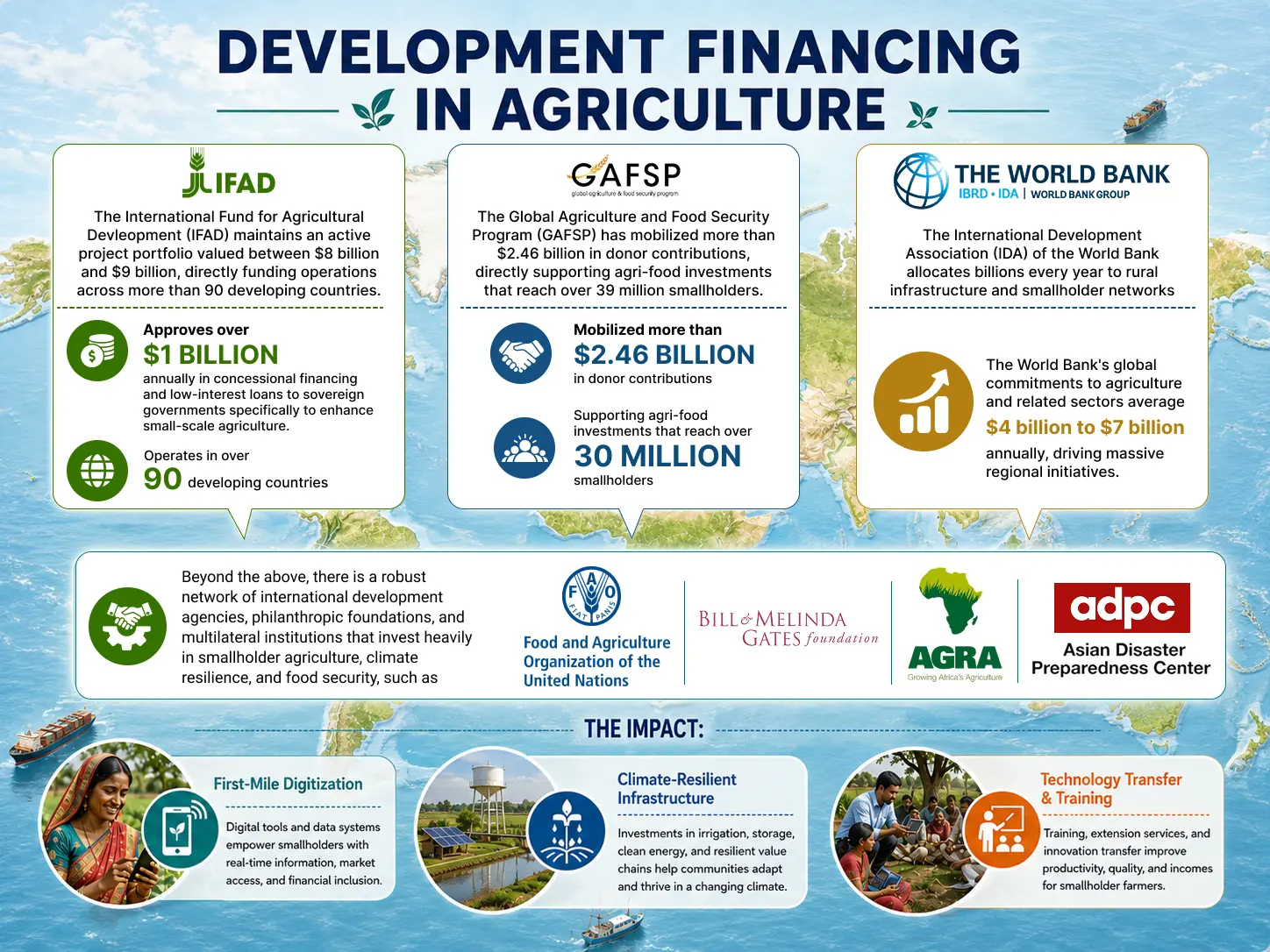
When looking strictly at international development finance over longer horizons, global funders committed a cumulative $252 billion in Agriculture, Forestry, and allied sectors during a recent two-decade tracking period. This funding is distributed through specific financial instruments and targeted sub-sectors. Here is a quick pictorial representation.
At the center is the field officer, the link between the development agency and the farmer.
And here is a moment every field officer knows well. Standing in a remote village, notebook in hand, trying to capture data from a farmer who speaks a language the form wasn’t designed for. Somewhere far away, these numbers are crucial for making policy decisions that will affect thousands of people. Behind you, a farmer’s entire livelihood hangs on uncertainties, a solitary struggle for survival against the uncertainties of erratic monsoons, crop disease, a market price they have no visibility into. This is not an edge case. It is the daily operational reality of agricultural development agencies working across the Global South. It has been for decades. And for too long, the tools available to carry it were simply not equal to the task.
Agriculture feeds the world, and the world’s food future is under pressure as never before. A global population approaching 10 billion. Climate volatility is disrupting growing seasons from sub-Saharan Africa to South Asia. Smallholder farmers, who produce a third of the world’s food, largely excluded from the data systems, financial services, and decision-support tools that would help them thrive. Empowering these farmers spread across inaccessible landscapes, speaking multitude of languages, farming plots too small for conventional agricultural investment is not just a development priority. It is a prerequisite for a stable food future.
Development agencies are the mechanism through which that empowerment happens at scale. They are the connective tissue between global climate commitments and the farmer in the field who needs to know, right now, whether to irrigate or wait. Between food security targets set in multilateral summits and the ground-level programs that determine whether those targets are met development agencies are the bridge.
What they have lacked, until recently, is technology commensurate with that mission.
That is changing. Faster than most people realize. A new generation of agricultural technology built not for research labs or corporate farms but for the realities of field operations in developing economies is reshaping what development agencies can see, know, and act on. The visibility gap is closing. The feedback loop between field reality and program management is being rebuilt in near real time.
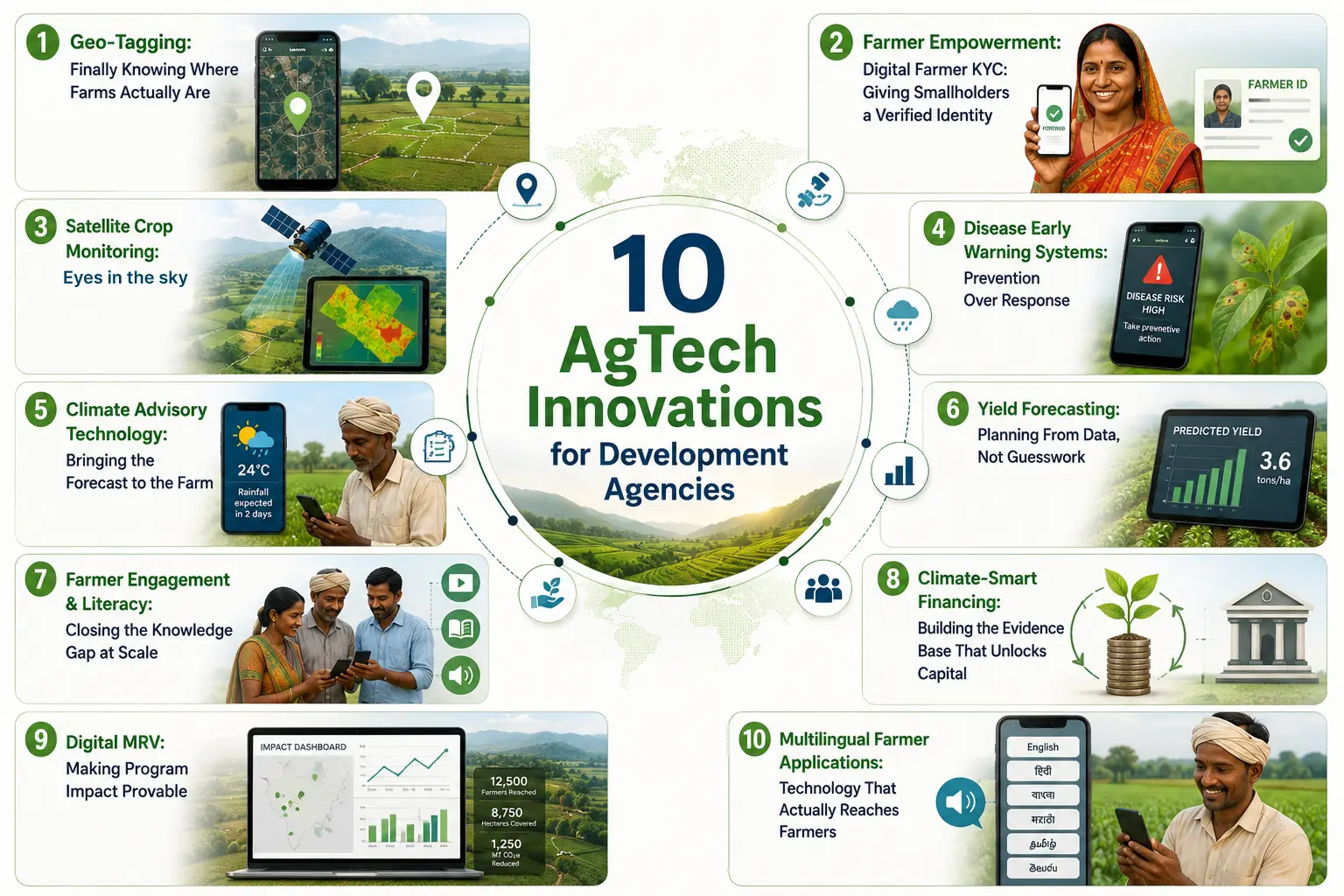
Here are ten technologies that are making this transformation real.
Ten technologies redefining how development agencies design, implement, and measure agricultural programs on the ground
1. Geo-Tagging: Finally Knowing Where Farms Actually Are
It sounds basic. It isn’t.
A shocking proportion of agricultural development programs still operate without verified, geo-referenced farm boundaries. Beneficiary data is self-reported. Farm sizes are estimated. Nobody can say with certainty how many acres a program is actually covering or whether the same farm has been registered twice under different names.
Geo-tagging fixes this at the source. Field officers use mobile applications to map farm boundaries using GPS, capturing verified coordinates for every enrolled plot. While using Cropin app, data collated in remote areas is stored in the app and syncs to the platform when the field agent has internet coverage. The result is a verifiable, accurate land record, often the first one a farmer has ever had.
For development agencies, this is the foundation of everything else. You cannot target subsidies, measure coverage, or verify outcomes without knowing where the farms are.
2. Farmer Empowerment: Digital Farmer KYC: Giving Smallholders a Verified Identity
Most of the world’s 500 million smallholder farmers are invisible to the formal systems designed to serve them. No verified identity. No credit history. No way for a bank, insurer, or government program to know they exist.
Digital Know Your Customer (KYC) processes change this fundamentally. They capture verified farmer identity, namely name, location, land tenure, crop history, household data in a structured, portable digital record. For many farmers, this is their first formal digital footprint.
For development agencies, the downstream impact is transformative. Subsidy delivery becomes targeted. Duplicate registrations disappear. Financial institutions can extend credit to farmers who were previously unbankable. And for the first time, program monitoring can track *actual people* not estimated beneficiary counts.
3. Satellite Crop Monitoring: Eyes in the sky
Field visits are expensive. They are slow. And they are physically impossible to conduct at national scale.
Satellite crop monitoring solves the coverage problem. AI models analyze multispectral satellite imagery to identify crop types, map cultivation areas, monitor growth stages, and detect stress events (read drought, flooding, pest pressure) across millions of acres simultaneously.
This isn’t future technology. Cropin has used this approach to map wheat cultivation across Kenya at a resolution that traditional government surveys could never achieve. In Nigeria and Mexico, satellite monitoring has detected production declines across vast regions, giving policymakers the intelligence to act before food security crises develop. The data arrives in near real time, not six months later.
4. Disease Early Warning Systems: Prevention Over Response
By the time a farmer sees disease symptoms on a leaf, the damage has already started. Preventive action is possible only if you know the risk is coming.
Cropin’s disease early warning systems (DEWS) is a probabilistic model that continuously analyzes temperature, humidity, rainfall patterns, historical data and crop growth stage to generate probability scores for specific disease outbreaks plot by plot, weeks in advance. Field teams get prioritized alerts. They visit the right farms at the right time. And they act before yield loss becomes irreversible.
For development agencies running food security programs, this shifts the entire dynamic. You are no longer responding to crises. You are preventing them. That is a fundamentally different value proposition, and a far better use of limited program budgets. The Cropin platform enabled mitigation efforts not just for one development agency but for many, including ADPC, AGRA, and Space4Good across the Global South.
5. Climate Advisory Technology: Bringing the Forecast to the Farm
A national weather forecast is useless to a smallholder farmer in a remote valley. What matters is hyperlocal, the rainfall expected on *this farm*, *this week*, and what it means for *this crop*, at *this growth stage*.
AI-powered climate advisory tools do exactly this. They combine weather forecast data, satellite imagery, and crop-specific agronomy models to generate field-level, actionable recommendations. When to irrigate. When to apply inputs. When a heat event is likely to affect pollination. What to do about it.
Cropin has deployed this capability to help farmers in climate-vulnerable regions adapt to shifting rainfall patterns, build drought resilience, and adjust planting calendars in real time, including in the FIRA project across Mexico. For development agencies with climate adaptation mandates, this is how you turn a climate commitment into a measurable outcome.
6. Yield Forecasting: Planning From Data, Not Guesswork
National crop yield estimates are typically produced months after harvest, based on statistical samples and expert estimates that are out of date before they are published.
AI-powered yield forecasting changes this. By continuously analyzing satellite data, weather variables, crop stage models, and historical patterns, these systems generate plot-level yield projections months before harvest. Aggregated upward, they give governments and agencies an early, reliable read on production across entire regions.
The applications are direct: food import and export decisions made earlier and more accurately; emergency food assistance pre-positioned before a shortfall hits; and program impact, did our intervention actually improve yields? measured with evidence rather than assumptions.
7. Farmer Engagement & Literacy: Closing the Knowledge Gap at Scale
Technology that reaches a program dashboard but never reaches the farmer is technology that has failed. The most important last mile in agricultural development is not logistics, it is knowledge.
Digital farmer engagement platforms now make it possible to share structured Package of Practices: crop-specific, stage-specific, locally calibrated agronomic guidance, directly with farmers and field advisors in real time. Weather and pest alerts are delivered proactively, in the farmer’s own language, via app, SMS, or voice. Knowledge that previously traveled slowly through extension networks, arriving weeks after it mattered, now reaches the right farmer at the right moment.
The income impact of this is not theoretical. When farmers receive timely, accurate agronomic guidance on what to spray, when to plant, and how to manage soil moisture during a dry spell, they make better decisions. Better decisions mean lower input waste, reduced crop loss, and higher marketable yields. These are the direct pathways from farmer literacy to farmer income.
What this looks like at scale: the AGRA partnership in Africa
AGRA – the Alliance for a Green Revolution in Africa is one of the continent’s most ambitious agricultural development organizations, working across Ghana, Nigeria, Burkina Faso, Mali, Tanzania, and Mozambique. The challenge it faced was familiar and formidable: how do you reach millions of smallholder farmers with meaningful agronomic support when your field advisor network cannot physically cover the geography?
The answer was the digitization of the Village-Based Advisor (VBA) network. In partnership with Cropin, AGRA trained and equipped 10,626 VBAs with digital tools, enabling them to engage farmers with real-time advisories, monitor farm conditions, and deliver Package of Practices guidance at scale. Through this digitized network, the program reached 3 million smallholder farmers across six countries, a reach that no analog extension system could have achieved.
Agricultural productivity and farmer income improved across all six program countries. The VBAs themselves became local entrepreneurs, creating employment and economic anchors in rural communities. And AGRA gained, for the first time, centralized visibility into farmer engagement data across a continent-scale program.
This is what farmer engagement at scale looks like when it is built on the right digital infrastructure. Not just information delivery, but a sustained, data-backed relationship between advisors and farmers, one that compounds over seasons. And this is the scale successful developmental agency programs deliver.
8. Climate-Smart Financing: Building the Evidence Base That Unlocks Capital
Climate adaptation in smallholder agriculture has a financing problem. Not a shortage of willingness; climate funds, impact investors, and development finance institutions have significant capital available for the right programs. The shortage is evidence. Verifiable, standardized, audit-ready data showing that specific interventions are producing specific climate outcomes at specific farms.
Without that evidence base, climate finance cannot flow at the scale the challenge demands. Development agencies find themselves caught between ambitious program mandates and the inability to produce the MRV documentation that funders require.
Digital platforms are beginning to close this gap. When farm-level data is captured consistently, geo-referenced practices, satellite-verified land use, documented input applications, and yield outcomes linked to specific agronomic interventions; it becomes possible to construct the carbon and climate accounting. This unlocks concessional lending, carbon credit mechanisms, and results-based climate finance.
This is more than a reporting capability. It is a structural shift in how smallholder agriculture can access capital. Farmers who adopt climate-resilient practices can, for the first time, generate a verifiable record of those practices, a record that financial institutions can use to price risk, extend credit, and issue parametric insurance products tailored to actual farm conditions. This also solves the fundamental issue of financial inclusion.
For development agencies, the ability to generate this evidence base transforms their role. They become not just program implementers but climate finance facilitators able to connect the capital sitting in global climate funds with the farmers who need it most and can now prove they deserve it.
9. Digital MRV: Making Program Impact Provable
Monitoring, Reporting, and Verification (MRV), oh yes! This the backbone of development program accountability. It is also, in most programs, the weakest link.
Paper-based methods are slow, inconsistent, and error-prone. Data collected in the field bears little resemblance to the data that appears in a donor report six months later. Nobody in the chain can say with confidence that what was recorded actually happened.
Digital MRV replaces this with timestamped, geo-referenced, automatically structured field data. Every farm visit, advisory delivery, input distribution, and crop observation is recorded with date, location, and photographic evidence logged at the moment it happens, not reconstructed later. Donor reports become auditable. Impact claims become verifiable. And the feedback loop between field reality and program management closes; often for the first time.
10. Multilingual Farmer Applications: Technology That Actually Reaches Farmers
Every other technology on this list fails if the farmer can’t use it.
Most agricultural apps are built in English or at best, in one regional language. They require smartphones. They assume literacy. They are designed for the technology team, not for the farmer standing in a field at 6am with muddy hands.
Multilingual farmer applications are built differently. They work on basic smartphones. They deliver advisories, alerts, and market information in the farmer’s native language via app, SMS, or voice. They capture field observations with simple interfaces that don’t require technical training.
Cropin Connect does this across multiple languages and geographies, enabling field officers and farmers to communicate, capture observations, and receive guidance through a single platform regardless of where they are or what language they speak. For development agencies working across linguistically diverse regions, this is the difference between a technology program and a technology program that actually works.
These Ten Technologies. One Platform. And a Bigger Mandate Than Any of Them Alone.
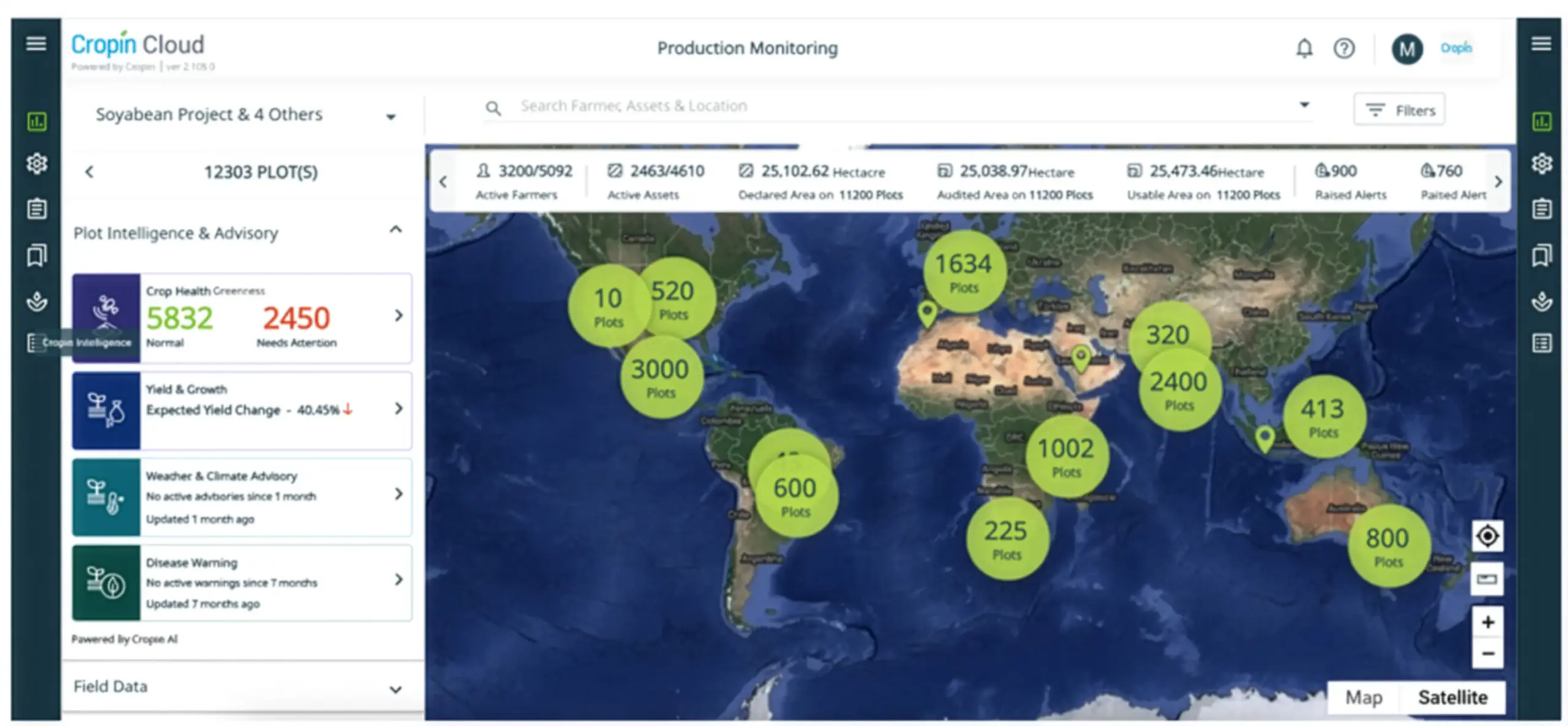
None of these innovations operates in isolation. The real power emerges when they work together when a geo-tagged farm boundary feeds a satellite monitoring system, which triggers a disease early warning, which generates a field advisory delivered in the farmer’s language, which is recorded by a digital MRV system and fed back to a program dashboard.
That integration is exactly what Cropin’s platform delivers. It is not a collection of separate tools. It is a connected intelligence system built for the scale, complexity, and human reality of agricultural development program.
The stakes extend beyond individual programs. Agricultural development, done well, is one of the most powerful levers for achieving the Sustainable Development Goals. SDG 1 (No Poverty), SDG 2 (Zero Hunger), SDG 8 (Decent Work and Economic Growth), SDG 13 (Climate Action), SDG 15 (Life on Land), every one of these converges on the smallholder farmer and the development agency trying to serve them. When programs are designed on verified data, measured against real outcomes, and built around genuine farmer empowerment, the impact compounds across all of these goals simultaneously.
The technology to do this exists. The programs that deploy it are already proving it works. What remains is to scale the will to bring these capabilities to every development agency, every program, every field officer standing in a remote village trying to change the trajectory of the farmers they serve.
Development agencies working in the field deserve technology that matches the ambition of their work. These ten innovations, deployed together, are how that ambition becomes measurable, accountable, and real.
See how Cropin works for development agencies
Author Bio

Krishna Kumar
Krishna Kumar is the Founder and Chief Executive Officer of Cropin, the world's most advanced AI platform for Food and Agriculture. He established Cropin in 2010 and pioneered the use of digital technologies and predictive intelligence. Cropin is transforming humankind’s oldest industry – agriculture into a modern, digitally connected sector. Today, Cropin has digitized over 30 million acres and empowered nearly 7 million farmers across 103 countries. Under his leadership, Cropin has introduced cutting-edge innovations, including Cropin Cloud and the industry's first real-time Gen AI platform, Cropin Sage, with the goal of building intelligence around every acre of cultivable land. Passionate about transforming global food systems through tech and data, he has also been recognized as a UBS Global Visionary, World Economic Forum Steering Committee Member, Top 10 Emerging Technologies of 2025, and serves as a non-official member of the National Startup Advisory Council. His areas of interest include deforestation monitoring, soil and crop intelligence, and precision agriculture. Passionate about leveraging technology for sustainable agriculture, Deepak believes that the future of farming will be shaped by the convergence of geospatial intelligence, AI, and actionable field insights to create more resilient and efficient food systems worldwide.