Synopsis:
As weather volatility, climate uncertainty, and supply chain disruptions continue to impact corn production across the United States, agribusinesses are moving beyond traditional forecasting methods toward AI-powered yield intelligence. This blog explores how satellite imagery, predictive analytics, weather intelligence, and Cropin’s Crop Knowledge Grid enable accurate corn yield prediction, real-time crop monitoring, and proactive risk management. It further demonstrates how seed manufacturers, food processors, traders, and procurement teams can leverage data-driven insights to improve forecasting accuracy, strengthen supply chain resilience, optimize sourcing decisions, and achieve greater certainty across the corn value chain.
Introduction
Corn is one of the most important agricultural commodities in the United States, supporting food production, livestock feed, biofuel manufacturing, and global trade. According to the USDA, the country produces approximately 14.9-15.1 billion bushels of corn annually (around 380-385 million metric tons), making it the world’s largest corn producer and reinforcing the importance of accurate yield forecasting across the supply chain.
Traditional forecasting methods often provide estimates after risks have already impacted crop performance. Today, advances in artificial intelligence, satellite imagery, and predictive analytics are changing how organizations approach corn yield forecasting.
With advances in AI and data analytics, agribusinesses no longer need to depend solely on historical data and field surveys. Near-real-time intelligence now enables continuous monitoring and more informed decision-making throughout the growing season. AI-powered corn yield prediction enables organizations to forecast production more accurately, manage risks proactively, and make better operational decisions across the value chain.
What Is Corn Yield Prediction - And Why Does It Matter for US Agribusinesses?
Corn yield prediction refers to the process of estimating the amount of corn that a field, farm, region, or sourcing network is expected to produce before harvest.
From an agronomic perspective, corn yield is determined by four primary components: ears per acre, kernel rows per ear, kernels per row, and kernel weight. These factors are influenced by weather conditions, soil quality, seed variety, crop management practices, and environmental stress throughout the growing season.
For modern agribusinesses, however, corn yield prediction extends beyond field biology. It has evolved into an enterprise intelligence function that combines AI, satellite imagery, weather models, and field-level data to forecast production outcomes at scale. Accurate corn yield forecasting helps organizations optimize procurement strategies, improve supply chain planning, allocate resources effectively, and reduce operational uncertainty.
As corn production becomes increasingly exposed to climate variability and market fluctuations, timely and accurate forecasting has become a strategic advantage rather than a seasonal reporting exercise.
The True Cost of Inaccurate Corn Yield Prediction for US Agribusinesses
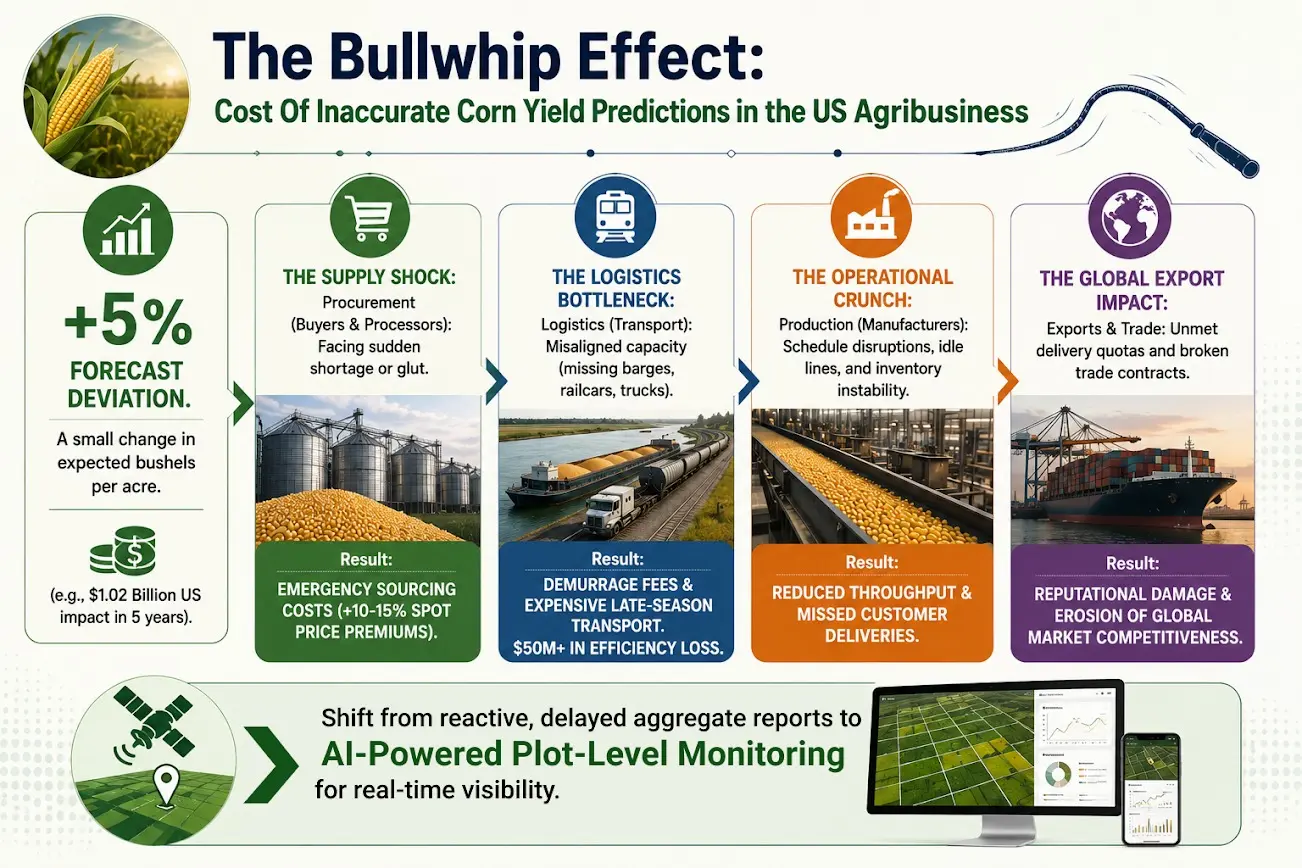
Inaccurate corn yield forecasts trigger an economic ripple effect far beyond the farm. The financial penalty hits standard operations. For procurement and logistics teams, a 5% forecast error (just several bushels per acre) on a tight-margin, volume-based commodity like corn can completely erase profit. This could cost US agribusiness an estimated $1.02 billion in the last five years alone.
When procurement relies on an inflated forecast, they encounter sudden supply shortages, triggering emergency purchases at volatile spot market prices (which often spike 15% during a localized squeeze). Conversely, under-forecasts lead to unexpected gluts, causing expensive oversourcing and storage crises. Grain elevators, transportation networks, and food processors can only maintain their delicate, thin-margin operational balance with stable production data. The lack of reliable, real-time intelligence forces reactive, costly decision-making at every node.
For food processors and grain buyers, limited visibility into future production can lead to emergency purchases, disruptions in manufacturing schedules, and difficulties in meeting customer demand. These challenges become even more significant when operations span multiple sourcing regions.
The volatility caused by inaccurate forecasting extends directly to the global market, as corn is a cornerstone of US agricultural exports. When domestic supply expectations shift unexpectedly, US exporters struggle to fulfill international trade commitments, often resulting in canceled shipments or significant contract renegotiations. These disruptions not only damage long-standing trade partnerships but also erode the competitive edge of US agribusinesses in the global commodities market.
Beyond forecasting, realized yield is influenced by harvest timing and field operations. This highlights the importance of combining AI-powered yield prediction with continuous crop monitoring to support better decisions throughout the growing season.
Why Traditional Corn Yield Forecasting Methods Are No Longer Enough
Traditional forecasting methods have played an important role in agricultural planning for decades. However, the scale and complexity of modern agribusiness operations require greater precision and speed.
Conventional forecasting approaches often rely on historical averages, manual field scouting, grower surveys, and periodic reporting cycles. While these methods provide valuable insights, they can be limited by delayed data collection, field-level heterogeneity, restricted geographic coverage, and inconsistent field observations.
Many forecasting systems also struggle to capture rapid changes caused by extreme weather events, disease outbreaks, or localized stress conditions. By the time issues are identified, the opportunity to mitigate losses may have already passed.
AI-powered corn yield prediction addresses these limitations by continuously analyzing large volumes of data from multiple sources. Satellite imagery, weather intelligence, crop growth models, and field observations are combined to generate dynamic forecasts that evolve throughout the season. This allows agribusinesses to move from periodic estimation to continuous intelligence.
Major Factors That Influence Corn Yield
Several interconnected factors influence corn productivity across the US growing regions. Understanding these variables is essential for improving corn yield prediction, identifying production risks, and making informed agronomic and business decisions throughout the growing season.
Weather Variability and Climate Change
Temperature extremes, drought, excessive rainfall, and severe weather events can significantly affect corn growth and development. As climate variability increases, weather intelligence has become a critical component of accurate corn yield forecasting and risk management.
Soil Health and Moisture Conditions
Healthy soils provide the foundation for strong root development, efficient nutrient uptake, and optimal water retention. Maintaining balanced soil moisture throughout the season is essential, as prolonged deficits or excess moisture can negatively impact final yields.
Crop Emergence and Germination Uniformity
Uniform emergence creates a consistent crop stand and supports stronger yield potential. Uneven germination can lead to competition among plants for sunlight, water, and nutrients, ultimately reducing overall field productivity.
Pest and Disease Pressure
Insects, fungal infections, and crop diseases can cause substantial yield losses when left unmanaged. Continuous corn crop monitoring helps detect early signs of infestation or disease, allowing timely interventions that protect crop health and productivity.
Nutrient Management and Irrigation Efficiency
Corn requires adequate nutrients and water at key growth stages to achieve its full yield potential. Effective fertilizer management and irrigation practices help maintain plant health, improve resource efficiency, and support consistent crop performance.
Seed Variety Performance
Corn hybrids differ in their ability to tolerate environmental stress, disease pressure, and changing weather conditions. Selecting the right seed variety for a specific region and growing environment plays a crucial role in maximizing yield outcomes.
Regional Crop Variability
Corn yield performance can vary considerably across states, counties, and sourcing regions due to differences in climate, soil characteristics, management practices, and local growing conditions. Understanding regional variability helps organizations improve forecasting accuracy and planning decisions.
Benefits of AI-Powered Corn Yield Intelligence
Advanced forecasting technologies help agribusinesses improve visibility, reduce uncertainty, and make informed decisions throughout the growing season. By combining AI, satellite imagery, weather intelligence, and predictive analytics, organizations can strengthen planning, improve operational efficiency, and manage risks more effectively.
Better Forecast Accuracy
- Better Forecast Accuracy : AI-powered corn yield prediction analyzes historical performance, current crop conditions, weather patterns, zone-sampling, and field-level data simultaneously. This comprehensive approach helps organizations generate more reliable forecasts, reducing uncertainty and enabling better production, procurement, and supply chain planning decisions. These insights also support precision agriculture corn yield strategies by helping stakeholders make more informed field and operational decisions.
- Faster Decision-Making : Real-time access to crop intelligence allows stakeholders to identify emerging risks and opportunities sooner. Faster insights support timely interventions, helping agribusinesses respond quickly to changing field conditions, weather events, and operational challenges before they affect productivity.
- Reduced Operational Risk : Early detection of crop stress, disease outbreaks, nutrient deficiencies, and adverse weather conditions helps organizations minimize potential losses. Predictive forecasting enables proactive risk management strategies, reducing disruptions across farming operations, procurement activities, and supply chains.
- Improved Resource Efficiency : Accurate yield forecasts support smarter allocation of labor, equipment, irrigation, fertilizers, and financial resources. By understanding expected production levels in advance, agribusinesses can optimize resource utilization, reduce waste, and improve overall operational performance.
- Scalable Crop Monitoring : Satellite-based corn crop monitoring enables organizations to track thousands of fields across multiple regions from a centralized platform. This scalable approach improves visibility into crop performance while reducing dependence on time-consuming manual field inspections.
- Sustainable Agricultural Operations : Yield intelligence helps organizations optimize input usage, improve resource management, and support responsible farming practices. Enhanced visibility into crop performance also strengthens traceability efforts, sustainability reporting, and long-term environmental stewardship initiatives across agricultural operations.
The Science of Corn Yield: Key Biological Stages Where Prediction Matters Most
- Emergence and Early Vegetative Growth : The foundation for yield potential is established during emergence and early vegetative development. Uniform germination and healthy stand establishment support consistent crop growth throughout the season. Poor emergence caused by unfavorable weather, soil conditions, or planting issues can limit productivity long before harvest.
- Rapid Vegetative Growth : During this stage, corn plants develop leaf area, strengthen root systems, and accumulate biomass. Adequate moisture, nutrients, and favorable temperatures are critical for healthy growth. Monitoring crop vigor during vegetative development helps identify stress factors that could affect future yield performance.
- Pollination and Reproductive Development : Pollination is often considered the most yield-sensitive stage of corn development. Heat stress, drought conditions, nutrient deficiencies, or other environmental pressures during this period can reduce kernel formation and significantly impact final production outcomes.
- Grain Fill and Maturity : During grain fill, kernels accumulate weight and determine final yield realization. Environmental stress during this stage can reduce grain quality and harvest volumes. Accurate forecasting during maturity supports harvest planning, supply chain preparation, and procurement decision-making.
- Critical Stress Windows: Where Most US Corn Yield Is Lost : Corn is particularly vulnerable during emergence, pollination, and grain-fill stages. Heat stress, moisture deficits, flooding, nutrient imbalances, and pest pressure during these periods can significantly reduce yield potential. Continuous crop monitoring and predictive analytics help identify these risks early, enabling proactive interventions that protect productivity and improve forecast reliability.
The Six Factors Impacting US Corn Yield the Most and How AI Monitors Each
Modern corn yield forecasting combines agronomic expertise with artificial intelligence to monitor the factors that most influence crop productivity. By continuously analyzing field conditions and environmental variables, AI enables earlier risk detection and more accurate yield predictions.
1. Seed Hybrid Selection and Genetic Performance Prediction
Corn hybrids respond differently to soil conditions, weather patterns, and management practices. AI analyzes historical performance data, environmental conditions, and yield outcomes to identify which hybrids are likely to perform best in specific regions and growing environments.
2. Planting Timing and Stand Establishment
Planting date and crop establishment significantly influence yield potential. Satellite imagery and field intelligence help monitor emergence patterns, evaluate stand uniformity, and identify establishment challenges that may affect productivity later in the season.
3. Nitrogen and Fertility Management
Corn requires adequate nutrient availability throughout its growth cycle. AI-powered monitoring helps identify nutrient stress indicators, assess crop response to fertility programs, and support more informed nutrient management decisions that improve yield outcomes.
4. Disease and Pest Pressure Management
Pests and diseases remain major threats to corn production. Continuous monitoring enables the early detection of abnormal crop conditions, allowing agribusinesses to identify potential outbreaks and implement timely interventions before significant yield losses occur.
5. Climate Stress: Heat, Drought, and Flooding
Weather variability is one of the largest contributors to yield fluctuations. AI combines satellite observations with weather intelligence to monitor exposure to heat stress, drought conditions, and flooding events while assessing their potential impact on crop productivity.
6. Harvest Timing and Post-Harvest Loss Reduction
Weather variability is one of the largest contributors to yield fluctuations. AI combines satellite observations with weather intelligence to monitor exposure to heat stress, drought conditions, and flooding events while assessing their potential impact on crop productivity.
No single factor determines corn yield in isolation. Hybrid performance, planting conditions, nutrient availability, pest pressure, climate stress, and harvest efficiency interact throughout the growing season to influence final production outcomes. Monitoring these variables across thousands of fields and multiple sourcing regions can be challenging using traditional methods alone. Cropin addresses this complexity by combining satellite intelligence, weather data, and its proprietary Crop Knowledge Grid with advanced conceptualized AI models to continuously track crop growth, detect emerging risks, and generate accurate yield forecasts. This enables agribusinesses to move from reactive decision-making to proactive yield management, improving operational visibility, reducing uncertainty, and strengthening supply chain resilience at scale.
The Role of Satellite Intelligence and the Crop Knowledge Grid in Corn Yield Forecasting
Modern corn yield estimation using satellite imagery has transformed agricultural decision-making. High-frequency satellite observations provide continuous visibility into crop growth, vegetation health, moisture conditions, and field variability throughout the season.
When combined with weather intelligence, agronomic models, and historical crop performance data, satellite imagery enables predictive analytics for corn farming at unprecedented scale. Organizations can monitor crop conditions across large sourcing regions and identify emerging risks before they affect production outcomes.
Cropin enhances this capability through its Crop Knowledge Grid, a signature that identifies over 10,000 crop varieties. By combining AI with large-scale agricultural datasets, Cropin helps organizations generate more accurate corn yield forecasting insights while supporting proactive decision-making across the value chain.
US Seed Manufacturer: Predicting Yield Across Corn Hybrids
Seed manufacturers often evaluate multiple corn hybrids across diverse geographies, environmental conditions, and management practices. Traditional assessment methods can be time-consuming and may not provide a complete understanding of hybrid performance at scale.
AI-powered corn yield forecasting enables seed companies to analyze hybrid performance across large growing regions using satellite intelligence, weather data, and historical production records. These insights help organizations identify which varieties perform best under specific environmental conditions, improving breeding strategies, product development initiatives, and commercial planning. By gaining greater visibility into hybrid performance, seed manufacturers can accelerate innovation and develop more resilient seed portfolios.
US Food Processor: Achieving Surety of Corn Supply Across Sourcing Regions
Food processors depend on a reliable supply of corn to maintain production schedules, manage inventory, and meet market demand. Production variability across sourcing regions can create significant procurement and operational challenges.
AI-powered corn yield prediction provides early visibility into expected production volumes months before harvest. This enables procurement teams to anticipate potential shortages, evaluate sourcing risks, optimize inventory planning, and strengthen supplier relationships. By improving forecast accuracy across sourcing regions, food processors can reduce uncertainty, improve operational continuity, and build more resilient agricultural supply chains.
How Agribusinesses Use Corn Yield Forecasting
AI-powered corn yield prediction delivers value across multiple agricultural sectors. By providing earlier and more accurate production intelligence, organizations can improve planning, reduce risk, and optimize decision-making throughout the agricultural value chain.
Seed Production Planning
Seed companies use corn yield forecasting to evaluate hybrid performance, optimize breeding programs, and improve production planning. Better visibility into yield outcomes helps identify high-performing genetics and supports more effective commercialization strategies.
Commodity Trading Intelligence
Commodity traders rely on production forecasts to understand supply dynamics and anticipate market movements. Yield intelligence helps improve risk assessment, support trading decisions, and strengthen visibility into regional production trends.
Procurement and Inventory Optimization
Agribusinesses use corn yield forecasting to align procurement strategies with expected production volumes. Improved visibility helps reduce supply shortages, avoid excess inventory, and support more efficient inventory management practices.
Food Processing Supply Planning
Food manufacturers depend on accurate production forecasts to maintain operational continuity. Yield intelligence supports sourcing decisions, capacity planning, logistics coordination, and inventory management throughout the supply chain.
Agricultural Lending and Insurance
Financial institutions use yield forecasting insights to evaluate production risks and improve lending decisions. Better visibility into crop performance also supports insurance assessments and agricultural risk management programs.
Government Food Security Planning
Public-sector organizations use crop forecasting to monitor agricultural production, assess regional risks, and support food security initiatives. Early visibility into crop conditions enables more proactive planning and policy development.
Conclusion
Corn production continues to face increasing uncertainty driven by climate variability, resource constraints, and evolving market demands. As agribusinesses seek greater visibility and resilience, traditional forecasting approaches are no longer sufficient on their own. AI-powered corn yield prediction combines satellite intelligence, predictive analytics, and agricultural expertise to provide a more accurate and timely understanding of crop performance.
By transforming raw agricultural data into actionable intelligence, organizations can improve forecasting accuracy, reduce risk, optimize operations, and strengthen supply chain planning. The future of corn yield forecasting lies in predictive, data-driven decision-making that empowers stakeholders to act with confidence long before harvest begins.
Drive Smarter Corn Yield Decisions with Cropin
Transform corn yield prediction from seasonal estimation to continuous intelligence. Discover how Cropin’s AI-powered platform, satellite monitoring, and Crop Knowledge Grid help agribusinesses forecast accurately, mitigate risks, and optimize supply chain performance at scale.
Frequently asked questions (FAQs)
What growth stages are most critical for US corn yield prediction accuracy?
Emergence, vegetative growth, pollination, and grain-fill stages are the most important phases for yield prediction. Monitoring crop performance during these periods helps improve forecast accuracy and identify potential risks before harvest.
What satellite data is used for corn yield prediction in the US?
Corn yield estimation using satellite imagery typically relies on vegetation indices, crop health indicators, moisture measurements, land surface observations, and weather-related datasets. These inputs help assess crop development and predict future production outcomes.
How do US seed manufacturers use AI for corn hybrid yield prediction?
Seed manufacturers use AI to evaluate hybrid performance across different environments, analyze historical yield data, and identify varieties that perform best under specific growing conditions. This supports breeding programs and product development decisions.
Can AI corn yield prediction improve supply chain planning for food processors?
Yes. AI-powered forecasting provides earlier visibility into expected production volumes, helping food processors optimize procurement strategies, manage inventory, anticipate shortages, and improve ove rall supply chain resilience.
How does corn yield prediction connect to nitrogen and fertility management?
Nutrient availability directly influences crop growth and yield potential. Yield forecasting models incorporate crop health and environmental data to assess the impact of fertility conditions, helping organizations make more informed nutrient management decisions.
Author Bio

Dileep M
Dileep leads Marketing at Cropin, where he drives brand growth and strengthens the company’s positioning across global markets. Over the last four years, he has been instrumental in shaping Cropin’s brand and demand-generation strategies that contribute to customer acquisition. He brings close to two decades of experience in communication, branding, and marketing for enterprise technology companies. With a strong focus on narrative building and strategic brand development, Dileep enables Cropin’s continued global expansion.